Rupee posts sharp recovery on 'improved' political situation
Rupee sharply retraces losses, gains over 13.78 per dollar to close at 285.08 in interbank market
Published May 12, 2023
KARACHI: The Pakistani rupee recovered sharply on Friday to rise on an "improved" political situation and a decrease in demand from the importers after falling to an all-time low of Rs300 a day earlier.
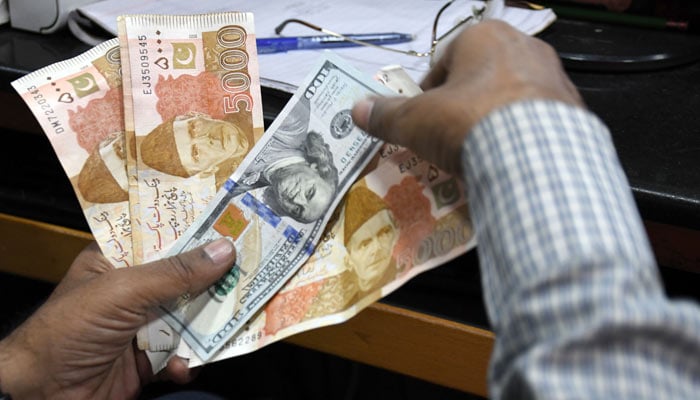
The local unit sharply retraced losses by gaining Rs13.78 per US dollar to close at 285.08 in the interbank market, after falling to 300 in the last trading session.
The recovery came following two major developments that took place over the last few hours.
First, according to market sources, the currency gained strength after the demand from importers relatively declined as oil payments were released a day earlier.
Secondly, the Supreme Court on Thursday declared Pakistan Tehreek-e-Insaf (PTI) Chairman Imran Khan’s arrest from a court premises "illegal" and ordered authorities to release him “immediately”.
Arif Habib Limited Head of Research Tahir Abbas said that a day earlier, when the rupee touched a historic low of 300, the demand for the US dollar was more because importers had to retire their payments due; however, today the demand is relatively less.
“Less demand coupled with an improved political situation has led to this sharp recovery,” he told Geo.tv.
The local currency market is facing a dollar shortage since last year, with the country's foreign exchange reserves currently enough just enough to cover one month of imports.
The cash-strapped nation of over 220 million people faces delays in securing a loan from the IMF amid an economic crisis.
Abbas recalled that the local unit lost over Rs20 in last three days; however, the currency has remained volatile since the uncertainties surrounding the IMF programme sparked default concerns.
Therefore, the currency market didn’t react negatively to Finance Minister Ishaq Dar’s statement, in which the senator claimed that Pakistan won’t default even if there is no IMF programme.
Explaining the movement of currencies, Dr Khaqan Najeeb, former adviser of the Ministry of Finance, said that currency’s movement in the short term is driven by the sentiments of the investors exporters, importers, remitters (in Pakistan’s case) as well as the inflows from debt creating and non-debt creating instruments.
“In Pakistan’s case, this sentiment over the last two, three days weakened as the country seemed to be in the challenging political situation,” he said, adding that the sentiment probably made people hold their dollars.
Hinting towards a possibility of intervention, Dr Najeeb said that it is possible that the central bank could have rightly intervened to ensure that the disorderly movement of the weakening of the rupee did not continue.