Thailand vs Cambodia: Military comparison in current conflict
Thai-Cambodian border dispute explodes into aerial warfare
Published December 08, 2025
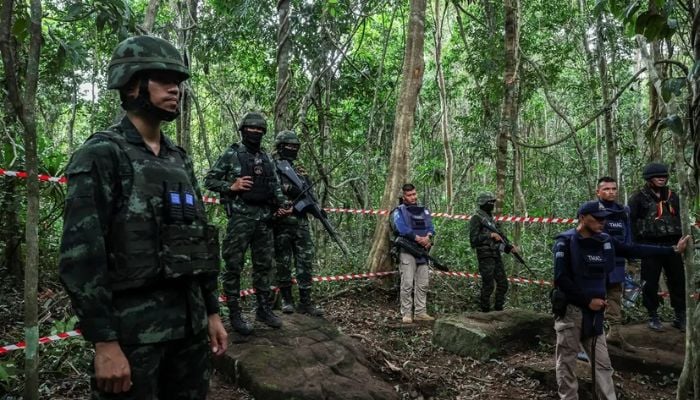
Tensions between Thailand and Cambodia have erupted into a significant military confrontation as Thailand confirmed the launch of airstrikes against Cambodian positions.
As reported by the Royal Thai Army, the air operations targeted “military targets in several areas” on Monday, December 8, in response to “Cambodian attacks along the disputed frontier.”
Thailand military claims the strikes destroyed a cable car system utilised by Cambodian army to transport weapons near the ancient Ta Khwai Castle temple complex.
Conflicting accounts of hostilities
The trigger for the latest violence remains contested. Thai officials reported that two of its soldiers were killed and several were wounded after coming under Cambodian fire in the northeastern Si Sa Ket province on Monday, December 8.
Responding to Thai military allegations, Cambodia’s Defense ministry has denied initiating fire.
It maintains that Thai forces launched unprovoked attacks with guns, tanks, and rockets into its Preah Vihear and Oddar Meanchey provinces, and that Cambodian troops exercised restraint by not retaliating.
Cambodian officials also report three civilian injuries on their side of the border.
A stark military asymmetry
With the recent conflict, a vast disparity in military capabilities between the two Southeast Asian nations is highlighted.
Thailand possesses a decisive, multi-domain military superiority over Cambodia, with greater funding, more advanced technology, and a wider range of capabilities.
Cambodia's strengths lie in larger numbers of certain land systems, recent strategic partnerships, and defensible trains.
Defense budget and man power
| Aspect | Thailand | Cambodia |
| Annual Budget | ~$7.5bn | ~$1.3bn |
| Budget Trend | Forecast to grow to $5.9bn by 2029 | Significantly smaller with major reliance on foreign partnerships |
| Active Personnel | ~361,000 | ~124,300 |
Land forces
| Aspect | Thailand | Cambodia |
| Battled Tanks | Modern fleet: 74 Chinese VT-4s, 49 Ukrainian T-84 Oplots | Hundreds of obsolete T-54/55 and Type 59 tanks |
| Armored Vehicles | Diverse fleet: ~130 Stryker IFVs, 100+ Scorpion LT, 200+ BTR APCs | Older BTR variants; newer Tigr/Dongfeng 4x4s |
| Artillery and Rockets | Modern towed & SPGs: CAESAR, ATMOS, M109A5, GHN-45 | ~300+ MLRS units, incl. long-range PHL-03 (120km+) |
| Air Defense | Standard SHORAD systems | Recently unveiled Chinese QW-3 MANPADS & TH-S311 C2 system |
Naval forces
| Aspect | Thailand | Cambodia |
| Major Combatants | 16+ frigates/corvettes, including modern Bhumibol Adulyadej-class frigate | Mainly patrol boats. Expected: 2 Chinese Type 056 corvettes |
| Flagship | HTMS Chakri Naruebet (helicopter carrier), though availability is poor | Ream Naval Base (developed with China for strategic access) |
Air forces
| Aspect | Thailand | Cambodia |
| Fighter/Combat Aircraft | Modern multi-role fleet: 11 JAS-39 C/D Gripens, ~50 F-16s, 12 new Gripen E/F on order | None. Only L-39C jet trainers (light attack capable) |
| Force Enablers | Saab 340 AEW&C (Airborne Early Warning), transport, reconnaissance | Limited to transport and utility helicopters (Mi-17, Z-9) |
| Key Detail | One of SE Asia's most capable air forces, with AEW&C for battle management | Possesses no credible air defense or counter-air capability against modern fighters |
Strategic context and modernization
In the realm of strategic partnerships, the two nations follow divergent paths that define their geopolitical posture.
Thailand has a multi-vector foreign policy. The country is a major non-NATO ally of the United States while simultaneously maintaining defense ties with China, Sweden, and South Korea.
By maintaining this balance, Thailand has access to diverse technology and maintains strong regional military standing.
In comparison to this, Cambodia’s partnerships are highly concentrated with China as its dominant patron and Russia as a secondary, legacy partner.
With this, Cambodia creates a relationship of deep dependence by offering strategic location most notably through the Ream Naval Base in exchange for sustained military and economic support.
This divergence extends directly into military modernization and operational doctrine.
Thailand actively integrates Western and Asian technologies and regularly participates in large-scale, multinational exercises such as Cobra Gold with the U.S. and regional partners, honing a conventional, combined-arms warfare approach.
In contrast, Cambodia’s doctrine is not publicly well-defined and its adoption of modern warfare concepts remains less visible.
But, it is actively modernizing its toolkit through China, recently acquiring advanced Chinese command-and-control (C2) and air defense systems indicating a focused effort to improve specific capabilities, likely within an asymmetric defense framework.