Australia's Bondi Beach attacker Sajid Akram was from Hyderabad, India
Indian authorities say Akram had ‘limited contact’ with family; made multiple India visits
Published December 16, 2025
- Sajid Akram moved to Australia in 1998, say Indian authorities.
- Akram last visited India in 2022, say Indian officials.
- His son, Naveed, the second attacker, was born in Australia in 2001.
One of the two attackers involved in the Bondi Beach shooting that left at least 15 people dead during a Jewish gathering in Australia on December 14 was from Hyderabad, according to Indian government officials, The Hindu reported.
The Indian authorities shared the details of the gunman, Sajid Akram, 50, who is now dead, after conducting a background verification, as per the report.
As per the Indian officials, Sajid, a resident of Tolichowki in Indian Hyderabad, moved to Australia in 1998 on a student visa and had returned to India only “two-three occasions" since relocating.
He last visited India in 2022.
“His father died in 2017; he did not even come to attend his last rites,” said a top government official.
According to another official, Sajid's immediate family continues to live in Hyderabad, and his elder brother is a medical doctor.
Sajid's son, Naveed, 24, the second attacker, was born in Australia in 2001 and holds Australian citizenship. He was also shot by the police during the Bondi Beach massacre and is currently receiving treatment in hospital.
“After completing bachelors in commerce from Hyderabad, Sajid moved to Australia and married a European woman. He retained his Indian passport,” said the official.
Responding to questions about possible domestic connections, the official said: “Preliminary investigation does not establish any local links so far. We do not have access to his activities in Australia. His background was checked based on information from our sources.”
Sources also told The Hindu that Australian authorities are "in touch" with Indian officials as the investigation continues.
When asked whether Sajid was of Indian origin, as suggested in reports, Australian Prime Minister Anthony Albanese said the matter was still under investigation.
“So I can’t go into that detail and it wouldn’t be appropriate to undermine the investigation by going into it,” Albanese told reporters on Tuesday.
Telangana state police, in a statement, also confirmed that Akram was originally from the southern Indian city of Hyderabad, adding that he had limited contact with his family in India.
“The family members have expressed no knowledge of his radical mindset or activities, nor of the circumstances that led to his radicalisation,” the police added.
Bondi suspect arrived in Philippines as 'Indian'
Earlier, the Philippines authorities also said that Sajid was an Indian national, citing the gunman's travel documents.
Sajid Akram and his son Naveed entered the country on November 1 with the southern province of Davao listed as their final destination, the Philippines immigration bureau had said.
The father and son spent nearly the entire month of November in the Philippines, authorities in Manila confirmed, with the father entering as an "Indian national".
"Sajid Akram, 50, Indian national, and Naveed Akram, 24, Australian national, arrived in the Philippines together last November 1, 2025 from Sydney, Australia," immigration spokeswoman Dana Sandoval told AFP.
"Both reported Davao as their final destination. They left the country on November 28, 2025 on a connecting flight from Davao to Manila, with Sydney as their final destination."
Police and military sources had earlier told reporters they were still in the process of confirming the duo's presence in the country.
"Early indications point to a terrorist attack inspired by Daesh, allegedly committed by a father and son," Australian Federal Police Commissioner Krissy Barrett said at a news conference.
"These are the alleged actions of those who have aligned themselves with a terrorist organisation, not a religion."
Police also said the vehicle which is registered to the younger male contained improvised explosive devices and two homemade flags associated with ISIS, or Daesh, a militant group designated by Australia and many other countries as a terrorist organisation.
Videos have emerged of the younger shooter preaching religion outside train stations in suburban Sydney. Authorities are still trying to piece together how he went down the path of violence.
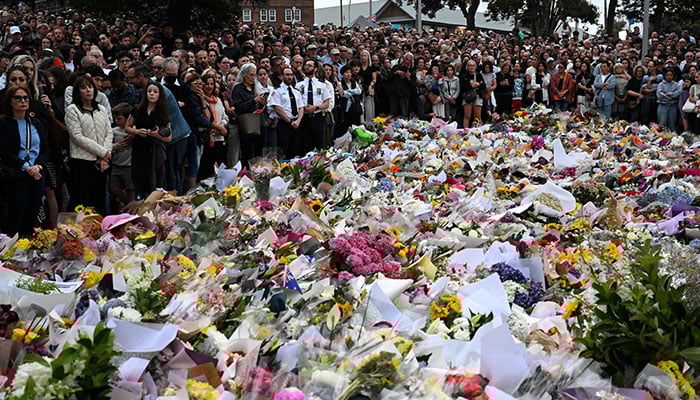
The attack on Sunday was Australia's worst mass shooting in nearly 30 years, and is being investigated as an act of terrorism targeting the Jewish community.
The death toll stands at 16, including Sajid, who was shot by police on the spot. The man's 24-year-old son and alleged accomplice, Naveed, was in critical condition in the hospital after also being shot.
The 15 victims ranged from a rabbi who was a father of five, to a Holocaust survivor, to a 10-year-old girl named Matilda Britvan, according to interviews, officials and media reports. Two police officers remained in critical but stable condition in the hospital, New South Wales police said.
Australian Prime Minister Anthony Albanese said Tuesday that the two men had likely been radicalised by "Daesh ideology".
Davao is a large urban centre located on the eastern side of Mindanao, the Philippines’ largest southern island. Armed groups are known to be active in economically disadvantaged areas of central and southwestern Mindanao.
The Philippine military, however, said it was unable to promptly verify claims that the two individuals had received “military-style training” during their time in the country, despite earlier reports suggesting otherwise.
Mindanao also has a long history of insurgencies against central government rule.
Pro-Daesh Maute and Abu Sayyaf militants — including foreign and local fighters — held Mindanao's Marawi under siege in 2017.
The Philippine military wrested back the ruined city after a five-month battle that claimed more than 1,000 lives and displaced hundreds of thousands of people.
While insurgent activity in Mindanao has significantly abated in the years since, the Philippine army continues to hunt leaders of groups deemed to be "terrorists".
A spokesman for the army's Mindanao-based 6th Infantry Division told AFP on Tuesday that they had heard nothing in recent years about Daesh-linked training camps or foreigners training with local insurgents.