Netanyahu's political future at stake with Iran war: experts
Analysts say Netanyahu's electoral prospects depend on how the conflict with Iran unfolds and lasts
Published March 03, 2026
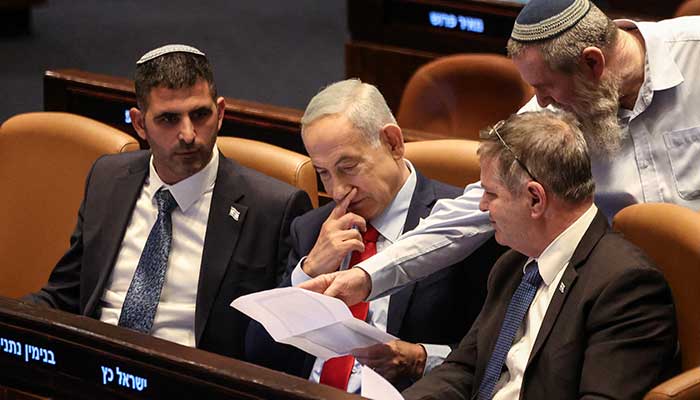
With elections approaching in Israel, the war with Iran has handed Prime Minister Benjamin Netanyahu an opportunity to restore an image deeply scarred by October 7, 2023 Gaza attack, experts say.
But any political dividend would depend on how the conflict unfolds and how long it lasts, they say.
A day after Iran's supreme leader Ayatollah Ali Khamenei was martyred in a wave of US-Israeli strikes, Netanyahu said that his close ties with Washington had enabled Israel to "do what I have long aspired to do for 40 years: to strike the terrorist regime decisively".
The Gaza war eroded Netanyahu's popularity. Critics have accused him of seeking to evade responsibility for the authorities' failure to prevent the deadliest day in Israel's history.
At 76, the leader of the right-wing Likud party is Israel's longest-serving prime minister, with more than 18 cumulative years in office across multiple stints.
Known for his political resilience, Netanyahu has been without a parliamentary majority since the summer, amid a crisis with his ultra-Orthodox religious allies.
He is also standing trial in a long-running corruption case and has sought a presidential pardon, with US President Donald Trump repeatedly pressuring President Isaac Herzog to grant one.
'Total victory'
Elections must be held by October 27 at the latest.
Netanyahu will call early elections, says Emmanuel Navon, a political analyst at Tel Aviv University.
"It's obvious. He won't wait until October given the commemoration of the October 7 anniversary," Navon said.
"If Netanyahu was at rock bottom after the Gaza attack, he has since gradually turned the tide," he added.
A Likud party led by Netanyahu would emerge ahead in elections held today, opinion polls suggest.
That would likely see him tasked with forming the next government, though he would still lack a majority with his current allies.
A victory over Iran could change that calculus, experts say.
"This offensive undeniably reinforces the image Netanyahu seeks to cultivate, the one associated with his 'total victory' slogan," independent geopolitical analyst Michael Horowitz told AFP.
"Netanyahu wants to show that this is not a campaign slogan but a reality. It is his national agenda and his electoral strategy," he added.
'Iran remains Iran'
Raviv Druker, a prominent journalist on Channel 13 television, argued that Netanyahu "will try to convince people that the victory is total even if that is an illusion," noting that "Hamas still runs Gaza, and Iran remains Iran even after Saturday's strike".
On the popular news website Walla, journalist Ouriel Deskal went further, suggesting Netanyahu may have chosen the timing of the hostilities to automatically delay — under a state of emergency — the March 30 deadline for passing a budget for which he has struggled to secure a majority.
Without a budget, the government would fall on April 1 and elections would be called.
In that scenario, Netanyahu would enter the campaign from a position of weakness.
By contrast "if this war against Iran is a success for Israel, it will be a political victory for Netanyahu," Navon said.
But should the war drag on, the picture could shift dramatically, Horowitz warned.
"Public tolerance for a long war with heavy casualties, combined with a high cost of living, remains extremely low," he said.
During the war last June, Iranian missiles killed 30 people in Israel. Since Saturday, 10 people have been killed in Iran's retaliatory strikes.
"Israel's victories are primarily attributed to the army and to civilian resilience, which enabled the country to wage the longest war in its history," Horowitz noted.
"The army's popularity is rising, not necessarily Netanyahu's."