Revisiting the idea of Pakistan
Had Pakistan been firmly democratic and adhered to political pluralism and rule of law, things might have been different
Published March 23, 2026
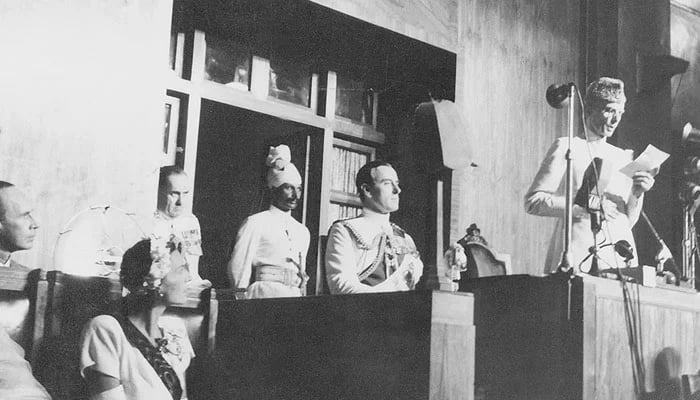
Historically speaking, the idea of Pakistan emerged when Muslims set their feet on the Indian sub-continent. It was on the occasion of the Lahore Resolution of March 23, 1940, that the idea of Pakistan was formally presented by the Muslim League, and it took seven years to transform that idea into a reality.
Renowned historian and political scientist on South Asian affairs, late Professor Stephen P. Cohen, wrote in his book “The Idea of Pakistan” (Lahore: Vanguard Books, 2005), “the idea of Pakistan as an independent pro-Western state remaining under Western (that is, British) tutelage was quite attractive. For many British strategists, the most secure foothold would be in an independent Pakistan, with its loyal army and Western-leaning Muslim League leadership.” He further states that “by making religion the basis for a separate nation-state, argued Pakistani nationalists, the new Muslim homeland would also be a progressive state because Islam, unlike Hinduism, is a modern religion with a proud position in history as the faith that brought to perfection the religions of the modern, advanced, scientific West, Judaism and Christianity.”
The idea of Pakistan, which gained impetus after the proclamation of the Lahore Resolution, focused on Islam as a unifying force among Muslims and called for the partition of the Indian sub-continent on the basis of religion. The Two-Nation Theory propagated by Quaid-i-Azam Mohammad Ali Jinnah and other leaders of the Muslim League was not merely a slogan but carried a vision for a separate Muslim homeland. However, it was also argued that the future state of Pakistan must not impose religion on its citizens and should accept non-Muslims as equal inhabitants of the country.
One can analyse the question “why to revisit the idea of Pakistan” from several angles. First, when the British defeated the Mughals and established their rule in the Indian sub-continent in 1857, they realised that the only way to ensure control over such a vast landmass and millions of people adhering to different cultures and faiths was by planting the seeds of division. That is how the British patronised the Hindus over Muslims. Sir Syed Ahmed Khan, the architect of Muslim modernisation, particularly through the promotion of education, established Aligarh Muslim University. His emphasis on learning English and science became the core objective of his movement in order to mitigate social backwardness among Indian Muslims.
From the basis of the Aligarh Movement emerged the idea of a separate homeland for Muslims, which later became the vision of Allama Mohammad Iqbal and Quaid-i-Azam Mohammad Ali Jinnah. By focusing on education and science, Aligarh became a symbol of Muslim renaissance and the ideological foundation of the Pakistan Movement.
Second, the idea of Pakistan propagated by Jinnah and other leaders of the Muslim League argued that a united India would not be able to protect the interests of Muslims, a fact which, it was argued, was proved during the Congress ministries of the late 1930s that allegedly discriminated against Muslims in provinces ruled by that party. Although Jinnah in his early political career was a proponent of Hindu-Muslim unity, in view of what he perceived as the biased attitude of Congress leaders, he concluded that minority Muslims and the Hindu majority might not be able to live together in a united India after British withdrawal. Hence, concern and fear prevailed among many Muslims of the sub-continent that they would have second-class status if India remained united following British departure.
Third, before March 1940, the Muslim League was unable to attract Indian Muslims without raising the slogan of religion. It was the leadership under Jinnah and the power of Islamic ideology that became a source of unity among Indian Muslims. It is another story that once Pakistan was created, the very idea that led to the emergence of a Muslim state failed to fully transform Jinnah’s vision into reality. The idea of Pakistan, which had attracted and mobilised the majority of Muslims of the sub-continent by 1947, lacked the institutional strength and leadership within the Muslim League to firmly establish democracy and political pluralism. Referring to weaknesses in the Muslim League, Stephen P. Cohen argued: “one of Pakistan’s many ironies is that neither of its two greatest leaders correctly foretold its strategic future. Iqbal wrongly believed that the Islamic nature of a new Pakistan would give it inherent strength. Instead, Pakistan has had to draw power from its relationship with other states and thus lacked the capacity to prevent the breakup of 1971. Jinnah, too, was excessively optimistic in thinking that the minorities in Pakistan would be hostages to good behaviour, and that natural cultural and economic linkages would strengthen relations between its various groups.” The surge of ethno-nationalism in post-1947 Pakistan further diminished the idea of Pakistan, as the new state failed to consistently follow democratic, egalitarian and just principles of governance.
Had Pakistan been firmly democratic and adhered to political pluralism and the rule of law, things might have been different. Jinnah’s Pakistan dismembered in 1971 because those who ruled the state lacked commitment to the original idea of Pakistan and had little regard for rule of law and good governance.
Fourth, when the idea of Pakistan transformed into reality in August 1947, the new state faced numerous challenges such as security threats from India, the Kashmir dispute, water issues and the settlement of refugees. Since the people of the new state were imbued with commitment and patriotism, these challenges were managed in the initial phase. However, after the death of Jinnah on September 11, 1948, and Liaquat Ali Khan on October 16, 1951, the leadership of the Muslim League failed to manage things properly leading to the rise of authoritarian culture and the imposition of martial law in October 1958. In this way, the idea of Pakistan, which had inspired the people of the new state with passion and purpose, could not prevent the erosion of democracy and the surge of ethno-nationalism.
The language controversy that led to the movement in the then East Pakistan to declare Bengali along with Urdu as a national language further deepened divisions. Although in 1955 Bengali was given the status of a national language alongside Urdu, the damage had already been done. A sense of deprivation among Bengalis against the West Pakistan-dominated ruling elite further challenged the idea of Pakistan. No serious lessons were learned in post-1971 Pakistan about how Jinnah’s Pakistan disintegrated and why the idea that had provided the impetus for a new Muslim homeland diminished over time.
Fifth, revisiting the idea of Pakistan is imperative for the new generation so that youth may develop a clear understanding of the spirit and ideology that motivated Muslims to struggle for a separate homeland. This requires the dissemination of knowledge about the idea of Pakistan through textbooks and academic discourse, focusing on the principles and purposes that guided the movement for a Muslim state.
Finally, had the formative phase of Pakistan focused consistently on democracy, political pluralism, rule of law and good governance, the country might have remained united and emerged as an economic powerhouse. The original idea of Pakistan had no space for corruption, nepotism or authoritarian governance. Sadly, it was because of contradictions between theory and practice in the implementation of the idea of Pakistan that the country gradually drifted from its original path.
The way out of the prevailing economic crisis, political instability, extremism, terrorism and foreign policy challenges lies in reverting to the foundational idea of Pakistan as envisioned by Quaid-i-Azam Mohammad Ali Jinnah — a democratic and welfare state.
The writer is Meritorious Professor of International Relations and former Dean Faculty of Social Sciences, University of Karachi. He can be reached at: [email protected]).