Araghchi in Islamabad; Witkoff, Kushner expected for US-Iran talks in Pakistan without Vance
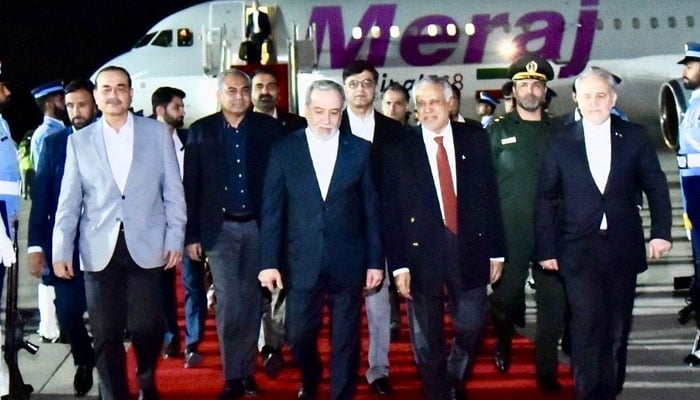
DPM Ishaq Dar, Field Marshal Asim Munir receive Iranian top diplomat upon his arrival in Islamabad, says FO

Published April 24, 2026
- DPM Dar urges continued dialogue and engagement.
- Dar, Araghchi discuss US-Iran ceasefire during phone call.
- Iran's FM lauds Pakistan's role in facilitating US-Iran talks.
Iranian Foreign Minister Abbas Araghchi touched down in Islamabad on Friday night amid expectations of renewed engagement between Iran and the United States to end the Middle East conflict.
FM Araghchi will hold meetings with Prime Minister Shehbaz Sharif and Deputy Prime Minister and Foreign Minister Senator Ishaq Dar during the visit.
The Iranian delegation was received by Deputy Prime Minister and Foreign Minister Senator Mohammad Ishaq Dar, Chief of Defence Forces (CDF) and Chief of Army Staff (COAS) Field Marshal Asim Munir, along with other senior officials upon arrival in Islamabad, the Ministry of Foreign Affairs said in a statement.
During the visit, the Iranian FM will hold meetings with Pakistan's senior leadership to discuss the latest regional developments as well as ongoing efforts for regional peace and stability, it added.
Earlier today, Iranian state media reported that Araghchi will depart on Friday (today) for a tri-nation tour that includes visits to Islamabad, Muscat and Moscow.
"The purpose of this visit is to hold bilateral consultations and discuss current developments in the region, as well as the latest situation in the war imposed by the United States and the Israeli regime against Iran," the state news agency IRNA said.
Meanwhile, US envoys Steve Witkoff and Jared Kushner will head to Pakistan on Saturday for a new round of talks with Iran on ending the war, the White House said.
"I can confirm Special Envoy Witkoff and Jared Kushner will be off to Pakistan again tomorrow morning to engage in talks," White House Press Secretary Karoline Leavitt told Fox News on Friday.
Leavitt said that Vance remained ready to fly to Pakistan but will not for now. "Everyone will be on standby to fly to Pakistan if necessary," she said.
A US logistics and security team is already present in the federal capital ahead of the potential second round of peace talks, sources said.
They said that the development was the result of pivotal conversations conducted by Pakistan's mediation team.
The talks would come more than two weeks after Vice President JD Vance held the first round of talks with Iranian representatives in Pakistan.
The development emerged shortly after Deputy Prime Minister and Foreign Minister Ishaq Dar urged continued dialogue and engagement to resolve disputes between the US and Iran, saying the diplomatic process was essential for advancing regional peace and stability.
DPM Dar made the remarks during a phone call with Araghchi, in which they also discussed the ongoing US-Iran ceasefire, according to a statement issued by the Foreign Office.
DPM Dar and Araghchi also exchanged views on the ongoing diplomatic efforts being pursued by Islamabad in the context of US-Iran engagement.
The Iranian FM lauded Pakistan's consistent and constructive role in facilitating peace talks between the US and Iran.
A second round of talks between Tehran and Washington faced ambiguity after both sides failed to agree on their respective measures in and around the Strait of Hormuz.
Tehran blocked the waterway after the US and Israel launched attacks across Iran on February 28. Apart from closing Hormuz, Tehran also launched strikes against Israel and US bases across the Middle East.
Prime Minister Shehbaz Sharif mediated a two-week ceasefire between the two sides on April 8 and then facilitated the first round of talks in Islamabad on April 11.
However, the talks concluded without a deal on a permanent end to the conflict.
Following an inconclusive first round of talks, US President Donald Trump announced a US naval blockade of Iranian ports.
Iran declared Hormuz open on April 17, citing a ceasefire agreement between Lebanon and Israel. However, it closed the strait the following day due to the US blockade of Iranian maritime trade, a measure Tehran considers an act of war.
Despite the hostilities on both sides, Islamabad continued its diplomatic outreach to bring Tehran and Washington back to the table and extend the two-week ceasefire.
Hours before the expiry of the ceasefire on April 22, US President Donald Trump announced extending the truce until an Iranian proposal was submitted and discussions were concluded.
In a post on Truth Social, the US president said he was acting at the request of Pakistan to hold off attacks until Iranian leaders and representatives could come up with what he called a unified proposal.