Maulana Fazl can play role in ending terrorism, enforcing governor's rule in KP: Bilawal
Bilawal invites opposition to hold talks if it genuinely wants to end terrorism, emergency in KP
Published October 18, 2026
- PPP chief says Karsaz tragedy can never be forgotten.
- Bilawal urges Fazl to openly condemn terrorist activities.
- Invites opposition to talks on ending terrorism, KP emergency.
Pakistan Peoples Party (PPP) Chairman Bilawal Bhutto Zardari said on Sunday that Jamiat Ulema-e-Islam-Fazl (JUI-F) chief Maulana Fazlur Rehman can play a role in ending terrorism and addressing the situation surrounding the imposition of governor's rule in Khyber Pakhtunkhwa (KP).
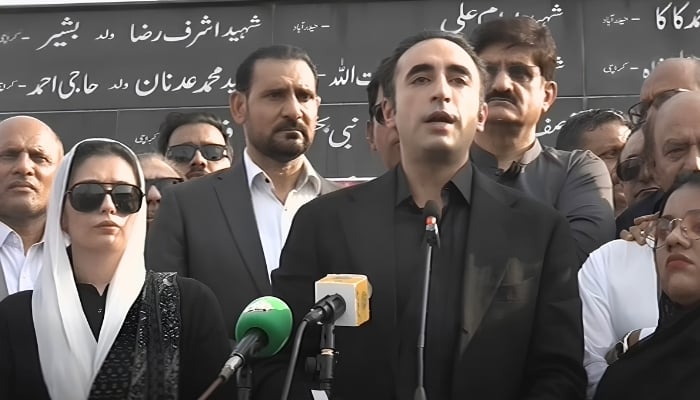
Bilawal made the remarks while addressing an event in Karachi marking the anniversary of the Karsaz tragedy, which took place on October 18, 2007, when twin bomb blasts struck a procession welcoming former prime minister Benazir Bhutto back to Karachi after eight years in self-imposed exile.
More than 180 people were killed and hundreds injured in the attack targeting her homecoming procession.
Speaking at the event, Bilawal said the Karsaz tragedy could never be forgotten, describing it as a painful chapter in the history of sacrifices made for democracy.
He urged the JUI-F chief to openly condemn terrorist activities, noting that members of the JUI-F had also lost their lives in terrorist attacks. He said the cleric could not deny the presence of terrorism in Balochistan and KP.
Criticising KP Chief Minister Sohail Afridi, who is now dysfunctional under the emergency measures, Bilawal said the provincial chief executive had not been willing to cooperate with the federal government and was not prepared to confront terrorism, adding that the PPP was ready to fight the menace.
The PPP chairman said both houses of parliament should work together to confront terrorism, stressing that the fight against the menace would continue until terrorists were eliminated.
"We will collectively confront terrorists," he said, adding that the armed forces were making sacrifices for the country's security.
Bilawal said the government had been compelled to impose emergency measures because of the security situation and urged political parties not to criticise counterterrorism measures without considering the challenges facing the country.
He said that his party had always imposed emergency measures through constitutional and legal means.
The federal government had imposed emergency in KP on October 11 after President Asif Ali Zardari approved the move on the advice of Prime Minister Shehbaz Sharif under Articles 232 and 234 of the Constitution.
The PPP chairman also invited the opposition to hold talks with the government if it genuinely wanted to end terrorism and the emergency in KP.
He said the federal government had decided to establish an electoral reforms committee and invited opposition parties to participate in its work.
Bilawal added that although the PPP was not part of the government, it was trying to deliver on its manifesto.
Bilawal's remarks came after Maulana Fazl criticised the federal government over the imposition of emergency and governor's rule in Khyber Pakhtunkhwa.
Earlier on Friday, Interior Minister Mohsin Naqvi claimed that the head of a political party was "deeply upset" over not getting the KP governorship or a role in the governor's rule setup.
Although Naqvi did not name the politician, his remarks came amid criticism of the federal government's decision to adopt emergency measures in the province.
Speaking informally to journalists in Lahore, the security czar claimed the politician had relied on the establishment's support for decades to remain in politics.
Naqvi also said that such politicians should not point fingers at others and should instead express political differences through arguments and facts rather than "indecent language and accusations".