PM Shehbaz reaches Beijing for 'high-level' talks with Chinese leadership
Prime minister witnesses signing of several MoUs between Pakistani, Chinese companies worth $1.2bn at conference
Published May 24, 2026
- PM Shehbaz to meet Chinese president, premier during Beijing stay.
- PM addresses Pakistan-China B2B Investment Conference in Hangzhou.
- PM also visits Alibaba Headquarters, oversees signing of MoUs.
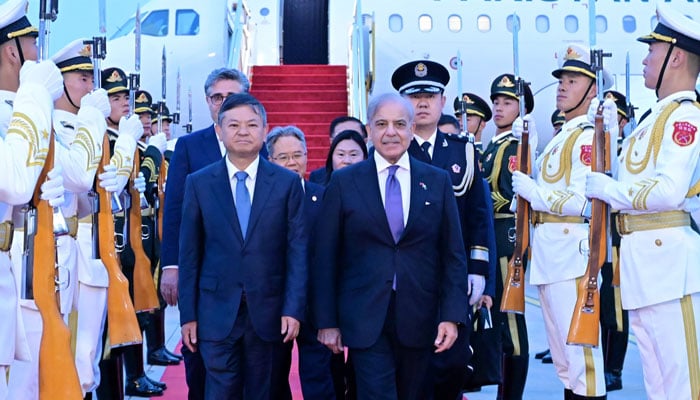
Prime Minister Shehbaz Sharif arrived in Beijing on Sunday for high-level meetings with Chinese President Xi Jinping and Premier Li Qiang as part of his four-day official visit to China.
The premier had landed in Hangzhou on Saturday, where he addressed the Pakistan-China Business-to-Business Investment Conference earlier in the day before travelling to Beijing.
Upon arrival in the Chinese capital, he was received by the Chinese Minister for Environment and Ecology, Huang Runqiu.
“During his stay in Beijing, the prime minister will hold high-level engagements, including meetings with Chinese President Xi Jinping and Prime Minister Li Qiang to further strengthen Pakistan-China All-Weather Strategic Cooperative Partnership and advance cooperation under CPEC Phase-II, particularly in trade, investment, industry, agriculture, science and technology, and people-to-people exchanges,” a statement by the PM’s Office (PMO) said.
The visit is taking place in the 75th anniversary year of the establishment of diplomatic relations between Pakistan and China.
In Hangzhou, the Prime Minister chaired the opening ceremony of the third Pakistan-China B2B Investment Conference, focused on charging infrastructure, battery energy storage, solar technologies, and pharmaceuticals.
He also engaged with provincial leadership, leading Chinese enterprises, including StarCharge, CATL and Xiuzheng Pharmaceutical, to explore practical investment and industrial cooperation.
Discussions with CATL focused on cooperation in advanced batteries, energy storage and solar-linked solutions to support Pakistan’s clean energy transition.
The prime minister also visited Alibaba Headquarters, where he was received by Executive Chairman Joe Tsai.
In a separate statement, the PM Office said that prime minister also witnessed the signing of several memoranda of understanding (MoUs) and cooperation agreements between Pakistani and Chinese companies, collectively worth $1.22 billion, at the conference.
While addressing the Pakistan-China B2B Investment Conference earlier today, the prime minister said that labour in China today had become pretty expensive and that China was obviously moving towards a very high level of industrialisation.
He observed that the industry where China was no longer competitive because of expensive labour could come to Pakistan, bring in plant and machinery, enter into joint ventures with Pakistani entrepreneurs, manufacture goods, and export to third countries.
“This model will be a win-win model for Chinese and Pakistani entrepreneurs, and this will be something of a roaring success in times to come, whether it is textile or leather or other areas,” the prime minister maintained in his speech broadcast on national TV channels.
He also invited Chinese businessmen to come and see the export zone in Karachi, where they would have great opportunities to understand business propositions.
Referring to the potential in mines and minerals, he said that it was also a very important area where Pakistan had large deposits of minerals and gemstones.
About the agriculture sector, he said Pakistan was basically an agrarian economy. Last year, they sent 1,000 boys and girls to China for advanced training, who returned and are doing a great job, but this was just the first step.
He said China imports about $100 billion worth of agricultural products from abroad. Pakistan’s share was just a fraction, adding that they needed their cooperation in this regard.
The prime minister hoped that in this manner, they would be able to produce agri products as per their requirement in terms of quality and other controls and if they worked together as iron brothers in this sector, they would be able to not only provide massive job opportunities in the rural areas of Pakistan but also be able to raise hundreds of thousands of small, medium entrepreneurs in the rural areas and have value addition and export those items to China.
In the next five to seven years, he said they expected an increase in their agricultural product trade to China by about $10 billion, which was not a big task.
He said this special economic zone would have modern infrastructure, a seamless business environment and would offer a red-carpet treatment and one-window operation to the Chinese.
“I would like to offer this opportunity to all of you to come forward, and we are going to offer land to you on a long-term basis in terms of lease,” he added.
The prime minister said that they had signed MoUs of worth billions of dollars, starting from Shenzhen and here in Hangzhou, stressing that these MoUs now needed to be converted into agreements.
He also expressed his satisfaction to hear that 30% of these MOUs had been converted into agreements, which most definitely ran into billions of dollars.
— With additional input from APP