Age of 'neurodivergents'
Every economic era selects for different traits, and the environment has abruptly changed
Published June 17, 2026
Two months ago, on TBPN, PalantirTech’s CEO Alex Karp offered a stark view of who will come out ahead in the coming decades. There are essentially two ways to know you have a secure future in the AI era. "One, you have some vocational training," he noted. "Or two, you’re neurodivergent."
While he advised Gen Z to skip elite college degrees, this wasn’t just edgy career advice. It was a sharp observation about the new cognitive demands of the modern world.
Automation of 'perfect' student
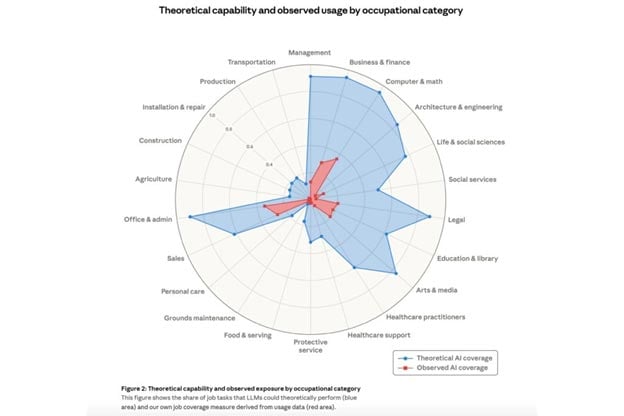
To understand why Karp’s statement rings true, we have to look at what AI actually does. AI is rapidly absorbing the exact skills the modern knowledge economy prized most:
- Routine information retrieval
- Pattern matching within established frameworks
- Administrative coordination
- Linear synthesis
The traditional "A student" who excels at absorbing data and regurgitating it flawlessly is suddenly competing against an algorithm that can do it in seconds. The credentials that have dominated white-collar hiring for decades are losing their premium because the baseline of intellectual labour has been commodified.
The revenge of the misfits
Karp’s first category of future-proof workers is practical: skilled trades professionals, from electricians to plumbers, possess physical, problem-solving skills that are hard to automate. These roles are also increasingly in demand as Big Tech builds out the massive physical infrastructure and data centres required to power AI.
But it is his second category, the neurodivergent, that challenges our fundamental understanding of intelligence.
If AI is handling the linear, organisational, and routine tasks, what is left for the human collaborator? The residual skills are exactly what the traditional education system often punishes:
- Nonlinear pattern recognition: connecting ideas across seemingly unrelated domains.
- Obsessive depth: the compulsion to hyper-focus on complex, niche problems until they crack.
- Comfort with ambiguity: the ability to hold contradictory ideas and navigate chaos without needing immediate resolution.
- System design over operation: wanting to build the machine rather than act as a cog within it.
These are the hallmark traits of the neurodivergent cognitive profile — brains wired with ADHD, autism, or dyslexia. For generations, these minds have been medicated, sidelined, or told they were broken because they couldn’t conform to the compliance-driven nature of the industrial and knowledge economies.
Now, they are the orchestrators. While AI acts as a tireless administrative assistant handling memory and data synthesis, the neurodivergent mind is free to do what it does best: direct creative vision, design complex systems, and obsess productively.
The corporate awakening
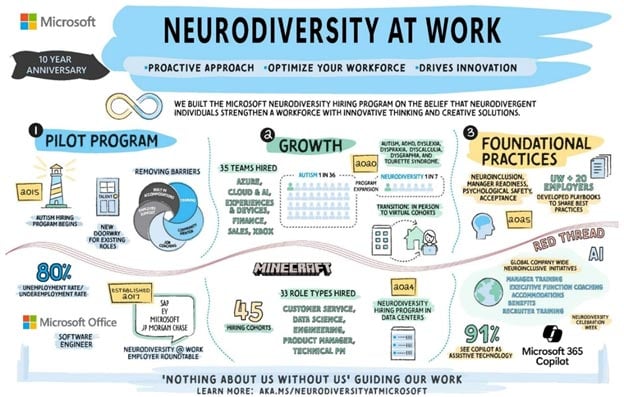
This shift is not just theoretical. It is already materialising in the labour market. The corporate world is realising that to leverage AI effectively, they need divergent thinkers. By 2027, an estimated one-fifth of Fortune 500 companies will be actively recruiting more neurodivergent talent.
The data from early movers backs this up. Programs at JPMorgan, Microsoft, SAP, and EY are reporting productivity gains of up to 140% and retention rates of 90–94% for neurodivergent hires, well above the broader workforce average.
Palantir is already acting on it. Their Neurodivergent Fellowship sets the same hiring bar as every other role. No diagnosis required. Karp reportedly conducts final interviews himself. Early rounds drew over 2,000 applications.
The teams that outperform in the future won’t be built entirely on polished MBAs. They will be built on cognitive diversity.
Rethinking 'smart'
We are watching a real-time behavioural sorting in the labour market. The definition of intelligence is pivoting away from the obedient rule-follower towards the creative system-builder.
If you or your child has ever felt like a misfit in a rigid educational or corporate system, Karp’s thesis offers a validating reality check: the misfits were never broken. The environment was simply optimised for a different era. The era has now changed, and the unique architecture of the neurodivergent mind is exactly what the future demands.
The writer is the chairman of the Pakistan Virtual Assets Regulatory Authority (PVARA).
Disclaimer: The viewpoints expressed in this piece are the writer's own and don't necessarily reflect Geo.tv's editorial policy.