Emergency or overreach?
Opposition describes proclamation of KP emergency, governor's rule as politically motivated and pre-planned
Published October 21, 2026
As a matter of course, every constitution and international treaty that confers rights and obligations on the parties presupposes a stable environment for smooth operation. Paradoxically, however, change is the only permanent feature of the world we live in.
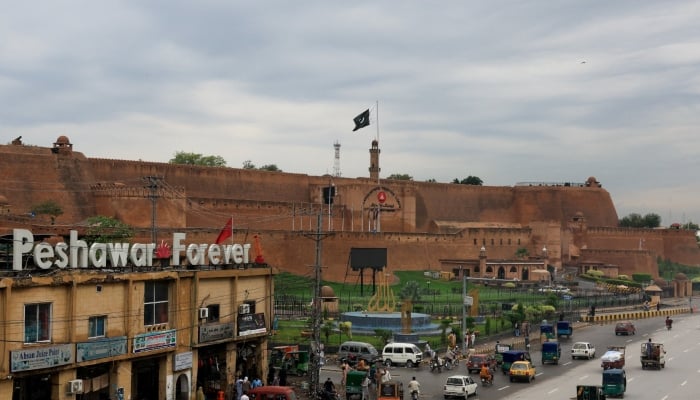
Aware of this basic truth, the framers of constitutions and treaties incorporate ‘exception’ clauses into the legal documents they draw up. Such provisions aim to allow a temporary departure from some guaranteed rights or stipulated obligations if an abnormal situation arises. The same may apply to the recent presidential proclamation of emergency in Khyber Pakhtunkhwa (KP).
Federalism or provincial autonomy is a cardinal principle of the 1973 constitution. Executive, financial and legislative powers are distributed between the federation or the federal government on one hand and the provinces on the other. In the normal course of events, the federal government can’t interfere with constitutionally mandated provincial autonomy, except in a few instances.
Article 148 (1), for example, stipulates that “The executive authority of every province shall be so exercised as to secure compliance with Federal laws which apply in that province”. Clause (2) of the same article states: “It shall be the duty of the federation to protect every province against external aggression and internal disturbances and to ensure that the government of every province is carried on in accordance with the provisions of the constitution”.
Likewise, Article 149 confers on the federal government the power to issue directions to the provinces to “ensure that executive authority of a province is exercised as not to impede exercise of the executive authority of the federation” and to “prevent any grave menace to the peace or tranquility or economic life of Pakistan” or any part of the country.
It follows that even in normal circumstances, the federal government is constitutionally mandated to protect the people of a province against both external aggression and internal disturbances. Leaving aside the phrase ‘external aggression’, the phrase ‘internal disturbances’ hasn’t been qualified by an adjective, such as ‘material’ or ‘grave’ or ‘serious’. This means that if we go by the text of the relevant provisions of the constitution, the federal government’s mandate is triggered by any level of internal disturbance in a province.
The federal government is mandated not only to ensure that provinces are constitutionally governed, but also that they don’t deviate from the constitution. Both these obligations are perpetual and don’t need any upheavals to exercise them.
Arising from the federal government’s dual mandate – protecting the provinces and ensuring constitutional governance therein – is the power to issue directions to the federating units on how they exercise their executive authority. For their part, the provinces must obey all federal laws. It’s understood that compliance with a law includes compliance with the policies and executive orders made under it.
The emergency powers of the president and the federal government primarily emanate from Articles 148 and 149. The constitution provides for three kinds of emergencies: national emergency (under Article 232), constitutional emergency (under Article 234), and financial emergency (under Article 235). The president has invoked Articles 232 and 234 to clamp an emergency and the governor’s rule on KP. So, we’ll leave aside the provisions relating to financial emergency.
Article 232 states: “If the president is satisfied that a grave emergency exists in which the security of Pakistan, or any part thereof, is threatened by war or external aggression, or by internal disturbance beyond the power of a provincial government to control, he may issue a Proclamation of Emergency”. The concisely framed text sets out two conditions for imposing a national emergency: the threat to the country’s, or a part of the country’s, security must be grave enough, and the situation must be beyond a province’s capacity to respond effectively. If either condition isn’t met, the proclamation of emergency is unwarranted.
Article 233 empowers the federal government to suspend fundamental rights while a national emergency proclamation is in force. Such a situation arose in 1998 when a nationwide emergency was proclaimed following Pakistan’s nuclear tests. The Supreme Court upheld the proclamation.
Article 234 provides that “If the president, on receipt of a report from the governor of a province, is satisfied that a situation has arisen in which the government of the province cannot be carried on in accordance with the provisions of the constitution”, he may clamp emergency on that province. Here, again, two conditions are stipulated: a constitutional breakdown in a province, and that the provincial governor, as a representative of the federation, has apprised the president of it.
Per the notification issued by the federal government, all the relevant conditions for clamping emergency and the governor’s rule on KP were met: One, there has been an ‘alarming increase’ in acts of terrorism and violence in the province. Two, the provincial government ‘failed’ to effectively respond to those acts. Third, the KP governor reported a ‘constitutional breakdown’ in the province.
The opposition, which ruled KP before the imposition of the emergency, has contested these claims, describing the proclamation as politically motivated and pre-planned and arguing that, instead of addressing the security situation, it would aggravate it. Thus, the question involved here is not primarily a question of law, as the federal government indisputably commands emergency powers, but a question of fact: whether the situation in KP had deteriorated to such an extent as to warrant intervention from Islamabad.
It may be argued that the federal government’s executive powers in provinces in normal circumstances (Articles 148-149) and the emergency powers that arise out of those powers run counter to the principle of provincial autonomy. Be that as it may, the 18th Amendment, which shored up provincial autonomy and was enacted in 2010 with the consensus of almost all political parties, didn’t do away with those federal powers. This may be interpreted to mean that, in principle, political parties agree on such powers. The question is when to exercise that authority. Obviously, emergency powers can’t be invoked arbitrarily; instead, invocation must be based on ground realities.
The previous occasion on which KP (then NWFP) was placed under the governor’s rule under Article 234 was in 1994 when then-president Farooq Leghari, acting on the advice of then-PM Benazir Bhutto, suspended the provincial assembly and then-CM Sabir Shah, who was from the PML-N. The proclamation undoubtedly aimed to replace the provincial PML-N government with that of the PPP or its allies. That act was yet another instance of the maxim that in politics there are no permanent friends and no permanent foes, and that actors on the political stage keep changing their roles.
The apex court set aside the 1994 presidential proclamation, ruling that the president couldn’t arbitrarily remove a CM, especially when he still held the confidence of the majority of the assembly’s members.
That said, the current situation in KP is remarkably different from that in 1994. The province is in the throes of terrorism, and the federal and the outgoing provincial governments were poles apart on how to tackle the menace. Unlike in 1994, the current imposition of governor’s rule in KP doesn’t seem like just a political move to change the guard. At any rate, the proclamation of emergency has been challenged in court, and the judiciary will have the final word on its constitutionality.
The writer is an Islamabad-based columnist. He tweets/posts @hussainhzaidi and can be reached at: [email protected]
Disclaimer: The viewpoints expressed in this piece are the writer's own and don't necessarily reflect Geo.tv's editorial policy.
Originally published in The News