Speaking Urdu in Delhi
SCO's Civilisational Dialogue Forum in Delhi offered an unusual opening in a region often overshadowed by conflict and division
Published November 26, 2026
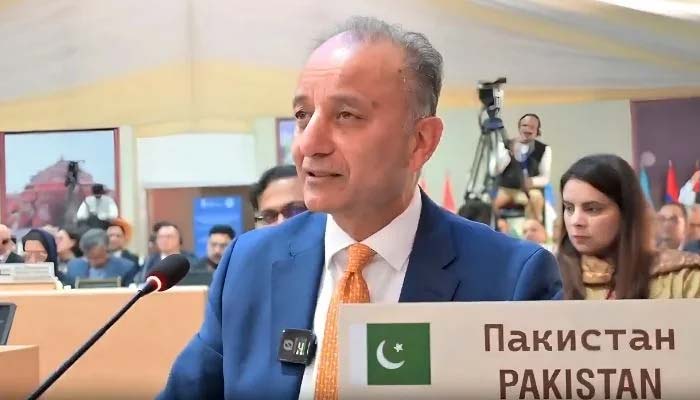
The SCO’s Civilisational Dialogue Forum in Delhi offered an unusual opening in a region often overshadowed by conflict and division. Such a gathering could provide a setting for dialogue, but it could not make that dialogue meaningful on its own. Pakistan’s climate minister, Musadik Malik, did something deceptively simple. At Delhi’s Purana Qila, near Mirza Ghalib’s grave and the shrine of Nizamuddin Auliya, he chose to speak in Urdu. English, he suggested, would have felt out of place.
It was a choice made with quiet confidence. At a gathering under the banner of the SCO, where security and strategy so often dominate the conversation, Malik invited his listeners to consider the region’s deeper civilisational history and the wisdom of purposeful regional engagement. He gave the forum’s title a living meaning.
The SCO offered a chance to meet across differences. In Delhi, that possibility depended on the tone and substance of what the participants said, and Malik chose both with care. He spoke of a Pakistan confident enough to welcome its many ancestors: the cities of the Indus, the Buddhist art of Gandhara, routes towards Afghanistan, Bukhara and Samarkand, and connections with Persia and the Arab world. Malik’s central insight was that dialogue requires distinct voices. A solitary identity can speak to itself; a civilisation grows when its many voices meet.
The place where he spoke made his point. Purana Qila carries traces of Humayun, whose dynasty looked towards Central Asia, and Sher Shah Suri, whose origins lay in the Afghan world. Malik did not dwell on conquest as the whole story of these encounters. The fort also invites us to think about the people who built, inhabited and worked around it, and the cultural life that unfolded over centuries. Rulers came and went. Artisans, poets, languages and ordinary lives gave these places further meanings. Urdu itself bears the marks of such encounters. It developed in the Subcontinent through contact among local speech, Persian literary culture, Arabic vocabulary, and the worlds of courts, markets and neighbourhoods. Hindi developed along a different but sometimes overlapping path. To speak of Urdu in Delhi was to acknowledge a shared part of the city’s cultural life. It was not a demand that anyone else surrender theirs.
Ghalib belongs to the literary memory of people in both India and Pakistan. Iqbal, born in Sialkot, drew deeply upon Rumi and made him a guide in his Javid Nama. Their words crossed today’s borders. In recalling them together, Malik spoke of a cultural world that had long made room for encounters across language and geography. That world belongs to people who read and cherish it, wherever they now live. None of these writers can be reduced to a modern passport.
There is also a political edge to speaking Urdu in Delhi today. When words and scripts are made tests of national authenticity, the space for a shared literary culture becomes smaller. Defending Urdu should never require diminishing Hindi, Sanskrit or India’s other languages; the reverse is equally true. Malik’s gesture restored Urdu’s presence to a discussion from which it could hardly be absent.
I remember being struck in Lucknow in 2001 by the distance between the city’s public writing and the Urdu literary life through which I knew it. A signboard cannot settle a nation’s history. Yet decisions about which languages are visible in public tell us something about whose memories are welcomed. That experience stayed with me as I listened to Malik speaking in Urdu at Purana Qila.
The question of inheritance extends beyond language. Mehrgarh in Balochistan records an early history of settlement and farming. Mohenjo-daro in Sindh and Harappa in Punjab preserve the urban achievement of the Indus civilisation. Dholavira, in Gujarat, shows that the same civilisation extended into what is now India. Its people did not know our present states or borders. Yet the cities they left behind exist in particular places, and those places deserve to be named honestly. Acknowledging Dholavira does not take Mohenjo-daro away from Pakistan; acknowledging Mohenjo-daro does not deprive India of its part in the history of the Indus. Both claims become clearer when we begin with the evidence and resist the urge to make the past fit a present quarrel.
Gandhara offers another chapter. Taxila and the Buddhist monastery of Takht-i-Bahi stand in present-day Pakistan. They testify to artistic, religious and intellectual exchanges wider than any modern nation. The centuries that followed brought other layers: Arab connections with Sindh, Turkic and Afghan influences, Sufi traditions and the cultural worlds of Lahore and Multan. This is a history of movement, learning and devotion as well as rivalry.
India, too, inherits histories that no single dynasty, faith or language can contain. Dholavira, the Buddhist past, the great traditions of southern India, Delhi’s Sultanate, Mughal Agra and the Sikh history of Punjab all form part of its record. Mughal Lahore belongs to Pakistan’s record, just as Mughal Agra belongs to India’s. These inheritances can be recognised on both sides without turning them into competing claims of sole ownership.
Malik brought this discussion of the past into the present through the catastrophic floods of 2022. He recalled people seeking refuge wherever they could, while schools and places of worship opened their doors. He also warned of damage to Mohenjo-daro. A climate minister could speak at a forum on civilisational heritage because the threat to historic places is real, and because civilisation also lives in the acts of care that help people survive a disaster.
His proposals gave that argument practical direction: a network of cultural institutions across the SCO, a shared digital record of heritage, and a framework to protect historic sites against climate hazards. Pakistan chairs the SCO Council of Heads of State and is due to host its next summit. It has an opportunity to take these proposals forward, with its own museums, archaeologists, cultural institutions and communities at the centre of the effort. A country’s civilisational confidence should be visible in what it safeguards.
There are, of course, those who question Pakistan’s claim to a past older than the state created in 1947. Former Indian foreign secretary Kanwal Sibal has objected to Pakistan’s civilisational narrative. Yet the date of a modern state’s creation cannot determine the age of the histories within its territory. Pakistan and India are modern states. Neither existed when the Indus cities were built. That does not erase the cities, or prevent either country from recognising the heritage within its borders. A country need not have existed in antiquity to care for the far older lives of people who once lived on its soil.
Nor is recognition an exclusive claim. Mohenjo-daro, Taxila and Takht-i-Bahi are in Pakistan; Dholavira is in India. The broader histories of the Indus, the Mauryans and the Mughals do not stop neatly at today’s frontier. We can acknowledge where the physical evidence lies and also acknowledge the wider human story of which it is part. Modern sovereignty brings responsibility for protecting sites; it does not grant sole ownership of a civilisation that crossed the lands of several present-day countries.
Malik’s strongest answer was the manner of his address. He did not ask India to relinquish Ghalib or the Indus civilisation. He spoke as a Pakistani able to welcome Ghalib, Iqbal and Rumi, Gandhara’s Buddhist monasteries and the cities of the Indus as part of histories that have shaped this region. The past need not become an argument for denying one another’s inheritance. At Delhi’s Purana Qila, he showed how it could become the ground for conversation, carried forward with confidence, humility and purpose.
The writer is a foreign policy & international security expert. She tweets/posts @nasimzehra and can be reached at: [email protected]
Disclaimer: The viewpoints expressed in this piece are the writer's own and don't necessarily reflect Geo.tv's editorial policy.
Originally published in The News