President Zardari approves de-notification of Justice Jahangiri following IHC verdict
Court orders govt to denotify jurist after declaring his appointment unlawful over invalid LLB degree
Published December 18, 2025
- Court rules appointment unlawful due to invalid degree.
- President approves jurist's de-notification on PM's advice.
- Defence accuses IHC chief justice of violating due process.
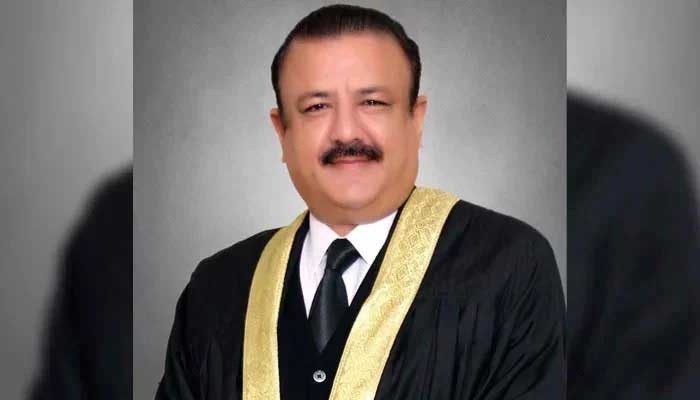
President Asif Ali Zardari on Friday approved the de-notification of Islamabad High Court (IHC) judge Justice Tariq Mehmood Jahangiri on the advice of the prime minister.
The approval was granted after the high court declared Justice Jahangiri's appointment unlawful, ruling that it did not meet the required legal standards.
In its verdict given on Thursday, the IHC directed Justice Jahangiri to vacate office, holding that he did not possess a valid LLB degree at the time of his appointment.
The decision was announced by the IHC Chief Justice Sarfraz Dogar-led two-member bench, which also comprises Justice Azam Khan, directing the Ministry of Law and Justice to remove and denotify the jurist.
The case centres on a controversy regarding Justice Jahangiri's LLB degree, which was cancelled by the University of Karachi.
According to the university's notification dated September 25, the university syndicate, in its meeting on August 31, 2024, approved "Resolution No 6" in compliance with the competent authority's decision, upholding the recommendation of the Unfair Means Committee (UFM).
Justice Jahangiri did not appear in person for the hearing, while his counsel, Akram Sheikh and Barrister Salahuddin, represented him before the court.
Barrister Salahuddin maintained that the court had three petitions relating to Justice Jahangiri and should first take up those petitions.
Advocate Sheikh apprised the court that Justice Jahangiri had instituted proceedings against the IHC CJ and other transferred judges.
He said that the respondents in the case were violating due process.
Meanwhile, Advocate Mian Dawood maintained that Justice Jahangiri appeared at the previous hearing and raised objections on the bench. He said Justice Jahangiri had initially argued that the case should be heard by a single bench and had now submitted a request for the matter to be heard by a full court.
Dawood added that even in a full court, Justice Jahangiri had sought the exclusion of the CJ and other transferred judges. He said the Supreme Court has granted the authority, in writs of quo warranto, to scrutinise every single document.
He further alleged that Justice Tariq Jahangiri took a false oath on the Holy Quran and left. Dawood said he himself swore that even Justice Jahangiri’s enrolment forms were bogus, adding that if Justice Jahangiri was truthful, he should produce his LLB Part I and Part II marks sheets.
Could CJ 'settle scores'?
Advocate Sheikh said bias in the case was "evident to all", adding that the matter was fundamentally based on prejudice.
He further told the court that cases against the CJ were pending before the Federal Constitutional Court and the Supreme Judicial Council.
Advocate Sheikh said that the CJ was ranked 15th on the Lahore High Court (LHC) seniority list and questioned whether the CJ could "settle scores".
Barrister Salahuddin presented arguments on two petitions, while Sheikh argued on one petition.
Barrister Salahuddin requested that the case be adjourned for an indefinite period and asked the court to grant 30 days' time for submission of replies.
Karachi University Registrar Imran Siddiqui also appeared before the IHC and submitted original academic records related to Justice Jahangiri's degree.
Justice Dogar asked the Karachi University registrar to clarify the final decision regarding the degree, to which he said that the university had finally cancelled the judge's degree.
At this, Barrister Salahuddin said that a petition challenging this action was already pending and that the Sindh High Court (SHC) had suspended Karachi University’s declaration.
Barrister Salahuddin argued that for the past one and a half years, propaganda had been spread alleging that Justice Jahangiri's degree was fake.
He said the registrar had now admitted that Justice Jahangiri had appeared in LLB Parts I, II and III, and that the issue pertained to procedural irregularities rather than a fake degree.
According to Barrister Salahuddin, Karachi University acknowledged issuing the degree and later cancelling it due to alleged irregularities.
The registrar also admitted that this was not a case of a fake degree but one cancelled on procedural grounds, he said.
Meanwhile, Siddiqui apprised the court that the Islamia Law College's principal has said that Justice Jahangiri had not been the institution's student.
"Justice Jahangiri was caught cheating [therefore] the [KU's] UFM imposed a three-year ban on him for cheating and threatening the examiner," the KU official told the court, adding that the judge was eligible to retake the exams again in 1992.
The KU registrar further pointed out that Justice Jahangiri used a fake enrolment form to bypass the ban and obtain the degree instead.
The judge, he added, appeared in the LLB Part I exam under the name "Tariq Jahangiri son of Muhammad Akram", whereas in LLB Part II exam he appeared as "Tariq Mehmood son of Qazi Muhammad Akram".
"Justice Jahangiri appeared in the LLB exam via a fake enrolment number," remarked Siddiqui, further highlighting that the Islamia Law College has no record of the form provided by the judge for LLB Part II.
"The authorities confirmed this and the [KU] syndicate declared the degree cancelled on the findings," the KU registrar noted.
At this, Islamabad Bar Council (IBC) lawyer Raja Aleem Abbasi said that the varsity's decision to cancel Justice Jahangiri's degree has, in fact, been suspended by the SHC.