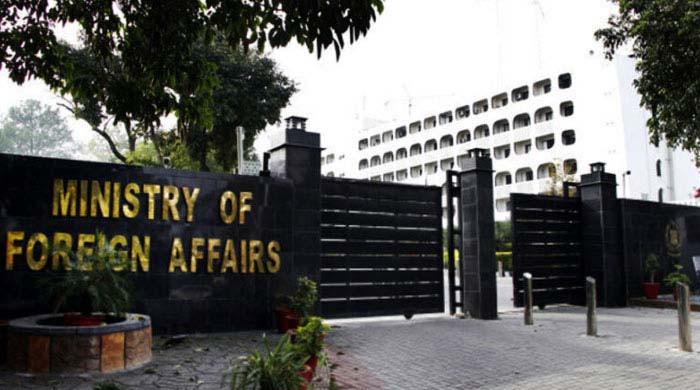
Pakistan will support Saudi Arabia 'whenever needed': PM aide on Middle East tensions
"Unquestionable that Islamabad will come to Riyadh's aid", says Mosharraf Zaidi
Published March 11, 2026
- Pakistan will assist KSA "no matter what and no matter when".
- Riyadh has made arrangements for supply of oil, diesel: PM's spox.
- Zaidi stresses principle between countries for backing each other.
Amid the ongoing US-Israel war against Iran, Pakistan has expressed readiness to support Saudi Arabia "whenever needed".
Speaking to Bloomberg TV, Prime Minister's spokesperson for Foreign Media Mohsarraf Zaidi has said it is unquestionable that Islamabad will come to Riyadh's aid "no matter what and no matter when".
Zaidi's remarks are to be taken amid escalating tensions in the Middle East after the US and Israel launched attacks on Iran on February 28, with Tehran retaliating by targeting US bases across the Gulf region, including Saudi Arabia, with missiles and drones.
Although Iranian President Masoud Pezeshkian has expressed regret over strikes in regional countries, Tehran has maintained that it will target those sites which are used to launch attacks on its soil.
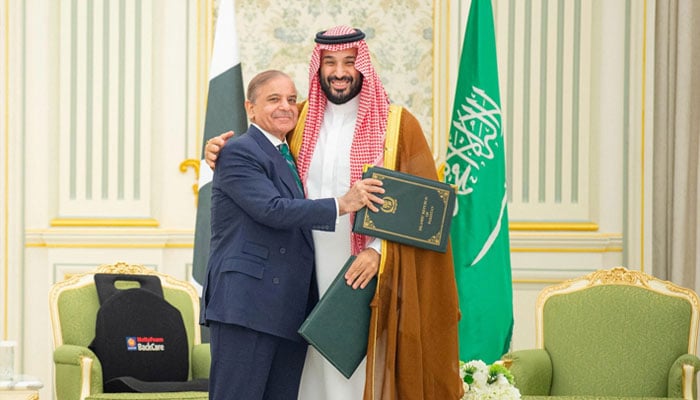
Pakistan and Saudi Arabia signed the landmark Strategic Mutual Defence Agreement (SMDA) in September last year, which treats an attack on either nation as an act of aggression against both.
A day earlier, PM Shehbaz had congratulated Ayatollah Mojtaba Khamenei on assuming the responsibilities of Iran's Supreme Leader after his father Ayatollah Ali Khamenei was martyred in a US-Israeli strike.
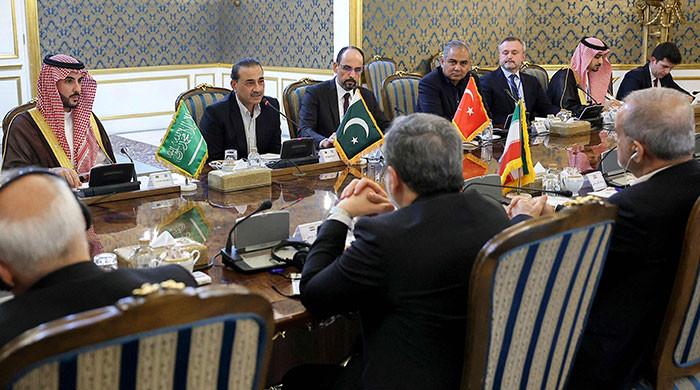
Before that, Chief of Defence Forces Field Marshal Asim Munir had visited Saudi Arabia and met Defence Minister Prince Khalid bin Salman, wherein the two sides discussed Iranian attacks on the kingdom within the framework of the joint strategic defence agreement between the two countries.
Separately, Islamabad, as per PM's Adviser on Political Affairs Rana Sanaullah, is working to persuade Iran to stop its attacks on Saudi Arabia.
Expanding on an in-camera briefing, Sanaullah said that the military leadership had informed that they were in constant contact with Iran, with efforts underway to resolve misunderstandings and ensure Gulf countries are not targeted.
He further pointed out that Deputy Prime Minister and Foreign Minister Ishaq Dar said that Iran had stated it would not carry out attacks against Saudi Arabia if Riyadh guaranteed that its territory would not be used against Tehran.
Elaborating on the Pakistan-Saudi relations amid heightened tensions in the Middle East, PM's spokesperson Zaidi highlighted that Islamabad and Riyadh have always "operated on the principle of being there for the other".
"The real question is what is Pakistan doing to make sure things don’t come to a point where any of its closest partners are further embroiled in a conflict that could potentially undermine stability and prosperity in the region," he remarked.
He also revealed that Saudi Arabia has made arrangements to support Pakistan's supply of oil and diesel since the start of the conflict — which has triggered a fuel shortage concern across the globe due to the closure of key shipping route of the Strait of Hormuz by Iran.
Furthermore, he noted that DPM Dar has had "constant conversations" with Iranian FM Abbas Araghchi due to which, he stressed, Tehran has adopted conciliatory efforts towards the Gulf nations.
The remarks come as the country has started importing crude oil through the Red Sea route after the closure of the Strait of Hormuz disrupted shipments in the wake of the conflict in the Middle East, sources told Geo News.
A Pakistan National Shipping Corporation (PNSC) vessel has reached Yanbu port in Saudi Arabia and will depart for Karachi on Thursday (tomorrow) carrying 73,000 tonnes of crude oil, the sources said.
Another PNSC vessel, Shalamar, has also managed to load oil from the Fujairah port and is now heading towards Karachi.
Shipping sources said the disruption in the Strait of Hormuz has affected several vessels, with two PNSC ships currently stranded near Karachi and at a charter port due to the ongoing situation.