Pakistan raises water flow concerns with India over 'unusual Chenab River fluctuations'
Water ministry says India not permitted to empty dead storage of reservoirs under Indus Water Treaty
Published December 19, 2025
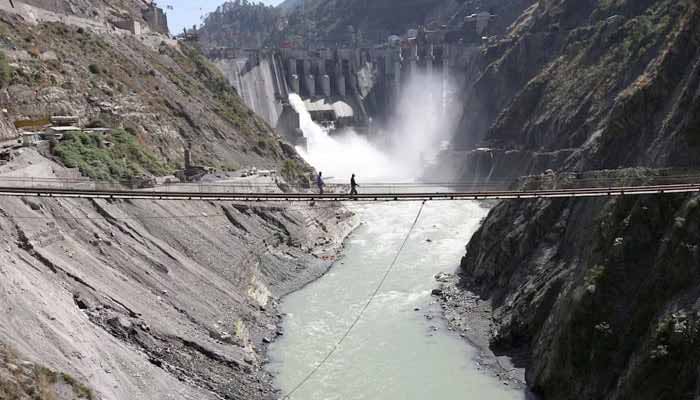
- Chenab flow drops to historic decade-low levels.
- Satellite imagery flags unusual Baglihar reservoir activity.
- River discharge stabilises after mid-December recovery.
Pakistan has formally taken up the issue of unusual fluctuations in the Chenab River’s water flow with India after official monitoring showed an extraordinary reduction earlier this month, the Ministry of Water Resources said on Friday.
According to a press release, the Punjab Irrigation Department is carrying out continuous monitoring of the Chenab River flow at Marala, excluding Jamu and Manawar Tawi, and sharing the data with the Office of the Pakistan Commissioner for Indus Waters.
The data indicates that after a period of volatility, the river’s discharge has now stabilised.
The press release came a day after Pakistan demanded an answer from India over its continued and abrupt variations of the flow of River Chenab, asking the international community to take notice of India’s continued disregard of a bilateral treaty as New Delhi once again resorted to “weaponisation of water”.
Spokesperson Tahir Andrabi, during the weekly media briefing on Thursday, pointed out that Pakistan had observed abrupt variations in the flow of the River Chenab during the past week, particularly 7 December onwards.
In today's press release, the water ministry noted hydrological records from the first half of December 2025 show that from December 10 to December 16, the Chenab experienced an exceptional decline in flows.
"During this window, the river flow frequently dropped and the lowest flow observed were 870 cusecs, which was significantly below the historical 10-year minimum range of approximately 4,018 to 4,406 cusecs for those dates," it added.
To assess the cause of this extraordinary reduction, the press release said, satellite imagery dated December 8 and December 13, 2025, was examined, revealing a significant reduction followed by an increase in the surface area of the Baglihar reservoir. "This pattern suggests that the reservoir was first emptied and then refilled," it added.
The ministry clarified that under the Indus Waters Treaty, India is not permitted to empty the dead storage of reservoirs of run-of-the-river hydroelectric plants constructed on the western rivers.
In light of the findings, the Pakistan Commissioner for Indus Waters has formally raised the matter with the Indian Commissioner for Indus Waters, seeking details and data related to the unusual reduction in the Chenab’s flow under the treaty framework.
The press release said a positive shift in river hydrology began on December 17, when the flow started rising steadily. By 7:00am that day, the discharge reached 6,399 cusecs, bringing it back within the historical ten-year range for the first time since the mid-month decline.
Data from the Punjab Irrigation Department further shows that as of December 19, 2025, the Chenab’s flows remain within the last ten-year range of maximum and minimum levels. Recent readings on December 19 recorded flows of 4,505 cusecs and 6,494 cusecs, aligning with or exceeding historical norms for this time of year.
Authorities said continuous monitoring of the river will remain in place to ensure a timely response to any future fluctuations. The ministry also clarified that any information circulating from sources other than the Office of the Pakistan Commissioner for Indus Waters holds no official standing.
'India's manipulation of water threatens Pakistan's food security'
Speaking during a briefing to foreign diplomats earlier in the day, Deputy Prime Minister and Foreign Minister Ishaq Dar termed India's recent unilateral suspension of the Indus Water Treaty in the aftermath of April's Pahalgam attack a threat to the country's food and economic security, which "could trigger a severe humanitarian crisis".
Dar condemned India’s move to suspend the treaty in April 2025, describing it as a clear example of weaponising water resources. He warned that such actions threaten Pakistan's food security and have the potential to trigger a severe humanitarian crisis.
"Indian manipulation of water at critical time of our agriculture cycle directly threatens the lives and livelihoods as well as food and economic security of our citizens," Dar said.
"The Indus Water Treaty is a cornerstone for peace and stability in South Asia," he added, noting that India has halted the exchange of hydrological data and disrupted the joint monitoring mechanism agreed upon under the treaty, further escalating tensions.
The nuclear-armed neighbours signed the Indus Water Treaty in September 1960, which was mediated by the World Bank. The agreement split the Indus and its tributaries between the two countries and regulated water sharing.
India was granted the use of water from three eastern rivers — Sutlej, Beas, and Ravi — while Pakistan was granted most of the three western rivers — Indus, Jhelum, and Chenab.
There is no provision in the treaty for either country to unilaterally suspend or terminate the pact, which has clear dispute resolution systems.
Following the tensions between Islamabad and New Delhi after the killing of 26 people in Indian Illegally Occupied Jammu and Kashmir (IIOK) in April 2025, New Delhi unilaterally held the IWT in abeyance.
New Delhi accused Islamabad of orchestrating the deadly militant attack, an allegation that Pakistan denies.