Ex-SBP governor Shamshad Akhtar passes away
Akhtar also served as caretaker minister for finance and revenue
Published December 27, 2025
- President Zardari, FinMin express grief over Akhtar's death.
- Ex-SBP governor passes away due to cardiac arrest.
- Akhtar was serving as PSX chairperson at time of her death.
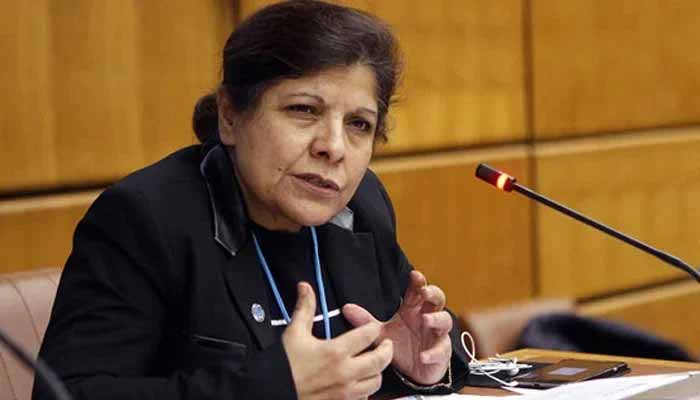
Dr Shamshad Akhtar, former governor of the State Bank of Pakistan (SBP) and ex-caretaker federal finance minister, passed away on Saturday at the age of 71 after suffering a cardiac arrest.
Akhtar was serving as chairperson of the Pakistan Stock Exchange at the time of her death, giving her a rare role spanning Pakistan's monetary policy, fiscal management and capital markets.
She was widely regarded as one of Pakistan’s most accomplished economists, with a distinguished national and international career spanning several decades.
Dr Akhtar served as the first woman SBP governor, assuming office on January 2, 2006, for a three-year term. She was the 14th governor of the central bank since its establishment in July 1948 and played a pivotal role in strengthening Pakistan’s economic governance, financial sector reforms and international economic engagement.
Separately, she served twice as federal finance minister in caretaker governments — first in 2018 and later from 2023 to 2024 — holding multiple key economic portfolios during periods of political transition.
On March 23, 2024, Dr Akhtar was awarded the Nishan-e-Imtiaz, Pakistan’s highest civil award, in recognition of her outstanding services in the field of economics and public finance.
Condolences pour in
President Asif Ali Zardari expressed deep sorrow and grief over the passing of Dr Akhtar.
In a statement, the president paid tribute to her contributions to economic management and financial governance, acknowledging her role in strengthening key state institutions. He prayed for the elevation of her ranks and extended heartfelt condolences to the bereaved family.
Prime Minister Shehbaz Sharif paid tribute to the late SBP governor and said she was a “devoted public servant” and served the nation with distinction.
“She made outstanding contributions to strengthening Pakistan’s financial architecture,” said the premier and offered his “heartfelt condolences and prayers” to the family.
Meanwhile, Finance Minister Muhammad Aurangzeb also expressed deep sorrow over the death of Dr Akhtar, saying that she was a "dignified, principled and thoughtful voice in the economic history of Pakistan."
"Akhtar was a high-level economist and a wonderful person," he said, noting that she served with utmost integrity and dedication in multiple high positions. "Shamshad Akhtar's national services will always be remembered with respect," he added.
The United Nations Escap said the economist “steadfastly worked to strengthen regional economic cooperation and integration, supporting inclusive and sustainable development across Asia and the Pacific”.
Umar Saif, who served as caretaker minister for IT and telecommunications, took to X to express deep grief over Akhtar's passing.
"In the few months we served together in the cabinet, we formed a special bond. She was loving, thoughtful, and deeply competent. We would jokingly call each other “my favourite minister” whenever we met," he wrote on X.
Calling the Akhtar's death a national loss, Saif said: "Pakistan is a poorer place today."
A career spanning global financial institutions
Prior to her appointment as SBP governor, Dr Akhtar served at the Asian Development Bank (ADB), where she held the position of Director General, Southeast Asia Department, from January 2004. Earlier, she served as Deputy Director General of the department and as Director of the Governance, Finance and Trade Division in ADB’s East and Central Asia Department.
She began her career at the ADB in 1990 and steadily rose through the ranks, becoming manager in 1998 after serving as senior and principal financial sector specialist. From 1998 to 2001, she acted as ADB’s Coordinator for the APEC Finance Ministers Group and served on several internal committees, including the Reorganisation Committee, Appeals Committee and Oversight Committee.
During her tenure, Dr Akhtar represented the ADB at major global forums, including the Bank for International Settlements (BIS) and the International Organisation of Securities Commissions (IOSCO). She developed extensive regional expertise in the financial and economic affairs of Southeast Asia, Central Asian Republics and the People’s Republic of China.
Before joining the ADB, Dr Akhtar worked for 10 years as an economist at the World Bank’s Resident Mission in Pakistan. She also briefly served in the planning offices of the federal and Sindh governments.
Her work covered a wide range of areas, including macroeconomic analysis, monetary and fiscal policy, finance, and structural reforms in key sectors such as industry and agriculture. She authored and contributed to influential papers on Pakistan’s taxation system, inter-governmental fiscal relations, poverty incidence and foreign direct investment.
At the World Bank, she also played a key role in analysing monetary policy, the banking sector and the diversification of financial markets.
Dr Akhtar was closely involved in reforms of Pakistan’s financial regulatory institutions, including the restructuring of the Securities and Exchange Commission of Pakistan and the Insurance Commission.
She worked extensively with the private sector, including Pakistan’s stock exchanges, and advised central banks on financial market reforms.
Her expertise extended to banking sector legal, regulatory and institutional reforms, as well as the development of long-term funding mechanisms, particularly through bond markets.
Dr Akhtar received numerous international accolades. She was named Asia’s Best Central Bank Governor from Emerging Markets and honoured by The Banker’s Trust. In 2008, The Wall Street Journal Asia recognised her as one of Asia’s top ten professional women.
She was also awarded medals by the presidents of Kazakhstan and Turkmenistan.
Since 2019, she served as one of 12 Global Advisors to China’s Ministry of Foreign Affairs on the Belt and Road Initiative and as Policy Sherpa at the Boao Forum for Asia, where she later became a Council Advisor.
Additionally, she was a member of the Advisory Council of the Sustainable Finance Centre at SOAS, University of London, part of the UN Global Women Leaders Group, and served on G20 task forces on infrastructure during the presidencies of Japan, Saudi Arabia and Italy. She also advised the UN Secretary-General’s groups on food security and financing for development.
Born in Hyderabad, Dr Akhtar received her early education in Karachi and Islamabad. She earned a BA in Economics from the University of Punjab in 1974, followed by an MSc in Economics from Quaid-e-Azam University, Islamabad.
She later obtained an MA in Development Economics from the University of Sussex in 1977 and completed her PhD in Economics from the UK’s Paisley College of Technology in 1980.
She was a Fulbright post-doctoral fellow and served as a visiting fellow at Harvard University’s Department of Economics in 1987.
Dr Akhtar presented numerous research papers at international conferences, seminars and symposia. Her research interests focused on monetary and fiscal policy, banking and capital markets, international financial architecture, regulation and supervision, and industrial and corporate restructuring.
Her passing marks the end of an era in Pakistan’s economic policymaking, leaving behind a legacy of institutional reform, global engagement and academic excellence.