Sindh rolls out double-decker bus service in Karachi — what are routes and fares?
Sharjeel Memon says 125,000 people using People's Bus Service on daily basis, work resumed on Red Line BRT
Published December 31, 2025
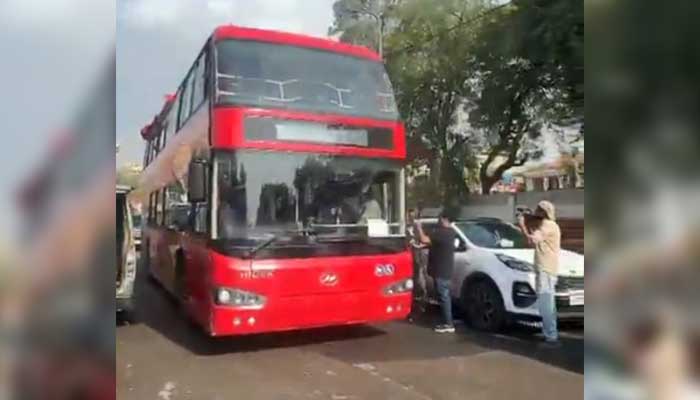
- Route of double-decker bus service is 22 kilometres: minister
- Sharjeel Memon says fare service's will be Rs80 to Rs120.
- Double-decker buses to be operated from Malir to Sharea Faisal.
Marking a positive development for commuters in Karachi, the Sindh government on Wednesday rolled out the double-decker bus service in the metropolis.
Speaking on the inauguration, Sindh Minister for Transport Sharjeel Inam Memon said that the route of the double-decker is 22 kilometres and its fare will be Rs80 to Rs120.
"The double-decker bus service will initially be run from Malir to Sharea Faisal," said Memon, adding that efforts were being made to extend the service to other roads as well.
Expanding on the public transport statistics, the minister said that 125,000 people were using the People's Bus Service on a daily basis, whereas the number stood at 65,000 for the Green Line Bus Service.
Noting that the construction work had resumed on the Red Line BRT Project, Memon noted that Rs9 billion have been allocated for the improvement of roads in the industrial area.
A day earlier, the minister had said that the double-decker bus service was currently being launched on a trial basis and on a limited scale.
The provincial transport minister said that he had discussed the expansion of the service with Sindh Chief Minister Syed Murad Ali Shah to bring additional double-decker buses, which he said would be expanded in future.
Meanwhile, the Sindh government has also linked the Green Line BRT Project with the Orange Line where passengers can now utilise both services using a single card.
The minister's remarks and the public transport services are to be taken against the backdrop of deteriorating conditions of Karachi's roads and infrastructure, where several areas of the city remain littered with broken and dug-up roads for nearly a year, causing severe inconvenience, vehicle damage, rising pollution and health problems, while authorities have failed to provide lasting relief.
Districts including East, West, South, Central, Keamari, Malir and Korangi face persistent issues of damaged roads, water shortages and sewage overflows, making daily travel difficult and worsening air pollution across the city.
Karachi’s administrative control is divided among 23 institutions, including the Karachi Metropolitan Corporation (KMC), towns, cantonment boards, Karachi Port Trust (KPT) and railways, while the KMC controls only 32% of the city’s land.
Areas such as North Nazimabad, once known for wide and well-maintained roads, are now marked by broken streets, dust and a deteriorating sewerage system. Residents say elected representatives, town administrations and the Sindh government have all failed to address the situation.
Gas pipeline excavation by Sui Southern Gas Company (SSGC) further damaged already weak roads. Despite funds reportedly provided to town administrations for repairs, conditions remain unchanged months later, while post-rain patchwork was limited to only a few roads.
Despite announcements of a Rs25 billion infrastructure package by the Sindh chief minister, road improvement projects by the mayor and development funds approved for MNAs, residents say Karachi continues to wait for meaningful change.