Ex-PTI leaders-hosted confab urges govt bigwigs to enter dialogue with opposition
Acting as "bridge" between rivals, National Dialogue Committee proposes president, PM, Nawaz lead govt’s side in talks
Published January 07, 2026
- Dialogue committees urged to defuse political crisis.
- Leaders warn polarisation hurting economy, governance.
- Calls grow for media freedom, detainees’ release.
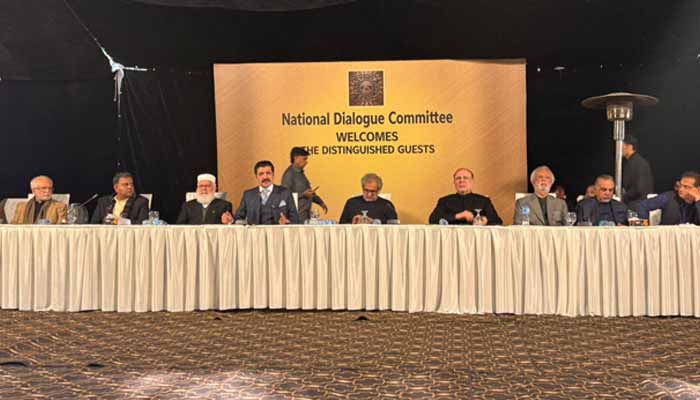
ISLAMABAD: A national conference convened by the National Dialogue Committee (NDC) has urged the government's top leadership to step forward and engage directly in a structured political dialogue with the opposition in an effort to ease political tensions and stabilise the country’s democratic and economic landscape.
The call came during a representative national gathering convened by the NDC in Islamabad on Wednesday, attended by leaders of major political parties, intellectuals, journalists, lawyers and other stakeholders associated with Pakistan’s political and democratic system.
The National Dialogue Committee was recently formed by former Pakistan Tehreek-e-Insaf (PTI) leaders, including Fawad Chaudhry, former Sindh governor Imran Ismail and Mahmood Moulvi.
The three former PTI leaders have time and again pushed reconciliation initiative aimed at cooling political temperatures in the country, particularly between the establishment and the PTI, sources told The News.
Unlike earlier attempts focused on PTI founder Imran Khan’s incarceration in the Adiala jail, the group’s immediate emphasis is on Kot Lakhpat Jail, where several senior PTI leaders, including Shah Mahmood Qureshi, Mian Mahmoodur Rashid, Ejaz Chaudhry, Umar Cheema and Dr Yasmin Rashid are currently imprisoned.
In a joint declaration issued after today's meeting, the committee expressed serious concern over political instability, economic hardships faced by the public, restrictions on political activity and the media, and the persistent threat of terrorism.
Participants stressed the need for national unity, political reconciliation and confidence-building measures, while appreciating the NDC’s role as a bridge between the government and the opposition.
The committee called for the formation of separate negotiation committees by the government and the opposition to formally initiate talks.
It proposed that President Asif Ali Zardari, PML-N President Nawaz Sharif and Prime Minister Shehbaz Sharif represent the government side, while the NDC would, in consultation with senior opposition leaders currently in jail, announce the names of the opposition’s negotiation committee.
The declaration also emphasised that restrictions on political activities should be lifted, the immediate appointment of leaders of the opposition in both the National Assembly and Senate, and political freedoms ensured within the constitutional framework.
It also demanded the release of women political workers, including Bushra Bibi and Yasmin Rashid, withdrawal of cases against political activists, an end to media censorship and removal of curbs on television anchors.
The declaration urged both the government and opposition to refrain from using the armed forces for political purposes or engaging in negative propaganda against state institutions.
The meeting paid tribute to the sacrifices of Pakistan’s armed forces, police, Rangers and other security personnel in the fight against terrorism, offering prayers for the martyrs and patience for their families. It reaffirmed national unity in safeguarding Pakistan’s sovereignty, defence, security and the dignity of state institutions.
The participants agreed to continue engagement and dialogue at the national level, reiterating that the National Dialogue Committee would persist in playing its role in the broader public and national interest.
'National dialogue only way forward'
Addressing the national conference, former prime minister Shahid Khaqan Abbasi said everyone shared responsibility for Pakistan’s deteriorating conditions, adding that he knew of no individual or institution free from blame.
He said national problems were reflected in the state of the economy, which suffered when media freedom and the rule of law were undermined. He warned that a country mired in chaos could not function, noting that hybrid governments had existed for six decades and that the issue was not the release of any single individual.
Abbasi said overseas Pakistanis sent $38 billion in remittances last year, highlighting the need to understand national realities. He stressed that politicians, the military, judges and business leaders must sit together to resolve issues, adding that despite claims of patriotism, the elite had effectively captured the state.
Meanwhile, PTI leader Sher Afzal Marwat said Pakistan had never properly understood the concept of national security, citing the Treaty of Hudaybiyyah as an example of compromise producing long-term results.
He said dialogue always led to sustainable outcomes and that political hostility had been pushed to extremes. He maintained that the military should be Pakistan’s strength, not the other way around, and said PTI’s founding chairman had never rejected talks.
Marwat said dialogue should focus on the basic system rather than being limited to the release of the PTI founder or Kot Lakhpat prisoners. He said he was elected on a PTI ticket but acknowledged that a rigid mindset had harmed the party.
For his part, PTI leader Imran Ismail said the national dialogue had begun a month earlier and had now taken the shape of a formal committee. He said Pakistan’s political situation was abnormal and that a collective effort was required to put the country on a path of development. Recalling decades of exposure to terrorism, he said unity was essential to counter the threat.
Barrister Saif said political polarisation had created serious difficulties but such dialogue could help reduce national problems. He noted the absence of some political parties, saying they feared political losses. He said differences between PTI and the state needed to be reduced, calling the release of the PTI founder and other political prisoners necessary. He said ruling circles feared post-release consequences, which was why tensions were worsening instead of easing.