After AI cameras, Karachi Traffic Police officers to issue e-challans via mobile app
Relevant traffic police officer to also be identified in e-challan; special mobile app to be operationalised soon
Published January 16, 2026
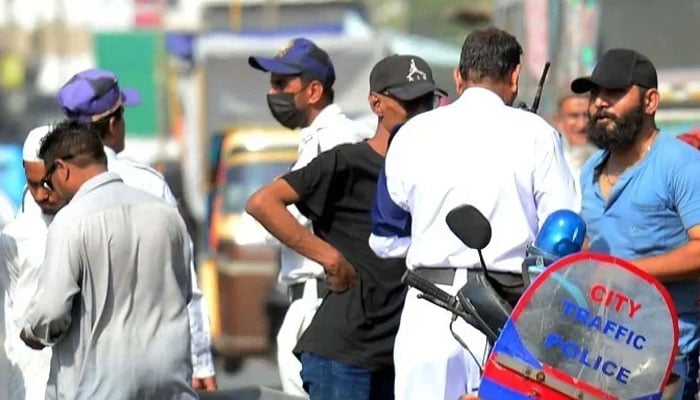
- Special mobile app to be downloaded onto officers' phones.
- Traffic police personnel to take picture of violations via app.
- Image to be sent to e-challan officer who will issue fine.
KARACHI: After launching AI-based e-challan system in October 2025, the authorities are now preparing to empower traffic police officers to also issue fines and challans using their cellphones.
For this purpose, a special mobile application will be downloaded onto the personal mobile phone of authorised traffic police officer, who will take a picture of the traffic violation using his mobile phone app.
The image will then be sent to the e-challan officer via an automatic system.
A mobile app in this regard has already been developed, and will soon be operationalised on an experimental basis.
The app, as per the officials, will only be downloaded to the personal mobile phones of authorised police officers in Karachi.
If a police officer sees any vehicle violating traffic rules in his area during duty, he will take a picture using the app and the e-challan officer will then issue a fine.
The relevant traffic police officer will also be identified in the issued e-challan.
E-challan via Tracs
The Traffic Regulation and Citation System (TRACS) was launched on October 27, aimed at replacing the outdated manual ticketing process with a fully automated e-ticketing mechanism, utilising advanced AI-integrated CCTV cameras to detect violations such as over-speeding, red light jumping, and helmet non-compliance.
The Tracs removes human discretion, confrontation and potential bias, ensuring fairness and accountability on the roads.
Whereas Tracs Sahulat centres at major traffic offices and police stations offer support to citizens for paying fines, clarifying violations and contesting challans.
The integration of Tracs with key government databases, including excise and taxation, the driving licence system and Nadra e-Sahulat, and modern payment gateways allows citizens to view and pay traffic fines securely online or via their mobile devices.

The Tracs app further simplifies the process, empowering users to monitor violations and settle challans in real-time.
In its initial phase, 200 cameras have been installed across Karachi, with plans to expand to 12,000 cameras city-wide and eventually to other districts in Sindh. The system's integration with the Citizens-Police Liaison Committee ensures transparent oversight and redressal.
But since its inauguration, the news system has sparked debate with critics pointing to the lack of adequate facilities and infrastructure in Karachi to support its implementation.
The initiative, since its launch, has garnered mixed reactions from various segments of society, with some criticising it for hefty fines while others welcoming it as a much-needed step to tame the city's traffic-related issues.
Last month, the Sindh government hinted at reducing fines for minor traffic offences and common mistakes by motorcyclists.
The provincial government, as reported by The News on Friday, has defended the enforcement of e-challans before the Sindh High Court, submitting that legislation with regard to e-Challan was made for public safety and to protect the road users, transporters, passengers and pedestrians.
Filing comments on petitions challenging legislation with regard to imposition of e-challans and amendments in the provincial motor vehicles (amendment) act, the Sindh mass transit department said that penalties have been increased to control rising traffic violations, causalities, fatal accidents and traffic congestion to safeguard the road users and regulate the traffic.
It said the e-challan has been introduced in the first phase on main roads where infrastructure is fine with proper road lanes, operational signals, service roads and deployment of traffic police. It was submitted that the e-challan was introduced after consultation with all stakeholders and complete media campaign and publication through print, electronic and social media platforms.