Erosion of rule of law contributing to conflict, humanitarian crises: Pakistan tells UNSC
Envoy says core UN principles are under unprecedented strain, citing India’s unprovoked aggression in May last year
Published January 27, 2026
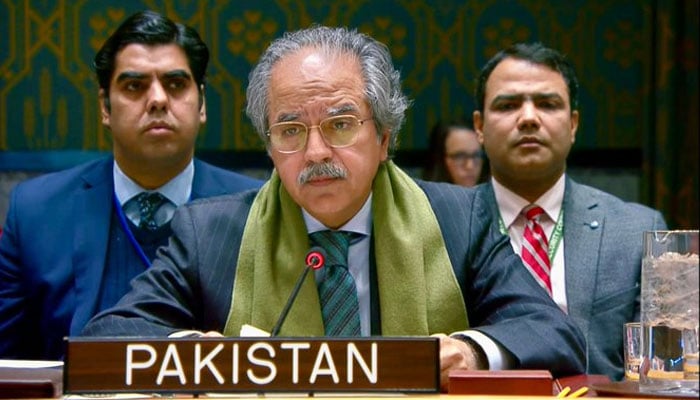
- Selective application of legal norms weaken trust: Asim Iftikhar.
- Envoy says developing countries face effects of "double standards".
- Instability deepens, disputes entrench when law yields to power.
UNITED NATIONS: Pakistan has called for stronger respect for international law, warning that selective application of legal principles is deepening global instability.
Speaking at a high-level debate of the UN Security Council on January 26, Pakistan’s Permanent Representative to the UN, Ambassador Asim Iftikhar Ahmad, said the erosion of the rule of law was contributing to conflict, humanitarian crises and weakening trust between countries.
He said international law was meant to make relations between states predictable and stable. But when countries ignore agreed rules, he warned, "law risks losing its meaning".
The Pakistani envoy said the core principles of the UN Charter — including sovereignty, territorial integrity and the prohibition on the use of force — were being challenged more frequently. He cautioned against attempts to normalise unilateral actions outside the UN framework.
"Selective application of legal norms, erosion of treaty obligations, and unilateral actions have weakened trust among states and strained the multilateral system anchored in the UN Charter," he stressed.
"When law yields to power or expediency, instability deepens, disputes entrench further, and peaceful coexistence jeopardised."
Referring to tensions with India, Ambassador Ahmad said Pakistan had experienced violations of international law first-hand, pointing out that India carried out military aggression last year, that led to Pakistan responding in self-defence under Article 51 of the UN Charter.
He added that lasting peace in South Asia required resolving the Kashmir dispute in line with UN resolutions and ensuring respect for treaty obligations, including water-sharing agreements.
Turning to the wider global picture, he said many developing countries had long faced the effects of “double standards” in the international system. Despite this, he said, nations in the Global South continued to place their trust in the UN and in a fair, rules-based international order.
The UN envoy also pointed to what he described as positive developments, including progress in international maritime law and recent advisory opinions by the International Court of Justice on Palestine and climate change. He said such legal rulings must be respected universally, not selectively.
He told the Council that the situation in Palestine highlighted the consequences of failing to apply international law equally. Denying people their right to self-determination and ignoring UN resolutions, he said, damaged the credibility of the international system.
Pakistan proposed several steps to strengthen compliance with international law. These included better monitoring of how Security Council resolutions are implemented, more frequent legal briefings to the Council, and greater use of the International Court of Justice in resolving disputes.
He said the rule of law could not be upheld through statements alone. “If multilateralism is to endure,” he said, “law must prevail over force, and justice over impunity.”
He reaffirmed Pakistan’s commitment to resolving disputes peacefully and to supporting a UN-centred international order based on equal rules for all states.
"Pakistan remains committed to a UN Charter-inspired rules-based international order in which disputes are resolved peacefully, obligations are honoured, and the United Nations serves as a true guarantor of peace, justice, and dignity for all," he added.