Pakistan neither shut door on diplomacy nor seeking war with Afghanistan: FO
PM Shehbaz will attend inaugural meeting of Trump’s Gaza board, confirms FO
Published February 12, 2026
- FO says diplomacy continues even during skirmishes.
- Says Pakistan wishes peace to “ our Afghan brothers and sisters".
- PM Shehbaz to attend inaugural meeting of Gaza board, says FO.
ISLAMABAD: Amid prevailing tensions between Islamabad and Kabul, Pakistan on Thursday reiterated its call for the Afghan Taliban regime to take concrete action against terror outfits operating from their soil.
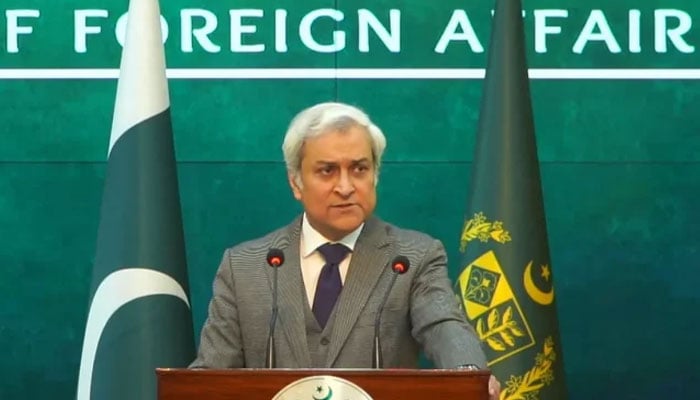
In his weekly press briefing in Islamabad on Thursday, FO spokesperson Tahir Andrabi emphasised that Pakistan would neither shut the door on diplomacy nor open the door to war between the two brotherly countries.
“Diplomacy continues even in wars. Diplomacy continues even during skirmishes.”
He said that Pakistan wishes peace and prosperity to “our Afghan brothers and sisters”.
Referring to the recent report of the United Nations Security Council (UNSC), he said that the document extensively supported Pakistan’s narrative on the banned Tehreek-e-Taliban Pakistan (TTP) and Afghanistan as it highlighted that the interim Afghan government continued to provide a permissive environment to terrorist outfits.
Besides referring to al-Qaeda acting as a multiplier and service provider to other armed terrorist groups in Afghanistan, he said the UNSC report also pointed out that the TTP enjoyed greater operational liberty and support, consequently attacking the territory inside Pakistan.
“The report corroborates Pakistan’s position that TTP resurgence is linked to post-2021 interim government takeover. So this is an important report, and we follow it up with the relevant UN secretariat and departments and also with the members of the international community, particularly the members of the Security Council and other relevant stakeholders,” he added.
Responding to a question, the spokesperson confirmed that Prime Minister Shehbaz Sharif would attend the inaugural meeting of the Board of Peace on February 19, accompanied by the Deputy Prime Minister and Foreign Minister Ishaq Dar.
“We have joined the Board of Peace in good faith… We are in it, not in isolation, not as one voice, but as a collective voice of eight Islamic Arab countries…So our collective voice is resonating in the Board of Peace and we will continue to strive for the right and progress and prosperity of the people of Palestine,” Andrabi added.
Asked about the Indian External Affairs Ministry’s statement following the recent Islamabad blast, he said: “It reflects an undertone of justification of terrorism on the pretext of one thing or another…It goes against India’s stated position that they oppose terrorism in all forms.”
“We conclude from these statements that India may oppose terrorism in all its forms, but it supports when it takes place against Pakistan,” he added.
The spokesperson also highlighted that the lynching of Muslims in India continued unabated, as at least 55 Muslims were lynched across India last year, pointing to a disturbing and persistent pattern of targeted and hate-motivated violence.
He said that many of these incidents occurred on the basis of explicit complicity of local authorities and local political leaders, underscoring the role of state patronage and impunity in enabling such crimes.
Calling upon the Indian government to investigate all such incidents and the international community to monitor the situation, he said that such incidents unfolded within a broader social and political climate marked by hostility, where Hindutva-driven narratives increasingly portray Muslims as outsiders and legitimise exclusion.
Responding to a question about the US President Trump’s repeated statements on the India-Pakistan 90-hour war in May last year, he said that Pakistan was appreciative of the US role during that conflict for peace, for the prevention of war.
He said that Pakistan had shot down a number of Indian Rafael jets, and the evidence was available internationally, and corroborated by international reports, as well as the manufacturers of those planes.
Asked about the Iran-US talks, the spokesperson said that Pakistan supported all initiatives aimed at dialogue and diplomacy to settle all outstanding issues, including that of nuclear talks.
Responding to a query, he said that Pakistan’s decision to play T20 match against India reflected the magnanimity as a result of the contacts made by Sri Lanka and Bangladesh, as well as by realisation within the relevant authorities managing cricket internationally that weaponisation and politicisation of cricket was wrong, unwarranted and it defied the game that we all cherish, he added.
He said that two joint statements by foreign ministers of eight Muslim states condemned Israeli ceasefire violations in Gaza and unlawful settlement actions in the occupied West Bank, besides reaffirming their stance of establishing a Palestinian state on the 1967 borders with Jerusalem as capital.