In phone call with MBS, PM Shehbaz slams ‘serious regional escalation'
PM also speaks with UAE president to "convey Pakistan’s strong condemnation of regional escalation"
Published February 28, 2026
- Dar, Araghchi review evolving situation in wider region.
- Israel, US launch strikes to destroy Iran's missile arsenal.
- Iran retaliates by firing missiles at Gulf states, Israel.
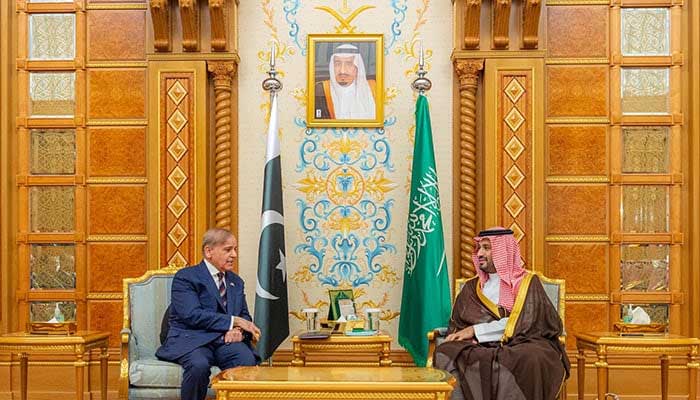
Prime Minister Shehbaz Sharif on Saturday held a telephonic conversation with Saudi Crown Prince Mohammed bin Salman this evening as tensions escalated in the Middle East following Israel-USA attack on Iran.
A statement issued by the PMO said the premier condemned the serious regional escalation that had taken place as a result of the Israeli attack on Iran today, followed by the regrettable attacks on other Gulf countries.
While assuring the Saudi leadership of Pakistan’s full solidarity and support in the current situation, the PM said that Pakistan would always stand with its Saudi brothers and sisters, at all times to come, and under all circumstances.
PM Shehbaz said that Pakistan was ready to play a constructive role at this difficult time and prayed that the blessings of the holy month of Ramadan would bring peace to the region at the earliest, the statement added.
Separately, PM Shehbaz also spoke with UAE President Sheikh Mohamed bin Zayed Al Nahyan to convey Pakistan’s strong condemnation of the dangerous regional escalation following the Israeli attack on Iran and the regrettable strikes against the UAE and other Gulf countries.
“I expressed my deep sorrow over the tragic loss of a Pakistani national in Abu Dhabi. Pakistan stands in full solidarity with the UAE, and we will always stand by our Emirati brothers and sisters in these difficult times,” the premier said in X post.
Earlier today, Deputy Prime Minister and Foreign Minister Senator Ishaq Dar on Saturday received a telephone call from his Iranian counterpart Abbas Araghchi during which he strongly condemned the unwarranted attacks against Iran and urged an immediate halt to the escalating tensions.
The Ministry of Foreign Affairs said that the two leaders reviewed the rapidly evolving situation in Iran and the broader regional landscape.
During the conversation, Dar stressed the need for urgent resumption of diplomatic engagement, calling for de-escalation and a peaceful, negotiated resolution to the crisis.
Israel and the United States launched strikes on Iran on Saturday, plunging the Middle East into a renewed military confrontation as President Donald Trump vowed to destroy Tehran's missile arsenal and prevent it from developing a nuclear weapon.
Tehran responded with a sweeping barrage of missiles targeting Gulf states and Israel, marking a sharp escalation in regional hostilities.
Iran's Islamic Revolutionary Guard Corps (IRGC), the ideological arm of the republic, said the strikes targeted the US Fifth Fleet headquarters in Bahrain, additional American assets across the Gulf, and sites in Israel.
Explosions and air defence activity were reported across Saudi Arabia, Bahrain, Qatar and the United Arab Emirates (UAE), as well as in Israel and Iraq, in the hours following the initial launch. The missile salvo came after Tehran had repeatedly vowed a forceful retaliation in the event of an attack.
Several Gulf Arab states confirmed they were targeted. Kuwait, Qatar, the UAE and Jordan said their air defence systems intercepted incoming Iranian missiles. The UAE's state media reported that one person was killed in Abu Dhabi.
A strike on a school in Iran killed 24 people, an Iranian provincial official said, while in Israel, the army deployed search and rescue teams to multiple locations following reports of fallen projectiles.
Smoke was rising over Tehran's Pasteur district, the site of the home of Khamenei, and there was a huge security deployment in the capital.
Israeli media reported that Iranian Supreme Leader Ayatollah Ali Khamenei and President Masoud Pezeshkian were among the targets of the attack.
Iranian state television said Pezeshkian was "safe and sound", while the Fars news agency said "missile impacts were reported in the Keshvardoost and Pasteur districts" of Tehran.