Hazrat Ali's martyrdom
Hazrat Ali’s life was built upon a rich legacy of spreading knowledge
Published March 11, 2026
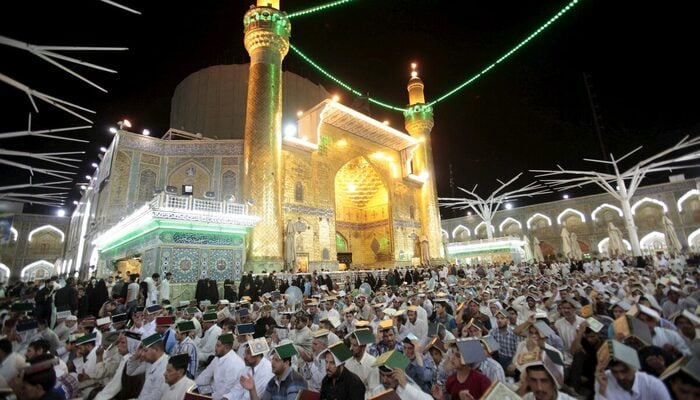
A rapid surge this week in the number of pilgrims visiting the final resting place of Hazrat Ali (a.s.) in the city of Najaf, Iraq, marked a powerful moment to remember the legacy of one of the most towering figures in global history.
It was at the historic ‘Kufa’ mosque near Najaf where Hazrat Ali (a.s) was attacked with a poison-dipped sword, and badly injured by assassin Abdul Rehman ibne Muljim, on the early morning of the 19th of Ramazan as he led the ‘fajr’ prayers. Hazrat Ali succumbed to his deep wound across his forehead and embraced martyrdom two days later on the 21st of Ramazan.
The martyrdom of Hazrat Ali (a.s) will be remembered across Pakistan today (Wednesday, 21st Ramazan), where scores of ‘majalis’ (gatherings of mourners) have been held since Monday (19th of Ramazan) alongside public processions. Similar events have taken place elsewhere across the world, hosted by communities of Muslims.
This week’s commemorations were yet another powerful reminder of the miraculous birth of Hazrat Ali (a.s) inside the holy Kaaba, just two months earlier. Together, the birthplace of Hazrat Ali and the site of his martyrdom continue to work as magnets for scores of Muslims to pay homage to a rare historical figure who continues to inspire numerous individuals and communities across the world.
This year’s remembrance has gained a special significance as the Muslim world faces unprecedented bloodshed led by the US-Israel nexus targeting Iran and Lebanon. It followed the ruthless Israeli invasion of Gaza that martyred at least 72,000 Palestinians, though some accounts claim a much higher figure. Events in Gaza have clearly become a case of genocide committed by the Jewish state, which will be remembered for all time to come.
In this context, the five-year rule of Hazrat Ali (a.s.) as Caliph, which ended in 661 AD, has left an enduring legacy that teaches precious lessons on matters ranging from statecraft to the essential qualities of leadership. Hazrat Ali’s personality was multi-faceted, from his achievements on the battlefields to his roles as a jurist, an administrator, a leader, a ruler and, above all, a scholar and a guide to his fellow Muslims. Remembering Hazrat Ali (a.s.) brings forth a powerful legacy of the ideal standards that a leader must embrace to succeed in matters of justice and statecraft.
Hazrat Ali’s life was built upon a rich legacy of spreading knowledge that is famously remembered with his oft-repeated claim: “Salooni, Salooni, Qabla an Tafqaduni (Ask me, Ask me before I am not amongst you)." From the pulpit in Madinah after Prophet Muhammad (Peace Be Upon Him) passed away to the seat of his caliphate in Kufa, Hazrat Ali (a.s) repeatedly defended his command over knowledge on matters ranging from religion to worldly affairs and science.
In recognition of his towering character, some of the more celebrated honorific titles bestowed upon him included ‘Asadullah’ (Lion of Allah), ‘Haider’ (Lion), ‘Babul Madinatul Ilm’ (Gateway to the city of knowledge) and ‘Fatahe Khyber’ (the conqueror of the Jewish-held fort of Khyber outside Madinah).
One of the most impressive accounts of Hazrat Ali’s knowledge was compiled in ‘Nahjul Balagha’ – a historical text that contains many of his sermons, letters, and sayings. Over time, ‘Nahjul Balagha’ has been translated from its original Arabic into Persian, Urdu, English, French and German. These accounts have helped scholars, historians and policymakers learn from the legacy of Hazrat Ali (a.s) and draw enduring lessons.
His impressive personality has been recognised over the centuries not only by Muslims but also by non-Muslims. “Have you ever heard about a monarch who used to grind the grains with his own hands and prepared for himself the bread which could be broken only by pressing with the knee? He who mended his shoes himself?” famously wrote George Jordac, the Lebanese Christian scholar in his book ‘The Voice of Human Justice: A biography of Imam Ali AS’.
Originally published in Arabic as ‘Sautul Adalatil Insaniyah’, the publication showers praise upon Hazrat Ali (a.s): “He (Hazrat Ali) who did not accumulate any worldly wealth, because he had no object in view except to heal the afflicted and the oppressed, so that he might realise their rights from the oppressors, and make them [people] happy”.
This tribute was among the many powerful reminders of a letter that Hazrat Ali (a.s) wrote to Maalik e Ashtar, one of his closest companions, upon the latter’s appointment as governor of Egypt, then a province of the Islamic empire. For centuries, the letter has been cited repeatedly for offering guidance to rulers on administering an ideal state for all times to come. “Remember that mutual trust and goodwill between the ruler and the ruled are bred only through benevolence, justice and service. Cultivate goodwill amongst the people, for their goodwill alone will save you from troubles. Your benevolence to them will be repaid by their trust in you, and your ill-treatment by their ill-will", wrote Hazrat Ali (a.s).
In an important reminder to rulers for all times to come, he emphasised the importance of protecting well-established traditions set by their predecessors. “Do not disregard the noble traditions set by our forbearers, which have promoted harmony and progress among the people, and do not initiate anything which might minimise their usefulness. The men who had established these noble traditions have had their reward, but responsibility will be yours if they are disturbed”, he wrote.
Today, remembering the life of Hazrat Ali (a.s) on the anniversary of his martyrdom offers unending lessons, both for rulers of communities and countries in danger of being targeted, and for their populations at large. At a time when so many Muslims stand in danger of being sacrificed, their will to survive will receive a lift from the enduring lessons left by Hazrat Ali (a.s).
The writer is an Islamabad-based journalist who writes on political and economic affairs. He can be reached at: [email protected]
Disclaimer: The viewpoints expressed in this piece are the writer's own and don't necessarily reflect Geo.tv's editorial policy.
Originally published in The News