Uncertain Iran, uneasy region
Leadership decapitation is a dramatic act, but history shows that entrenched ideological systems rarely crumble simply because a towering figure is removed
Published March 05, 2026
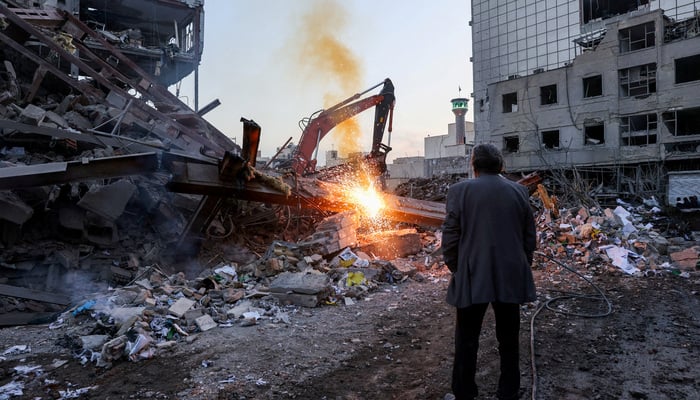
If the US and Israel believed that eliminating Iran’s supreme leader, Ayatollah Ali Khamenei, would automatically trigger regime collapse in Iran, they may have gravely miscalculated.
Leadership decapitation is a dramatic act, but history shows that entrenched ideological systems rarely crumble simply because a towering figure is removed. Iran’s Islamic Republic has spent nearly five decades institutionalising continuity amid crises. Any assumption that the system would implode overnight underestimates its structural resilience.
Since the 1979 revolution, the Islamic Republic has evolved from a revolutionary movement into a complex state apparatus with layered power centres. The office of the Supreme Leader is constitutionally entrenched and succession is well defined. When Ayatollah Ruhollah Khomeini died in 1989, the transition to Khamenei was marked by notable institutional coherence.
Iran’s political order is not monolithic; it draws strength from the Islamic Revolutionary Guard Corps (IRGC), the clerical establishment, the security services and parallel administrative institutions that operate corporately rather than personally. Removing a supreme leader may intensify elite battle lines, but does not automatically dismantle the underlying architecture of power.
Yet what has come to light in recent weeks is not just a military operation, but a strategic gambit combining diplomacy with kinetic blows, timed in ways that raise serious questions about intent. While indirect nuclear negotiations between the US and Iran were ongoing in neutral venues like Geneva and described by Iranian officials as ‘positive’ with progress on several technical fronts, a major coordinated strike by the US and Israel was launched abruptly, targeting leadership facilities, air defences and political centres across Iran.
This sequence — positive diplomatic rhetoric followed by a devastating assault — suggests an unsettling pattern of deception embedded in strategy. It is one thing to pursue diplomacy as a sincere instrument of conflict resolution; it is another to use it as a vehicle to gain time, reduce public friction and then strike when Tehran is most exposed or least expecting it. Whether intentional or opportunistic, this juxtaposition has eroded trust and strengthened hardliners who argue that external engagement is futile and dangerous.
Critics argue that this duality reflects a broader US trend towards leadership decapitation as a policy tool — an approach that has become starkly evident in both Tehran and Caracas. In Venezuela’s case, a US operation earlier this year resulted in the capture of Nicolas Maduro, a move widely condemned in the region and seen as a direct intervention in a sovereign nation’s political fabric. Whether framed domestically as promoting democracy or protecting regional security, such actions set a dangerous precedent: that the removal of leadership, irrespective of domestic legitimacy or process, is an acceptable instrument of national strategy.
External military or covert interventions often produce outcomes opposite to those intended. Nationalist consolidation tends to follow foreign pressure. Iran’s experience during the eight-year war with Iraq, decades of crippling sanctions and periodic domestic unrest have reinforced a siege mentality within the state structure. In moments of perceived existential threat, even internal critics close ranks. Rather than catalysing regime change, external aggression can strengthen hardline narratives and marginalise reformist currents.
Another major obstacle to any genuine regime-change ambition is the absence of a credible, popular alternative. For decades, the son of the former Shah, Reza Pahlavi, has been touted by some external observers as a transitional figure. Yet symbolism abroad does not translate into political capital at home. Iranian society today is not the Iran of 1979; a generation has grown up entirely under the Islamic Republic, with grievances centred on economic hardship, governance deficits and social freedoms — not on restoring monarchy or embracing imported leaderships.
Effective regime change requires three converging elements: elite defections, organised domestic political structures and broad societal legitimacy. At present, no single opposition figure or movement appears capable of uniting Iran’s diverse social and political constituencies. Even Washington seems cautious about placing its bets on singular exile leadership, including the de facto Crown Prince Reza Pahlavi. Without a coherent alternative, a power vacuum would not automatically translate into liberal democracy; it could just as easily yield intensified authoritarian consolidation or chaotic fragmentation.
This leads to a more troubling possibility: if orderly regime replacement is improbable, could fragmentation become the de facto objective? Iran’s ethnic mosaic — Kurds in the northwest, Azeris in the north, Arabs in Khuzestan, Baloch in the southeast, alongside the Persian majority — is frequently cited in geopolitical analyses. Peripheral grievances exist, as they do in most multi-ethnic states. But Iranian nationalism has historically functioned as a centripetal force, especially when confronted with external threats.
Efforts to inflame ethnic or sectarian fissures from outside may generate localised unrest, but they also risk igniting broader instability across the region. A fragmented Iran would not be a contained event. It would send shockwaves across Iraq, the Gulf, Syria and Afghanistan. Energy markets would react violently. Militant groups could exploit vacuums. Refugee flows could strain neighbouring states. Maritime security in the Strait of Hormuz would become precarious, with global economic repercussions. Oil prices have already shot up to $100 per barrel.
For Israel, a divided Iran might appear to reduce the coherence of a principal adversary. Yet history cautions that collapsing states rarely produce stable strategic environments. The disintegration of Iraq after 2003 did not eliminate threats; it reconfigured them in more unpredictable forms. The Middle East is littered with examples of state weakening, creating long-term security dilemmas rather than durable solutions.
For Pakistan, the stakes are particularly grave. Islamabad is already navigating a tense security landscape, with a persistent TTP challenge on its western frontier and perennial hostility with India on its eastern front. Adding a destabilised Iran to this equation would multiply geostrategic pressures and stretch national bandwidth.
Pakistan shares a sensitive border with Iran in Balochistan, a province already grappling with insurgent undercurrents. Any attempt to stir ethnic separatism inside Iran’s Sistan–Balochistan province could have spillover implications across the border, leading to refugee inflows, cross-border militant movements and sectarian provocations complicating internal security.
Pakistan also has longstanding economic and energy interests tied to stable relations with Tehran, including trade ties and future connectivity projects. Islamabad, therefore, will have to approach the unfolding situation with calibrated prudence. First, rhetorical restraint is essential. Public alignment in polarising great-power contests rarely serves medium-sized states well.
Second, intelligence coordination and border vigilance must be strengthened to anticipate spillover risks. Third, diplomatic channels with Tehran should remain open and active, irrespective of internal Iranian transitions. Finally, quiet coordination with regional actors, including Gulf states and China, may help mitigate destabilising ripple effects.
The central lesson is clear: regime decapitation is not synonymous with regime transformation. Iran’s system is structured to absorb shocks, manage succession, and project continuity. The absence of a credible alternative reduces the probability of an orderly transition. Attempts to fracture the country along ethnic or sectarian lines would unleash forces no external actor could fully control.
In an already combustible Middle East, engineering chaos is a perilous gamble. For Pakistan, stability in Iran is not a matter of ideological preference but strategic necessity. Vigilance, restraint and proactive diplomacy will be essential as the region navigates what could become one of its most consequential inflexion points in decades.
The writer is a former ambassador of Pakistan to Iran and the UAE. He is also a former special representative of Pakistan for Afghanistan and currently serves as a senior research fellow at the Islamabad Policy Research Institute (IPRI).
Disclaimer: The viewpoints expressed in this piece are the writer's own and don't necessarily reflect Geo.tv's editorial policy
Originally published in The News