Satellite data shows Earth is getting ever brighter at night
Study documents effects of nighttime artificial lighting
Published April 09, 2026
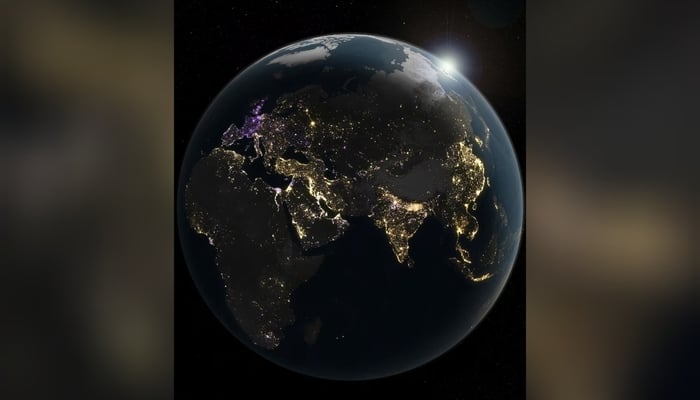
Daily satellite observations have revealed a continued nighttime brightening globally due to artificial lighting, with important regional variations including a surge in sub-Saharan Africa and Southeast Asia alongside a deliberate dimming in Europe driven by concerns over energy conservation and light pollution.
Researchers documented a 16% net increase in global nighttime light from 2014 to 2022, but showed it was not a steady brightening but rather a patchwork of increasing and decreasing regional brightness shaped by numerous factors. The United States in 2022 had by far the highest total luminosity of any country, followed by China, India, Canada and Brazil.
Brightening was found to be propelled mainly by rapid urbanization, infrastructure expansion and rural electrification.
Dimming, however, had two very different drivers. Abrupt dimming was usually caused by natural disasters, power grid failures and armed conflicts. Gradual dimming was often deliberate, guided by government regulations, transitions to energy-efficient LED lights and efforts to cut light pollution.
"For decades, we've held a simplified view that the Earth at night is just getting steadily brighter as human population and economies grow," said Zhe Zhu, a professor of remote sensing and director of the University of Connecticut's Global Environmental Remote Sensing Laboratory, senior author of the study published on Wednesday in the journal Nature.
"We discovered that the Earth's nightscape is actually highly volatile," Zhu said. "The planet's lighting footprint is constantly expanding, contracting and shifting."
The researchers used more than a million daily images obtained by a US government Earth-observation satellite and processed by NASA. Previous global studies relied mostly on annual or monthly composite satellite images.
The most dramatic brightening occurred in emerging economies, particularly in sub-Saharan Africa and Southeast Asia. It was led by Somalia, Burundi and Cambodia, followed by several African nations including Ghana, Guinea and Rwanda.
"This isn't just urbanisation. It is a massive expansion of energy access," Zhu said. "These numbers represent a profound shift as entire regions transition from near-total darkness to becoming part of the global electric network."
Massive light loss occurred in countries such as Lebanon, Ukraine, Yemen and Afghanistan, where light was a casualty of armed conflict and infrastructure collapse. Similar declines were observed in Haiti and Venezuela, where dimming was more closely associated with prolonged economic crises and unreliable energy supply.
"In Ukraine, we observed a sharp, sustained decrease in light that aligned perfectly with the escalation of the conflict in February 2022," when Russia launched a large-scale invasion, Zhu said.
"We see similar abrupt darkness falling over regions in the Middle East during periods of conflict," Zhu said.
Europe experienced a 4% net decrease in nighttime light radiance, largely due to technological advances and environmental policies.
"It is driven by a widespread shift from older, less-efficient streetlights like high-pressure sodium lamps to newer, directional LED systems, as well as strict national energy-efficiency mandates and dark-sky conservation efforts," Zhu said. "Europe is fascinating because it presents a very structured dimming pattern."
Zhu called France a world leader in dark-sky conservation and energy-efficiency mandates.