NASA to investigate mysterious Moon pit that could become home for future astronauts
NASA studies have shown that the interior of some lunar pits have stable temperature
Published October 07, 2026
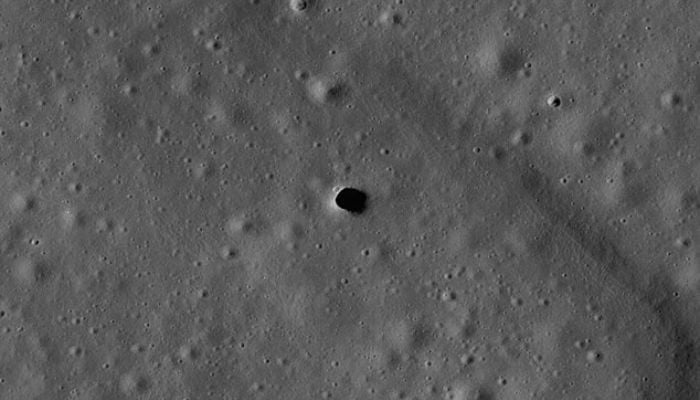
The National Aeronautics and Space Administration (NASA) is geared up to explore a deep pit on the Moon that could be a huge underground lava tube. Marius Hills pit is a roughly 34-metre-deep hole in an ancient volcanic area on the lunar surface.
The American space agency will send GIMLI (Geophysical Instruments for Marius Lunar pit Investigation) to the area to examine what lies beneath the surface.
The question scientists want answered is if the hole leads anywhere?
Researchers have long believed that pits such as Marius Hills may be skylights formed when the roof of an ancient lava tube collapsed. If so, there could be much bigger spaces lurking under the moon's surface.
That is a possibility that is important for more than geology. Life on the surface of the Moon is hard.
The temperature can vary from about 127C in the day to about minus 173C at night, and the astronauts have to contend with radiation and small meteorites as well.
But a cave might change that. NASA studies have shown that the interior of some lunar pits is much more stable, at temperatures of approximately 17C.
If Marius Hills does connect to a large lava tube, the underground space may provide natural protection for astronauts, rather than having to engineer each layer of protection.
It doesn't mean that NASA has already discovered a ready-made Moon base. It remains to be seen if there is an underground tube under Marius Hills and what its shape and size are.
The feature was first spotted by Japan's Kaguya spacecraft in 2009, and was later observed by NASA's Lunar Reconnaissance Orbiter, which provided a closer view of the walls and floor.