SpaceX CRS-35 launch creates rare ‘jellyfish cloud' over Tampa Bay
SpaceX CRS-35 launch lights up Tampa sky with rare noctilucent cloud
Published October 13, 2026
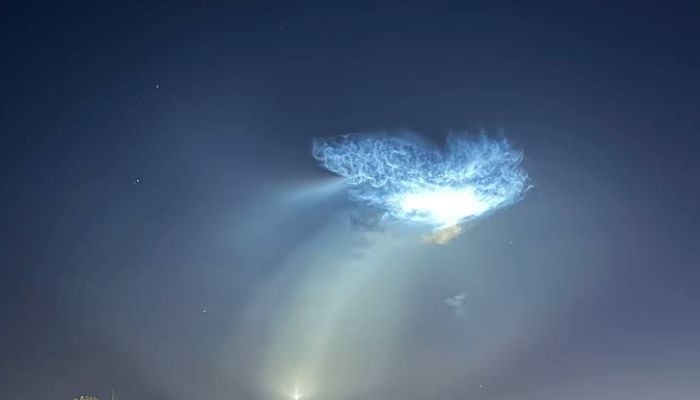
Tampa Bay residents were treated to an unusual sight Tuesday morning, October 13, when a SpaceX launch produced a glowing, silvery-blue cloud across the pre-dawn sky.
The phenomenon was a noctilucent cloud (an ice-crystal formation occurring 50-70 miles above Earth’s surface) created by the exhaust plume of a Falcon 9 rocket.
The launch itself was SpaceX’s CRS-35 cargo resupply mission to the International Space Station. Liftoff occurred at 6:33 a.m. EDT from Space Launch Complex 40 at Cape Canaveral Space Force Station.
The Falcon 9 first stage booster, B1096, flew for the eighth time, having previously supported missions including IMAP, CRS-34, NROL-77, and a Starlink flight. Following stage separation, the booster landed at Landing Zone 40.
The Cargo Dragon spacecraft, tail number C211, is on its fourth flight after previously flying CRS-26, CRS-29, and CRS-33.
It carries around 6,300 pounds of cargo, including the final pair of ISS Roll-Out Solar Arrays (iROSAs), a clamshell housing the failed Canadarm2 joint, and numerous science experiments studying artificial retinas, 3D heart tissue growth, and neurodegenerative disease inflammation.
Dragon is scheduled to autonomously dock with the Harmony module’s zenith port on Thursday, October 15, at around 11:00 a.m. EDT, following an approximate 52-hour flight. The spacecraft will remain docked for about a month.