Japan launches historic Mars mission to collect just 10 grams of lunar soil that could solve major mystery
The spacecraft will reach Mars in August 2027 and spend a few years to research on Deimos and Phobos
Published October 20, 2026
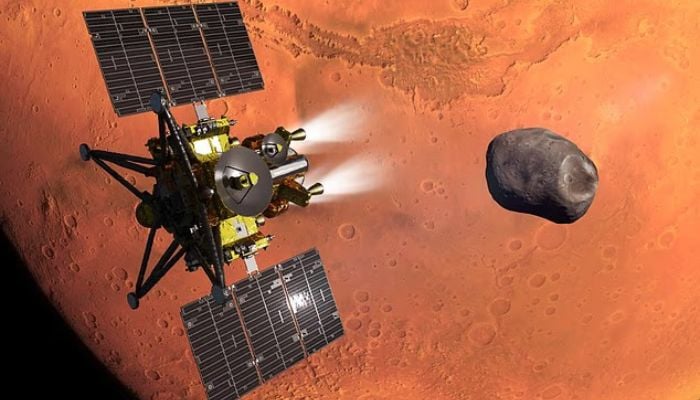
Japan has successfully launched a spacecraft towards Mars on a five-year mission to collect just 10 grams of soil from one of the planet's moons, hoping to answer a question that has puzzled scientists for decades.
The spacecraft, named Martian Moons Exploration (MMX), lifted off aboard an H3 rocket from Japan's Tanegashima Space Center on Tuesday.
According to the Japan Aerospace Exploration Agency (JAXA), the spacecraft successfully separated from the rocket about 71 minutes after launch.
But why are scientists spending approximately $578 million to bring back such a small amount of material? The answer lies in Phobos, the larger of Mars' two moons, whose origins remain a mystery.
There are two conflicting theories.
Phobos may be an asteroid captured by Mars' gravity, or it could have formed from debris thrown into space when another celestial body collided with the planet.
Studying its soil could help researchers determine which theory is correct and understand how the early solar system evolved.
The spacecraft will arrive at Mars in August 2027 for a few years of research on Deimos and Phobos.
It will also deploy a small French-German rover called Idefix to examine the moon's surface and help identify suitable landing sites.
The main spacecraft will then attempt to collect samples from Phobos and bring them back to Earth in 2031. If successful, Japan will become the first country to return material from a Martian moon.
The mission might also shed light on the process by which water and organic materials came to rocky planets, such as Earth, as well as assist scientists in their preparations for future human exploration of Mars.