Why Jinnah and Iqbal defended Bhagat Singh
Jinnah and Iqbal stood up for Bhagat Singh, who was neither a Muslim nor a Muslim Leaguer, because they believed he was a political prisoner
Published November 26, 2026
The Lahore High Court Bar Association is one of the oldest and largest representative bodies of lawyers in Asia. Its first president, Sir William Henry Rattigan, also served as vice-chancellor of Punjab University, Lahore. In 1893, while president of the Bar, he was also a member of the Supreme Legislative Council of India. He later joined the Punjab Legislative Council and, after returning to Britain in 1901, was elected to the House of Commons from Lancashire. Rattigan Road in Lahore, which connects the district courts to Government College University, still bears his name.
My point is simple: the Lahore High Court Bar once had presidents who were not only highly educated lawyers but also leading politicians. Before and after the creation of Pakistan, the Bar's presidents played a vital role in politics. In 1919, when British troops massacred civilians at Jallianwala Bagh in Amritsar, the Bar's president, Sir Muhammad Shafi, condemned the killings. He then joined Quaid-i-Azam in the Imperial Legislative Council in fiercely opposing the Rowlatt Act, which empowered the police to arrest any citizen without trial. Quaid-i-Azam resigned from the council in protest against this black law. Another president of the Bar, Khalifa Shujauddin, worked tirelessly with Allama Iqbal in 1937 to organise the Muslim League in Punjab. I need not dwell on the Bar's role against the dictatorships of General Ayub Khan, General Ziaul Haq and General Pervez Musharraf.
In January 1965, when Mohtarma Fatima Jinnah contested the presidential election against General Ayub Khan, Allama Iqbal's son, Dr Javed Iqbal, served as her polling agent in Jhang. He took part in her campaign alongside several lawyer leaders of the Lahore High Court Bar, including Rabia Sultan Qari, who in 1966 became the Bar's first woman president. Dr Javed Iqbal himself was elected president of the Bar in 1968.
On 24 November 2026, an All-Parties Convention was held in the Dr Javed Iqbal Hall of the Lahore High Court to oppose the 26th and 27th amendments to Pakistan's Constitution. Besides political parties, the Bar's president, Babar Murtaza Khan, invited representatives of human rights groups and lawyers' organisations from across the country. Maulana Fazlur Rehman, head of Jamiat Ulema-e-Islam-Fazl, had reached Lahore to attend, but at 11 in the morning he was placed under house arrest at a friend's residence to prevent him from taking part. The detention did the government no good: the Maulana addressed the convention via Zoom.
I was invited on behalf of the media. I drew the large gathering's attention to the board on the wall behind the stage, which listed the names of all the Bar's former presidents. Among them are men who, together with Quaid-i-Azam and Allama Iqbal, challenged the oppression and black laws of British imperialism. I told the participants that just as political prisoners in today's Pakistan are often charged with sedition, terrorism and murder, political prisoners under British rule were likewise charged with sedition and terrorism.
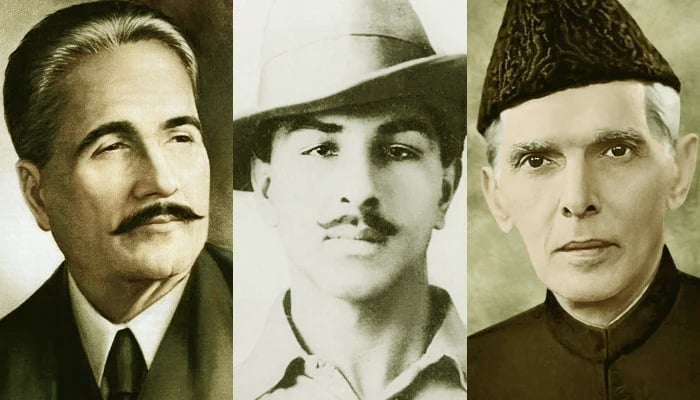
One such prisoner was Bhagat Singh, who was being tried in the Lahore conspiracy case, which the Lahore High Court Bar Association had declared illegal. In June 1929, Bhagat Singh demanded in Mianwali Jail that he be given the same rights as other political prisoners. When his demand was refused, he went on a long hunger strike. In September 1929, Quaid-i-Azam Muhammad Ali Jinnah spoke in the Central Legislative Assembly in support of his demands.
Around the same time, the Bar passed a resolution opposing the trial of Bhagat Singh before a special court rather than the ordinary courts. The resolution established a special committee to determine whether the special court was constitutional. Its members were the Bar's then president, Sir Dr Gokul Chand Narang, along with Malik Barkat Ali, Pandit Nanak Chand, Allama Dr Muhammad Iqbal, Sir Moti Sagar and Jagan Nath. Sir Moti Sagar and Jagan Nath attended none of the meetings and did not sign the report. The other four members, however, examined over several sessions, in light of the Government of India Act, the special court set up under the Viceroy's ordinance. They concluded that such a court could be established only in an emergency, but the government had declared no such emergency, making the trial of Bhagat Singh and his comrades unconstitutional. Allama Iqbal, Gokul Chand Narang, Malik Barkat Ali and Pandit Nanak Chand signed the report.
The report was sent to the government, which nevertheless announced that Bhagat Singh would be hanged on 23 March 1931. On 27 February 1931, Allama Iqbal, together with Bhagat Singh's other lawyers, filed a petition before the Privy Council to stop the execution, but it too was rejected. Quaid-i-Azam and Allama Iqbal fought to save a political prisoner charged with sedition and terrorism until his last breath.
Today, portraits of Quaid-i-Azam and Allama Iqbal hang in every government office in Pakistan, yet their struggle against black laws is forgotten. Pakistan still has laws like the Maintenance of Public Order (MPO), introduced by General Ayub Khan in 1960, under which anyone can be arrested without trial. At the Lahore High Court Bar's All-Parties Convention, I reminded the opposition parties present that when they were in government, they too enforced a black law like PECA through a presidential ordinance. Their campaign must not be limited to two amendments and the political prisoners of one party; it must cover all black laws and all political prisoners in Pakistan.
The Lahore High Court Bar and the entire legal community of Pakistan must follow in the footsteps of Quaid-i-Azam Muhammad Ali Jinnah and Allama Iqbal, who raised their voices for Bhagat Singh, a man who was neither a Muslim nor a Muslim Leaguer. They defended Bhagat Singh because he was a political prisoner.
The writer is a senior journalist, anchor, and columnist, associated with Geo News. He posts on X@HamidMirPAK