At UN, Pakistan slams India for ‘weaponisation of water' over unfounded terrorism claims
India’s unilateral move to hold IWT in abeyance marks grave legal departure, says Pakistan envoy
Published March 20, 2026
- Pakistan says no provision of IWT allows for unilateral suspension.
- Such actions amount to "weaponisation of water": envoy.
- Pakistan remains committed to implementation of IWT obligations.
Pakistan has strongly rejected “baseless remarks” by India at the United Nations and accused New Delhi of undermining the Indus Waters Treaty (IWT) while attempting to politicise water issues.
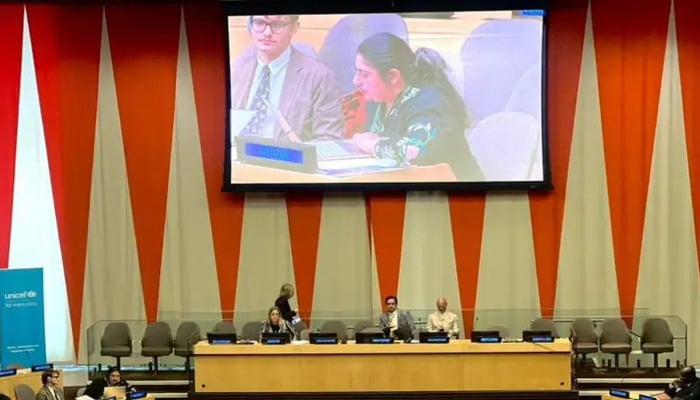
The exchange took place during a high-level UN event held to mark World Water Day under the theme of water and gender equality, where Pakistan’s Second Secretary Aleena Majeed exercised her right of reply following remarks by the Indian representative.
During the session, India’s envoy said New Delhi would continue to keep the treaty “in abeyance” until Pakistan takes credible and irreversible action against terrorism.
The Indian side also claimed that evolving technological, environmental and demographic factors necessitate revisions to the decades-old agreement, while alleging that past attempts to engage Pakistan on modifications had not progressed.
Responding to these assertions, Majeed said she was compelled to take the floor over India’s unfounded remarks.
She stressed that the Indus Waters Treaty, concluded in 1960, has endured wars, crises and prolonged political tensions between the two countries, including the longstanding dispute over the Indian Illegally Occupied Jammu and Kashmir (IIOJK).
She said India’s unilateral move last April to place the treaty in abeyance marks a grave departure from its legal and historical legacy, emphasising that no provision of the agreement allows for unilateral suspension or modification.
Majeed warned that these actions amount to the “weaponisation of water” for narrow political gains, putting at risk the livelihoods of millions dependent on the river system.
Referring to international legal proceedings at the Court of Arbitration, she noted that a 2025 supplemental award had reaffirmed that the treaty remains in force, with its dispute resolution mechanisms intact and binding.
She said the ruling made clear that neither party has the authority to unilaterally suspend or render the agreement inoperative, urging India to immediately resume full implementation.
She also rejected New Delhi’s allegations of terrorism as “entirely baseless,” calling them an attempt to deflect attention from India’s own record of state-sponsored violence and cross-border actions.
“India’s attempts to deflect attention through unfounded allegations of terrorism cannot conceal its record of sponsoring terrorism across its borders, perpetrating state violence in occupied Jammu and Kashmir, and conducting alleged state-backed operations abroad, including in North America,” Majeed said.
She further asserted that there is credible evidence of India’s alleged support for militant groups involved in attacks in Pakistan, resulting in significant loss of life.
Reiterating Pakistan’s stance, she said the country firmly rejects all attempts to weaponise water for political purposes and remains committed to international law and the faithful implementation of treaty obligations.