Pakistani runners deliver depth, discipline, tactical brilliance at London Marathon 2026
Despite different backgrounds, runners are united by shared identity and growing passion for distance running
Published April 26, 2026
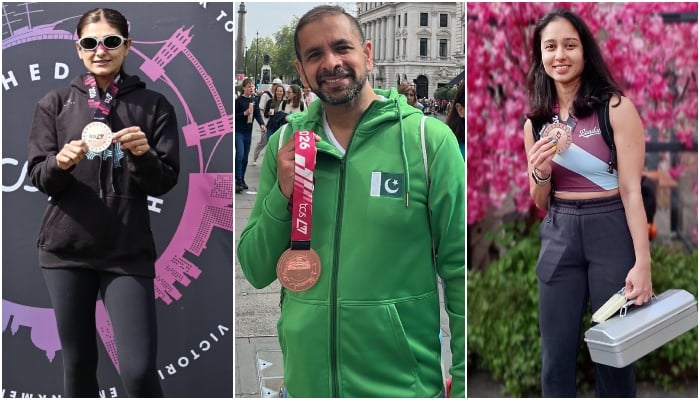
KARACHI: The 46th edition of the London Marathon turned into a statement event for Pakistani runners, as more than 30 participants from Pakistan and the global diaspora combined endurance with tactical maturity to produce a series of impressive performances.
From front-running pace control to disciplined race execution, the performances reflected not just participation, but a growing understanding of elite marathon racing.
At the heart of Pakistan’s success story was UK-based Abdullah Muhammad Athar, whose 2:39:53 finish made him the fastest Pakistani in the race, but it was the manner of his run that stood out.
Athar executed a near-perfect race strategy, maintaining remarkable consistency through the early and middle phases. He covered the first 10km in 37:07, holding a steady 3:43/km pace, and reached halfway in 1:18:23, firmly on course for a sub-2:40 finish.
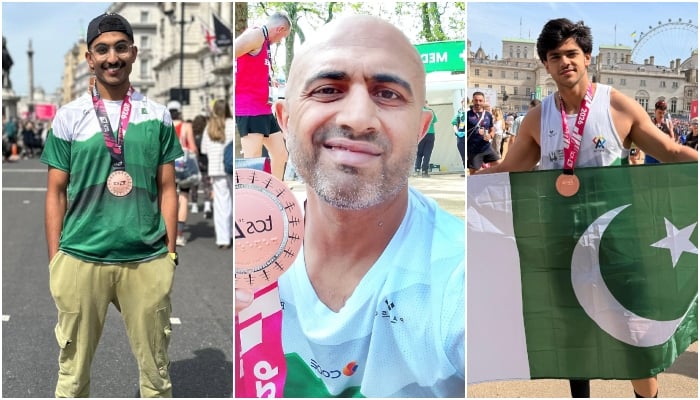
Even as fatigue set in during the latter stages, a common challenge in marathon running, Athar managed the slowdown smartly. His pace gradually shifted from 3:41-3:49/km between 20K-30K to around 4:00/km in the final stretch, ensuring a strong finish without a dramatic drop-off.
Reflecting on his journey, Athar emphasised the deeper value of the sport. “Most people in Pakistan think running takes too much time and commitment, but for me it does the opposite, it focuses the mind and gives structure to a busy life,” he said.
“About a year ago, my 10k PB was around 37 minutes. Today, I ran that pace back to back four times, finishing the London Marathon in 2:39 as the fastest Pakistani.”
With this, Athar has now set his sights on completing all seven World Marathon Majors, targeting sub-three-hour finishes across each.
Karachi’s Amin Mukaty followed with a well-managed run of 2:45:02, showcasing excellent pacing discipline on a course he described as physically demanding.
Mukaty opened slightly conservatively, covering 5km in 19:08, and reached halfway in 1:21:43, keeping himself within striking distance of his target time. His splits remained consistent in the 3:50–3:59/km range, reflecting a controlled approach.
Crucially, he avoided the late-race crash that often derails marathon efforts, maintaining composure through 30K to 40K, where many runners fade.
“I started very controlled and ended strong. I didn’t crash and that was the best part,” Mukaty said. “The crowd, the energy was wild… it was an amazing experience.”
Despite narrowly missing a personal best, his race execution stood out as one of the most disciplined among the Pakistani contingent.
In the women’s category, Dubai-based Sara Tahoor Lodhi emerged as the fastest Pakistani female, finishing in 3:25:02, a performance defined by a strong opening and resilience in the latter stages.
Tahoor ran a consistent first half, reaching 10K in 46:20 and halfway in 1:38:07, maintaining a steady 4:38/km pace. However, like many runners, she encountered the physical demands of the course beyond 25K.
Her pace dipped into the 5:00–5:20/km range between 30K and 40K, before she regrouped to close the race, demonstrating mental strength to complete the marathon strongly.
“Honoured to have represented Pakistan for the second time… I look forward to continuing to represent Pakistani women with dedication and pride,” said Sarah, who earlier won the Karachi Marathon.
Beyond the leading trio, the results reflected impressive depth across categories.
Karachi’s Rehan Adamjee (3:11:01) was in third place among Pakistani runners, while Adnan Gandhi (3:32:32) improved on his previous London Marathon performance despite tough conditions.
“On a hot and somewhat challenging course, I just knew that my second half would be tough, so I tried my best to run the first 25km in enough time to beat my 3hr 34min time from 2022., Alhamdulillah that happened, and I was able to run a 3hr 32min time at the age of 49, 4 years later and 2 mins faster,” he said.
“So proud to be in the same race as 2 world records were set under the elusive 2-hour marathon mark,” he added.
Further down the field, UK-based Sahil Kumar (3:57:44) broke the four-hour barrier, while Denmark-based Zeeshan Rab (4:01:43) completed his 55th career marathon, highlighting remarkable endurance longevity.
Sameen Nassar (4:04:35), Muhammad Hasan (4:07:25), and Adil Ali (4:07:51) formed a strong cluster around the four-hour mark, with several others close behind, including Hira Diwan Gandhi (4:12:53) and Imran Ghayur Ahmed (4:13:55).
Female participation also stood out, with multiple finishers across time bands, reflecting increasing inclusion and representation in endurance sports.
One of the defining features of this year’s participation was the global spread of Pakistani runners, from Karachi and Lahore to the UK, USA, the Middle East, and Europe.
Despite different backgrounds and training environments, the runners were united by a shared identity and a growing passion for distance running: a sport that is steadily gaining traction among Pakistanis worldwide.
As Athar’s words echoed across the event: "You get out what you put in.”
At the London Marathon, Pakistani runners did just that and the results spoke for themselves.
Complete results of Pakistani runners:
- Abdullah Muhammad Athar (UK/PAK) – 02:39:53
- Amin Mukaty (Karachi, PAK) – 02:45:02
- Rehan Adamjee (Karachi, PAK) – 03:11:01
- Sara Tahoor (Dubai-based, PAK) [female] – 03:25:02
- Adnan Gandhi (Karachi, PAK) – 03:32:32
- Faisal Shafi (Lahore, PAK) – 03:49:40
- Sahil Kumar (UK/PAK) – 03:57:44
- Zeeshan Rab (DEN) – 04:01:43
- Sameen Nassar (PAK/UK) [female] – 04:04:35
- Muhammad Hasan (PAK) – 04:07:25
- Adil Ali (UK) – 04:07:51
- Hira Diwan Gandhi (UK) [female] – 04:12:53
- Imran Ghayur Ahmed (NOR) – 04:13:55
- Hadia Kishver (PAK) [female] – 04:17:37
- Yusuf Hassan (UK) – 04:21:21
- Naveed Hussain (USA) – 04:31:03
- Wasim Akhtar (UK) – 04:45:09
- Henna Shabir (PAK) [female] – 04:55:05
- Ahmer Khan (AUT) – 05:00:02
- Javed Hussain (UK) – 05:10:42
- Sana Habib (UK) [female] – 05:18:45
- Huzaifa Hashmani (PAK) – 05:21:36
- Araf Mohammed (UK) – 05:23:52
- Qamar Zia (USA) – 05:31:05
- Maze Chishti (PAK) – 05:39:44
- Shanzay Ahmad (PAK) [female] – 06:56:41
- Alina Pervez (PAK) [female] – 07:01:30
- Sajid Khan - 07:06:44
- Azhar Hussain (PAK) – 07:07:15
- Adam Mohammed (UK) – 07:32:15
- Shifa Aftab - 08:05:42