Provinces won't be asked for more sacrifice beyond defence contribution: Bilawal
During NA budget session, PPP chief says provinces' NFC award share remained protected
Published June 18, 2026
- Bilawal welcomes Iran-US peace deal mediated via Pakistan.
- PPP chief reaffirms strong party's defence of BISP programme.
- Warns AJK protests harming Kashmir cause, Pakistan's image.
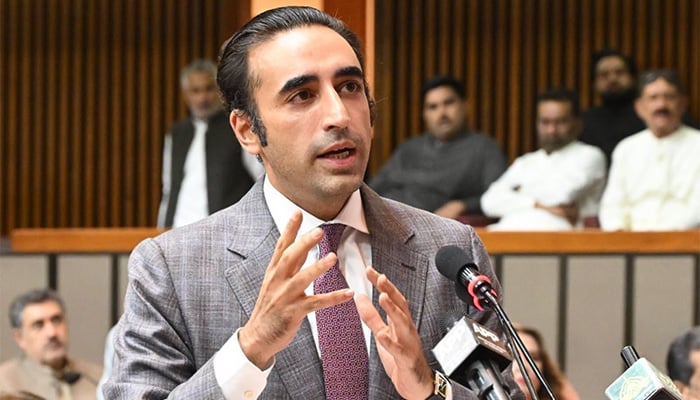
Pakistan Peoples Party (PPP) Chairman Bilawal Bhutto-Zardari said on Thursday that the federal government and provinces had mutually agreed to share the burden of "unusual national necessities", adding that beyond the three-year financial arrangement, the Centre would not request any further help from the provinces.
"We have agreed with the government to contribute our share for the country's defence," he said while addressing the National Assembly budget session.
Bilawal, whose party is a key ally of the Pakistan Muslim League-Nawaz (PML-N) in the Centre, said the provinces' National Finance Commission (NFC) Award share remained protected and that beyond this decision, no further share or sacrifice would be demanded from them.
"The provincial governments have made sacrifices time and again… they are doing so today as well," he said, adding that multiple issues had been resolved through constitutional means in coordination with the federal government.
He maintained that provincial governments had repeatedly made sacrifices in the national interest and were continuing to do so even today.
He stressed that while the federation was facing economic difficulties, the provinces were also grappling with serious financial challenges.
Bilawal said that despite the 18th Constitutional Amendment, no province had been given its due share.
The PPP chairman warned that tax relief for the tribal districts was due to expire in 2026, while terrorism was continuing to inflict losses on the country.
He said the situation required collective responsibility and a united national response to address the challenges confronting the state.
Bilawal said the Khyber Pakhtunkhwa government also set aside its political differences and decided to contribute in the national interest.
He welcomed the Pakistan Tehreek-e-Insaf's decision on the floor of the House, saying it reflected a willingness to put national priorities above political considerations.
"If we continue to work in this manner for the national interest, we will be able to confront every challenge," Bilawal said, expressing confidence that political forces could overcome difficulties through cooperation and a shared commitment to the country's interests.
The PPP chairman called for the introduction of projects capable of strengthening the national economy, stressing that economic planning should focus on sustainable growth rather than short-term measures.
He urged policymakers to prioritise initiatives that could generate economic activity and improve the country's financial outlook.
"We take loans to pay back loans," Bilawal said, and warned that the country's financial model remained heavily dependent on debt and lacked the foundations required for long-term economic stability.
The PPP chairman also argued that development should not be confined to major urban centres.
Iran-US peace deal
After Iran and the United States signed a preliminary peace deal through Pakistan's mediation, Bilawal congratulated President Asif Ali Zardari and Prime Minister Shehbaz Sharif on efforts aimed at promoting peace in the region.
Bilawal also paid tribute to Chief of Defence Force (CDF) and Chief of Army Staff (COAS) Field Marshal Asim Munir and the armed forces, commending their role and services.
He said Pakistan fully understood the costs and consequences of war, having endured immense challenges and sacrifices over the years.
The PPP chairman said Pakistan had faced and resisted terrorism, gaining first-hand experience of the damage caused by conflict and instability.
The PPP chairman described the signing of the US-Iran memorandum of understanding as a historic development.
He said the agreement represented an important step forward and expressed hope that diplomatic engagement and dialogue would contribute to lasting peace and stability in the region.
"Whenever peace prevails, nations progress," Bilawal said, arguing that economic development and prosperity were closely linked to stability.
Bilawal warned that there were elements seeking to undermine peace and create instability. He also referred to threats from India regarding Operation Sindoor, saying such developments risked harming efforts aimed at maintaining regional calm and reducing tensions.
PPP to defend BISP
The PPP chairman strongly criticised elements targeting the Benazir Income Support Programme (BISP), calling the campaign against the initiative "regrettable and shameful".
He said the poverty alleviation programme earned global recognition in supporting vulnerable segments of society.
Bilawal said the prime minister had assured him that, despite propaganda against the programme, the government would continue to strengthen and expand BISP.
He welcomed the commitment, saying it reflected the importance of protecting welfare measures aimed at supporting the country's poorest citizens.
Bilawal argued that Pakistan could not achieve meaningful progress unless its underprivileged and marginalised populations also advanced.
Declaring his party's unwavering support for the initiative, Bilawal said that whether others chose to defend the programme or not, the Peoples Party would continue to stand by it.
AJK unrest
Bilawal expressed concern over the situation in Azad Jammu and Kashmir (AJK), saying there is growing unease over recent developments and political tensions in the region.
He said that those participating in protests should recognise that "enough is enough now, and they should stand down", adding that continued agitation in its current form would not lead to the fulfilment of their demands and would further deepen instability.
He stated that the government would not allow any further damage to the AJK, stressing that the government remains open to dialogue and has never refused engagement with the protesting groups at any stage.
He urged the protestors to separate extremist elements from within their ranks, warning that their current methods of protest were counterproductive.
The PPP chairman further said that the actions being taken by protesters were damaging both Pakistan's international reputation and the broader Kashmir cause.
He alleged that the "Modi–Netanyahu nexus" is working against Pakistan, while reiterating that political solutions remain possible through peaceful and constitutional means rather than confrontation or escalation on the streets.
Bilawal also stated that an agreement with the Jammu Kashmir Joint Awami Action Committee (JAAC) was 80% complete, but noted that one of the demands had now become controversial and more difficult to resolve under current circumstances.
He categorically said that the issue of migrant seats cannot be compromised and stressed that the matter of migrant representation and seats could not be settled through threats or sit-ins.
Bilawal insisted that the issue must be resolved through negotiation and legislative procedures within a legal framework.
He further said that the issue involved equal rights of the JAAC, the Muslim Conference, and other political parties, and that all stakeholders must be taken on board to reach a workable consensus.
Bilawal concluded that efforts must be made to build agreement involving the Muslim Conference and the Muslim League, so that a consensus is achieved ensuring migrant representation is not compromised, while ultimately emphasising that "Kashmir will decide Kashmir itself".
Upon his party's victory in Gilgit-Baltistan, Bilawal said that the people of GB had placed their trust in his PPP by giving them 11 seats. He described the outcome as a decisive electoral mandate that demonstrated continued support for the party in the region.