Tesla drums up buzz for driverless Cybercab with 'no steering wheel, no pedals'
'A storm of Cybercabs' wrote Tesla CEO Elon Musk
Published September 04, 2026
Tesla has teased fans with a driverless Cybercab featuring ‘no steering wheel, no pedals' ahead of a big reveal that sent social media into a frenzy.
Tesla announced free rides of its ambitious Cybercap in “limited areas of Austin" on Thursday, September 3, 2026.
Tesla first teased its fans with a post on X (formerly called Twitter), writing “no steering wheel, no pedals," a nod to the company’s upcoming Cybercab driverless vehicles.
Soon after, another post followed, offering riders to “try it out” in Austin, Texas.
These posts followed after an invite-only event was held in Austin on Thursday, September 3.
How was it impossible for Elon Musk to keep himself at a distance from this ambitious announcement?
So, Musk took to his X (formerly Twitter) and not only shared the post but also pinned it, captioned as "A storm of Cybercabs.”
Tesla, alongside the announcement, also updated its robotaxi portal, saying Cybercab rides were available only in some parts of Austin, drawing massive crowds.
Though much of the details as to how much fares would be charged, pricing, and routes remain under wraps.
Pierre Ferragu, a Wall Street analyst, along with Tesla fans who have shared clips featuring Cybercab hitting Austin streets, are making rounds on the internet.
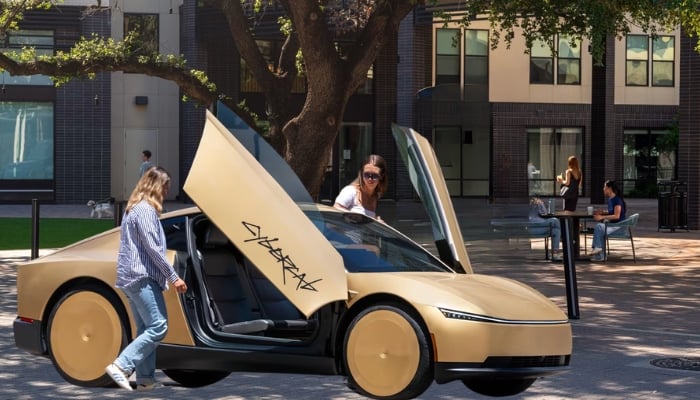
The “Cybercab” is a golden painted car with butterfly doors that hits the roads in Austin for restricted rides.
The Cybercap was first unveiled in a promotional video in October 2024, during the "We, Robot" event by Tesla.
The announcement led to Tesla stocks surging by 5.4% in regular trading on Thursday, September 3.
The electric auto maker manufactured the Cybercap as a driverless two-seater with butterfly doors that the company claimed will have no steering wheel or pedals.
Tesla presently markets cars with a system called FSD—short for Full Self-Driving (Supervised)—and requires a driver to remain at the wheel.
The Cybercap is being trialed under Tesla’s network of autonomous Model Ys.
Tesla has over 200 vehicles in its U.S. fleet that are registered as “unsupervised,” designed to function without a human behind the wheel at least within geofenced areas of select U.S. cities, per an independent third-party Robotaxi data tracking portal.