Ahsan Iqbal proposes SCO digital governance and AI capacity-building network
Planning minister calls for regional academy, digital infrastructure exchange, AI fellowships, and inclusive innovation facility
Published September 15, 2026
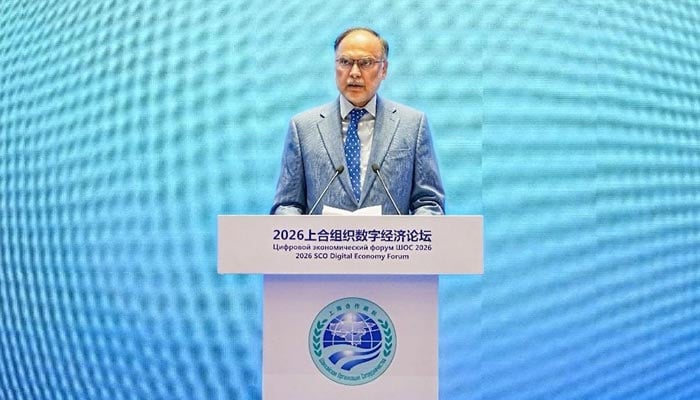
Federal Minister for Planning, Development and Special Initiatives, Professor Ahsan Iqbal, has proposed the establishment of an SCO Digital Governance and AI Capacity-Building Network to connect governments, civil-service academies, universities, national technology centres, research institutions and private-sector innovators across member states.
Delivering the keynote address at the Thematic Forum on Digital Governance and Capacity Building during the 2026 Shanghai Cooperation Organisation Digital Economy Forum in Urumqi, the minister said that the next frontier of transformation was not simply digitisation, but digital governance.
“Digitisation puts existing government processes online. Digital governance redesigns government around citizens, data, interoperability and outcomes,” he said.
“A paper-based bureaucracy cannot simply be transferred to a computer screen and called transformation. We must move from department-centric to citizen-centric government, from isolated databases to interoperable digital public infrastructure, and from reactive administration to data-driven and intelligent government.”
Iqbal said technology alone could not transform a state. Successful digital transformation required skilled people, capable institutions, adequate financial resources and governance arrangements that enabled the secure and responsible use of data and emerging technologies.
Highlighting Pakistan’s progress, he said digital transformation was embedded in the country’s national development agenda, Uraan Pakistan, through its E-Pakistan pillar. These priorities also converged with the Growth, Innovation, Green Development, Livelihood and Openness Corridors of CPEC 2.0.
He said the Digital Nation Pakistan Act 2025 had established the National Digital Commission and the Pakistan Digital Authority, providing clear institutional ownership of the country’s digital transformation.
The Digital Economy Enhancement Project was strengthening Pakistan’s digital public infrastructure and the Government’s capacity to deliver integrated, accessible and citizen-centred public services.
The minister said Pakistan was moving from AI awareness to AI adoption— and from adoption to measurable economic and social impact.
He informed the Forum that Pakistan’s National AI Task Force brought together government, academia, industry and technology experts across twelve thematic areas. The National Centre of Artificial Intelligence, operating through nine laboratories across six leading universities, had developed more than 220 AI products and designs for different sectors.
Pakistan had also set a target of developing one million AI-skilled non-IT professionals by 2030. Seven AI hubs were being established under the National AI Advancement Initiative, which would provide 20,000 training opportunities for graduates, teachers, public officials and industry professionals. Meanwhile, the DigiSkills programme had recorded more than 4.5 million enrolments.
“Digital capacity cannot remain confined to technology specialists,” Professor Ahsan Iqbal emphasised. “Ministers require digital leadership skills, civil servants must be able to work with data, regulators need to understand the systems they govern, and entrepreneurs require access to skills, mentors, finance and markets.”
Presenting Pakistan’s proposed framework for SCO cooperation, the Minister outlined five initiatives:
- An SCO Digital Governance Academy to train ministers, regulators, civil servants and municipal leaders in digital transformation, AI governance, cybersecurity, data management and citizen-centred service delivery.
- An SCO Digital Public Infrastructure Exchange to share experience, standards and adaptable solutions in digital identity, instant payments, electronic procurement, taxation, health, education and business registration.
- An SCO Fellowship for Digital Government and AI to facilitate placements and exchanges among young civil servants, researchers and technologists across member states.
- A Responsible AI and Data Governance Forum to promote cooperation on privacy, cybersecurity, algorithmic accountability, ethical AI and carefully governed cross-border data flows.
- An SCO Digital Inclusion and Innovation Facility to support capacity building, regulatory assistance and pilot projects for young people, women, underserved communities and institutions outside major technology centres.
Iqbal proposed beginning cross-border data cooperation with measurable pilots in trade and logistics, where digital integration could reduce transaction times and costs while increasing predictability. Cooperation could subsequently expand into agriculture, climate, health, research and industrial applications as institutional trust developed.
He stressed that SCO initiatives must be supported by measurable targets, including the number of officials trained, systems made interoperable, fellowships completed, joint projects launched and citizens gaining access to digital public services.
“Our cooperation must move from declarations to demonstrable outcomes,” he said.
Pakistan, he reaffirmed, stood ready to work with China and all SCO member states to translate this shared vision into measurable cooperation, inclusive development and shared prosperity.