Gaza occupation stabilisation
Be that as it may, so-called International Stabilisation Force is intended to do what Israel was unable to do despite genocide
Published December 24, 2025
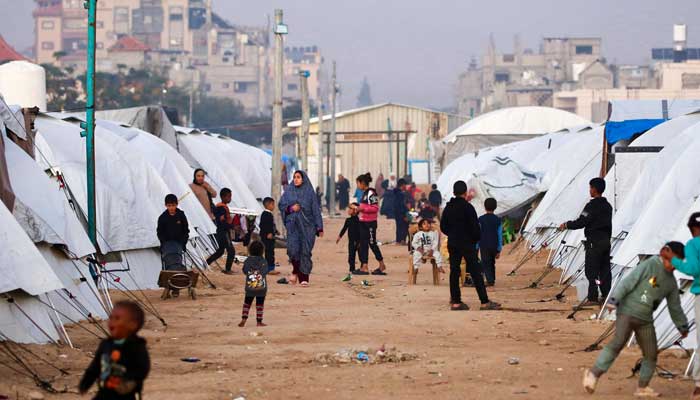
The Trump "stabilisation force" plan (referred to as the Plan), involving the use of troops from Muslim states, quickly morphed into the Trump-Netanyahu Plan ostensibly following a Trump-claimed Gaza ceasefire.
Sadly, many Muslim states succumbed to Trump's "charm" or pressure and went headlong into offering commitments to this Plan without even checking the fine print that was there after Netanyahu's rewrite of the Plan.
As the actual design of the Plan becomes clearer, many Muslim states have either hesitated or rejected any form of commitment. Pakistan has also been issuing cautionary statements regarding the Plan, primarily through Foreign Minister Dar and our envoy to the UN in New York.
I would also prefer not to believe US Secretary of State Rubio’s insinuation that Pakistan volunteered to commit its troops to the Plan on its own volition, given how Trump and members of his administration are prone to giving out disinfo and making grandiose claims.
However, be that as it may, the so-called International Stabilisation Force is intended to do what Israel was unable to do despite the genocide it has committed (and which continues to date) against the Palestinian people in Gaza — destroy Hamas, get all its "hostages" back and either slaughter or throw out the entire Palestinian people from Gaza.
So, first a "ceasefire" was declared by the US, but it never took effect as Israel continued and is continuing its bombings, its shooting unarmed Palestinians, including children, and preventing aid from reaching the survivors of the genocide.
Then it was proposed that an international military force from Muslim states, but under the command of Trump and Tony Blair (but his name was removed fast, given his Iraq legacy), be sent to disarm Hamas. So effectively this force would stabilise Gaza for Israeli occupation forces, who would not withdraw totally, and protect them from Hamas.
This is the real intent behind the International Stabilisation Force.
For Pakistan, this would be a total renegation of its principled position and policy on Palestine, plus possibly putting its troops in the direct line of fire of Hamas and even Israel. The fact is that right now there is no ceasefire in Gaza — and Israel is continuing its brutal occupation.
Nor does the Plan see an immediate withdrawal of Israel as the necessary first step if peace and stabilisation have to be established in Gaza as a start to the creation of a viable independent state of Palestine.
Going beyond the specifics of Gaza, Pakistan has always supported and been part of a UN-mandated and UN-commanded international military force for peacekeeping and peace enforcement operations. Pakistan has been a major contributor to UN peacekeeping since peacekeeping was added to the UN’s functions, following the inoperability of parts of Chapter VII of the UN Charter during the Cold War. At the same time, Pakistan opposed the Coalition of the Willing invasion of Iraq led by the US in 2003.
It is also a fact that such multilateral forces sent to conflict zones do not really work too well without UN cover and command. A case in point is the Multinational Force in Lebanon (MNF), deployed in 1982, comprising forces from the US, France, Italy and the UK.
It was unable to stabilise or bring peace to Lebanon after the 1982 invasion of Lebanon by Israel, and in 1984 this force was scuttled after the horrific 1983 suicide bomber attack on the Beirut barracks, killing over 200 American and 58 French personnel. This led to serious issues being raised about US policies in the region, as well as an aggravated conflict in Lebanon.
Closer to home in Afghanistan, we have an example of Nato trying to take over the 2001 UN-sanctioned International Security Assistance Force (ISAF), which was under UNSC through rotational command of the main contributing countries. Post-9/11, the UN Security Council, through Resolution 1386 (December 2001), had sanctioned the ISAF for Afghanistan.
As stipulated in the Bonn Agreement of December 2001, the progressive expansion of the ISAF to other urban centres and other areas beyond Kabul was duly approved through follow-on UNSC resolutions.
The US, clearly chafing under UNSC control, then did a sort of coup to have Nato replace ISAF in Afghanistan. It was not any UNSC resolution that sought Nato involvement. Instead, what is available on record is that Nato informed the UN secretary general, through a letter dated October 2, 2003 from its secretary general, that on August 11, 2003 Nato had assumed "strategic command, control and coordination of the International Security Assistance Force (ISAF)" – UN Document S/2003/970 Annex I.
This was followed by another letter from the Nato secretary general to the UN SG informing the latter of the North Atlantic Council’s agreement on a "longer-term strategy for Nato in its International Assistance Force (ISAF) role in Afghanistan". Both these letters were sent to the president of the UNSC by the then UN secretary general Kofi Annan on October 7 with the request that they be brought to the attention of the UNSC. So effectively, Nato presented the UNSC with a fait accompli.
Nato is a regional collective defence organisation and as such it needs to operate in the specific region of its membership since decision-making is restricted to this membership. In Afghanistan, it was seeking an out-of-area operation in which the country it was seeking to enter would have no control over its decisions.
That Pakistan, at the time, welcomed this move by Nato, was a major error and only aggravated the situation within Afghanistan and along the international Pakistan-Afghanistan border.
There is no legitimacy for any collective security organisation other than the UN with its universal membership. Article 51 of the UN Charter provides a very clear and limited framework for collective defence organisations. Also, under Article 53, there can be no action without authorisation of the Security Council except against an enemy state as defined in Article 53:2.
The MNF, the Coalition of the Willing and Nato in Afghanistan all show that efforts at peacekeeping, peace enforcement and even peace-making cannot be effective unless these are undertaken through UNSC consensus and, equally important, UN command.
We must learn from history, not repeat the mistakes. The present Trump-Netanyahu Plan is a non-viable starter, and Pakistan should have no part in it unless it is totally revised, beginning with a UN-supervised immediate, effective ceasefire and a complete Israeli withdrawal from Gaza.
The writer is a defence and security analyst.
Disclaimer: The viewpoints expressed in this piece are the writer's own and don't necessarily reflect Geo.tv's editorial policy.
Originally published in The News