Where free speech ends
Pakistan’s recent diplomatic demarche to UK should be understood, not as political posturing, but as lawful invocation of shared int'l and domestic legal obligations
Published December 30, 2025
Pakistan and the UK’s relationship has traditionally enabled candid engagement on sensitive matters within a framework of trust and mutual respect.
It is in this context that Pakistan’s recent diplomatic demarche to the UK should be understood — not as political posturing, but as a lawful invocation of shared international and domestic legal obligations.
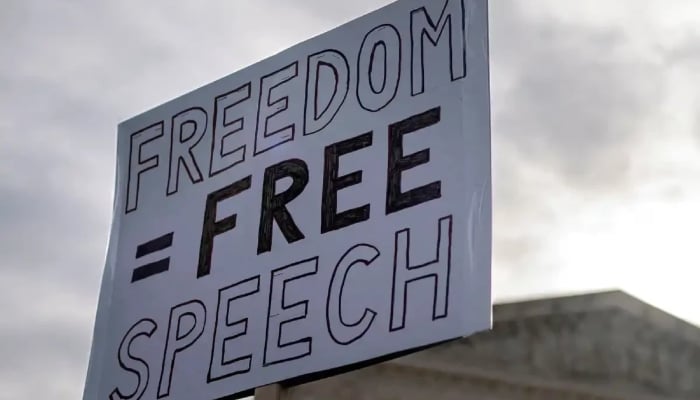
The issue is not an attempt to curtail free speech or political dissent. It concerns a sustained pattern of conduct originating from UK territory that Pakistan believes has crossed the legal boundary between protected expression and unlawful incitement. This includes coordinated disinformation, abusive and threatening rhetoric targeting constitutional institutions, harassment of diplomatic missions and, in some cases, explicit threats to public officials. International law and the domestic laws of both States distinguish lawful criticism from conduct endangering public order and security.
Pakistan has repeatedly raised these concerns through diplomatic channels, noting organised protests and digital broadcasts that go beyond isolated incidents. Amplified by online platforms and influencers, such narratives have destabilising effects, compelling any responsible State to respond.
International law is unequivocal. Article 19(3) of the ICCPR permits restrictions on expression when necessary to protect national security, public order and the rights of others. In contrast, Article 20 requires states to prohibit advocacy of hatred and incitement to violence. These safeguards preserve democracy.
The UK has embedded these principles in its domestic law. The National Security Act 2023 addresses foreign interference and hostile information operations. The Terrorism Acts of 2000 and 2006 criminalise encouragement and dissemination of terrorist narratives, while the Public Order Act 1986 and Communications Act 2003 regulate threatening, abusive and knowingly false communications. It is therefore legally untenable to suggest that conduct attracting scrutiny if directed at UK institutions becomes protected speech simply because its target is Pakistan.
A significant legal dimension concerns individuals holding dual nationality. Many of those involved possess Pakistani citizenship alongside UK nationality. Under settled principles of customary international law, a state may exercise criminal jurisdiction over its nationals for offences committed abroad, particularly where core state interests and national security are implicated.
Equally well established is the rule that a dual national cannot invoke diplomatic protection against his/her own state; in legal terms, such an individual owes constitutional allegiance and remains subject to domestic law.
Pakistan’s domestic legal framework expressly reflects these principles. Section 4 of the PPC extends criminal jurisdiction to offences committed by Pakistani citizens beyond territorial limits. Sections 121 and 121-A criminalise waging war against the state and related conspiracy, while Sections 505 and 506 penalise statements and threats intended to incite public mischief or fear.
In the digital sphere, Peca 2016 establishes a comprehensive regime: Section 10 addresses cyber-terrorism; Section 11 prohibits online hate speech and incitement to violence; Section 20 covers offences against the dignity of persons and institutions; and Section 1(4) provides for extraterritorial application where conduct is undertaken by Pakistani citizens or has effects within Pakistan.
At the same time, Pakistani law fully protects the right to dissent, critique governance and hold public office-holders accountable. That protection, however, does not extend to threats, calls for violence or coordinated efforts to destabilise constitutional institutions. Residence abroad does not dilute constitutional allegiance or legal responsibility.
Pakistan has recently taken the further step of formally requesting the extradition of certain individuals from the UK, supported by documentary material, digital evidence and clearly identified offences. These requests rest on due process and the principle of dual criminality.
While the independence of UK law-enforcement authorities is fundamental to rule of law, it does not displace state-to-state obligations under international law. The Corfu Channel principle prohibits states from allowing their territory to be used for acts causing serious harm to another state, while UN counterterrorism obligations require the prevention of incitement linked to violence.
Much of the conduct in question may also engage UK law itself. Pakistan’s demarche should therefore be understood as a law-based appeal to a trusted partner.
The way forward lies in measured, evidence-driven cooperation. Mutual legal assistance, enhanced law-enforcement coordination, timely digital evidence sharing and platform accountability under the UK’s Online Safety framework can help ensure that cross-border incitement and disinformation do not undermine democratic governance or public order.
Ultimately, the resolution of such cross-border challenges lies in the faithful application of international law and strengthened institutional cooperation. Instruments including the UN Charter, the ICCPR, the UN Convention against Transnational Organized Crime and binding UNSC resolutions impose clear obligations on states to prevent their territories from being used for incitement or acts prejudicial to another state’s sovereignty and security. These norms equally encourage enhanced Mutual Legal Assistance and coordinated enforcement responses.
At the domestic level, Pakistani authorities must continue refining the legislative and procedural mechanisms governing digital offences, including the effective implementation of Peca, the development of specialised cybercrime prosecution units and time-bound judicial processes to ensure expeditious adjudication without compromising fair-trial guarantees. Equally critical is structured engagement with global digital media platforms.
In this convergence of international law, domestic legal responsibility and institutional cooperation lies the sustainable path forward. Freedom of expression remains a foundational democratic value, but it does not extend to conduct that imperils public order, diplomatic relations or national security.
The writer is a practising advocate of the Supreme Court of Pakistan with 25 years of legal standing. He can be reached at: [email protected]
Disclaimer: The viewpoints expressed in this piece are the writer's own and don't necessarily reflect Geo.tv's editorial policy.
Originally published in The News