Economics of the solar boom
Rooftop solar is neither a luxury nor merely a green investment
Published January 03, 2026
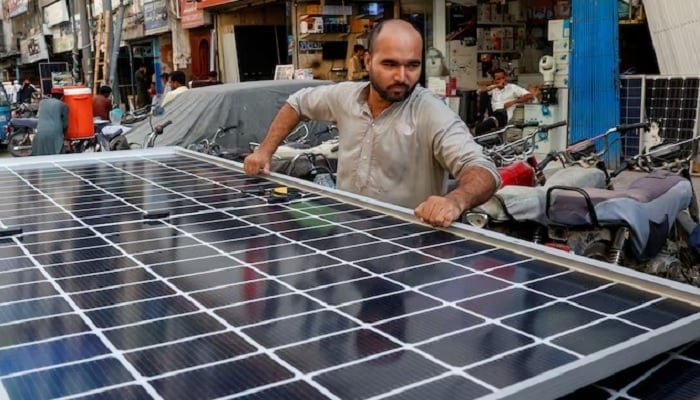
Pakistan’s ongoing solar boom is often explained through falling technology costs and abundant sunshine. This narrative is arithmetically correct but philosophically shallow.
A deeper explanation emerges when the phenomenon is viewed through the Life-Cycle Income Hypothesis, particularly in a context where formal consumption-smoothing institutions are weak, energy prices are punitive and households are compelled to internalise risks that elsewhere are socialised.
The immediate trigger lay beyond Pakistan’s borders: trade restrictions by the US and EU on Chinese solar panels created a global supply overhang that was rapidly diverted to alternative markets. Pakistan, with minimal tariffs and weakening grid economics, absorbed this surplus, driving prices down and pushing rooftop solar past a critical affordability threshold for middle-class households.
Yet geopolitics alone does not install rooftop panels. The decisive drivers are domestic and behavioural, and this is where the Life-Cycle Income Hypothesis becomes analytically instructive. In theory, individuals smooth consumption by borrowing when young, saving during peak earning years and dissaving in retirement, supported by pensions, insurance and stable utility pricing.
In Pakistan, this scaffolding is conspicuously absent. Pension coverage is limited, private retirement instruments are thin, health shocks are largely uninsured and electricity prices are volatile, regressive and prone to abrupt policy-induced jumps.
Under these conditions, rooftop solar is neither a luxury nor merely a green investment; it functions as a durable consumption-smoothing asset. Households are converting provident funds, gratuities, severance packages and retirement benefits into a physical hedge against future income and price uncertainty.
Rather than saving for retirement in financial instruments vulnerable to erosion, households save for retirement through solar energy by eliminating an unpredictable, recurring expense. The electricity bill is transformed into a largely fixed, front-loaded cost. This is life-cycle theory in practice, adapted under institutional stress.
This logic also explains why adoption is strongest among late-career professionals and early retirees. These cohorts face declining or fixed future incomes while rationally expecting electricity prices to rise. Investing retirement savings in rooftop solar is, therefore, a form of intertemporal arbitrage. In the absence of reliable pensions and predictable tariffs, the roof becomes the pension fund.
The role of Pakistan’s diaspora reinforces this dynamic. Remittances, traditionally treated as consumption support, are increasingly functioning as life-cycle capital transfers. Migrant workers, particularly in the Gulf, earn intensively for limited periods before returning home. For them, rooftop solar back home serves three functions simultaneously: a store of value anchored in a real asset, a reduction in future household expenses as remittance flows decline, and a visible signal of prudence. In life-cycle terms, diaspora-financed solar combines intergenerational and intertemporal smoothing, explaining its prevalence even in areas where incomes alone would not predict such investments.
Taken together, Pakistan’s solar boom is a decentralised household response to failures in the power sector and formal consumption-smoothing institutions. Excess supply from China lowered entry costs, but it was the life-cycle calculus of households, facing high tariffs, weak pensions and uncertain futures, that transformed cheap panels into a mass phenomenon.
What is striking is the policy response this transformation has triggered. Rather than interpreting rapid solar uptake as an economic signal that reveals distortions in tariffs, risk allocation and institutional credibility, policy planners appear to have defaulted to defensive reflexes. The instinct has been to curb or complicate rooftop solar through regulatory tightening, as if speed of adoption itself were the problem. This reflects fiscal fist-fighting rather than policy innovation.
Such measures may slow speculative exports, but they will not reverse the life-cycle logic driving solarisation. When households adopt solar primarily to hedge against future electricity costs rather than to earn from net exports, marginal regulatory tweaks cannot extinguish demand. As long as grid tariffs remain high, volatile and misaligned with income trajectories, solar will continue to function as a private consumption-smoothing instrument.
More importantly, treating solarisation as a policy problem risks missing a strategic opportunity. Pakistan’s power sector is trapped in a classic capacity trap: large, inflexible capacity payments spread over a shrinking consumer base, which drive tariffs higher and accelerate grid defections. Rooftop solar is not the cause of this trap; it is a rational household response to it. Suppressing that response addresses the symptom while deepening the disease.
If diagnosis is half the cure, the other half lies in policy imagination. Rather than doubling down on containment, Pakistan must pivot from regulatory reflexes to system design. The question is no longer whether solarisation can be slowed but whether it can be steered. It is at this juncture that policy must stop shadowboxing on rooftops and start working with the grain of household behaviour.
A more imaginative policy stance would reverse the framing altogether. Instead of resisting solarisation, policymakers should harness it as an innovative instrument to manage excess capacity, reduce peak-demand stress, and stabilise long-run system costs. Distributed solar, if intelligently integrated through tariff reform, aggregation and grid-service pricing, can become a system asset rather than a fiscal liability.
In effect, Pakistan already has a decentralised energy transition underway, privately financed, driven by life-cycle rationality and reinforced by diaspora capital. The choice facing the state is whether to proceed informally and adversarially, or strategically and cooperatively.
First, repurpose imported coal plants into grid-scale storage and flexibility hubs to mitigate the ‘duck curve’ and mitigate the capacity trap. Pakistan’s challenge is not a shortage of megawatts but a shortage of useful megawatts at the right time. Many imported coal assets, their switchyards, grid interconnections, land, security and skilled workforce, can be redeployed as flexibility platforms through phased coal-to-storage conversion, synchronous condensers for inertia and voltage support and hybridisation with nearby solar or wind.
The policy pivot must be from ‘pay me for being there’ to ‘pay me for balancing the system’: establish ancillary services markets and procure storage through competitive auctions focused on evening peaks. This allows midday rooftop solar surpluses to be absorbed and released during the high-tariff evening ramp, where economic, social, and political stress is most acute. In short, stranded thermal assets should serve as national shock absorbers, not national liabilities.
Second, deploy targeted solar as a smarter substitute for blanket subsidies under IMF discipline, particularly for protected consumers, by converting recurring fiscal leakage into a one-time social investment. If subsidy rationalisation is unavoidable, the political economy can be softened by shifting from ‘subsidising units forever’ to ‘reducing the units that need subsidising’.
A Solar-for-Protection programme, standardised solar kits, targeted through BISP, and feeder-level loss diagnostics can substantially reduce subsidy requirements while improving bill predictability. Done well, it also eases circular-debt pressures by shrinking subsidised consumption volumes rather than merely reallocating costs.
Third, catalyse green solar entrepreneurship as industrial policy rather than a retail afterthought, turning Pakistan from a dumping ground into a value-adding ecosystem. The objective is to localise jobs, skills, and after-sales reliability. This requires a Solar Skills-to-Enterprise pipeline: certified technician training, installer accreditation, and concessional working capital lines for SMEs that meet safety and quality standards.
Sensible localisation, mounting structures, cabling, protection equipment, and gradual inverter assembly should be encouraged without resorting to tariff walls that invite rent-seeking. The state’s role is to set standards and provide finance, not to pick brands. This will also curb the grey market and reduce safety incidents that often become pretexts for restrictive regulation.
Fourth, enable peer-to-peer (P2P) trading of surplus electricity so distributed solar becomes a feature of market design rather than an accounting irritant. If rooftop PV is here to stay, and it is, Pakistan should monetise its system value. Pilot P2P trading at feeder or microgrid level, with DISCOs as settlement operators: prosumers sell surplus locally at prices between export credits and retail tariffs, while paying transparent wheeling charges.
This keeps rents domestic, reduces technical losses by localising consumption, and converts “unwanted injections” into priced flexibility. Incentives align naturally: prosumers value timing and quality, consumers access cheaper power and DISCOs earn revenue from network services rather than policing self-generation.
Fifth, develop Virtual Power Plants (VPPs) by aggregating rooftop solar, batteries, and flexible loads into dispatchable capacity that the system can plan around. Pakistan’s distributed fleet is now large enough to matter; policy must make it legible to the grid. Licensing aggregators, mandating smart inverters and basic telemetry, and allowing VPPs to bid into capacity, reserve, and peak-shaving markets can transform fragmented household responses into a coordinated system resource.
For consumers, VPP participation improves payback even as export rates fall; for the grid, it delivers controllable peak reduction and ramp support, precisely what an inflexible generation mix lacks.
Put simply, Pakistan should stop treating solarisation as an administrative nuisance and start treating it as a policy instrument: a decentralised, privately financed pathway to ease the capacity trap, reduce subsidies structurally, create green jobs and add flexibility to a system that currently pays dearly for rigidity. The panels have already arrived at Pakistan’s doorstep; the question is whether institutions will keep shadowboxing on rooftops or finally learn to choreograph the dance.
In that sense, Pakistan’s solar boom offers a clear lesson in political economy. When formal consumption-smoothing institutions fail, households innovate. They do not wait for perfect policies; they install panels. The task of policy is not to fight this quiet rooftop revolution, but to align it with system-wide objectives, turning private prudence into public advantage and solarisation from an accounting headache into an exit strategy from the capacity trap.
Twitter/X: @Khalidwaleed_ Email: [email protected]
The writer has a doctorate in energy economics and serves as a research fellow at the Sustainable Development Policy Institute (SDPI).
Disclaimer: The viewpoints expressed in this piece are the writer's own and don't necessarily reflect Geo.tv's editorial policy.
Originally published in The News