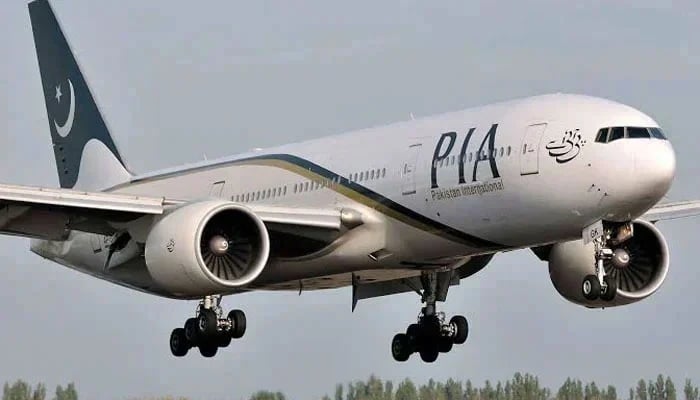
PIA's hollow billions
Pakistan's sale of PIA did not meaningfully change govt's balance sheet
Published January 10, 2026
The most misleading economic decisions are not dishonest. They are technically correct, structurally complex and publicly celebrated, yet deliver almost nothing a treasury can use.
If the government of Pakistan had announced that it received Rs10 billion from the sale of Pakistan International Airlines, the public reaction would have been appropriately subdued. Ten billion rupees does not appear to constitute reform. It does not appear to be fiscal courage. It does not even sound like a good year of damage control. So the government announced a different number instead: Rs135 billion. The difficulty, inconvenient as it may be, is that the first number is the one that matters. Public finance, unlike press conferences, has a stubborn attachment to cash.
The economically relevant question in any privatisation is disarmingly simple: how much money did the state actually receive that it can use to reduce debt, fund expenditure, or relieve fiscal pressure? By that standard, Pakistan’s sale of PIA did not meaningfully change the government’s balance sheet. What it changed was the narrative. Under the government’s chosen privatisation framework, only 7.5% of the winning bid is paid to the state in cash. The remaining 92.5% is contractually required to be reinvested in PIA as equity to stabilise operations.
Applied to the widely celebrated Rs135 billion bid, this yields approximately Rs10.1 billion in actual fiscal inflow. The rest never reaches the treasury. It cannot service debt. It cannot finance schools. It cannot even pretend to reduce the deficit. It stays inside the airline. To put this figure in context, Rs10 billion is fiscally microscopic.
Pakistan’s annual interest payments now exceed several trillion rupees; the amount received from the PIA transaction would not meaningfully cover even a few days of debt servicing. It does not alter the country’s borrowing trajectory, improve its credit outlook, or buy time in negotiations with creditors. In macroeconomic terms, it is a rounding error disguised as reform. The problem is not that the cash inflow was small, but that it was presented as large enough to matter.
At this point, it becomes useful to pause and translate the transaction into language that does not require an economics degree. Imagine selling your house for Rs135 million, but the contract specifies that you receive only Rs10 million, while the buyer must spend the remaining Rs125 million on plumbing, roof, wiring, and foundation. No accountant would record your income as Rs135 million. No economist would call you richer by that amount. You exited a liability. You were not paid. That is the PIA sale.
To be fair, this structure did not arise by accident. PIA could not be sold in its original form. The airline was deeply insolvent. Public disclosures placed its total liabilities at around Rs800 billion, far exceeding its assets. Before any buyer could be persuaded to step in, the government absorbed or restructured a large portion of this debt, estimated at Rs600 billion to Rs670 billion. Those liabilities did not vanish. They simply moved, from the airline’s books to the public’s.
Economists have a term for this sequence. It is called socialising losses before privatising control. It is not inherently irrational. Sometimes it is the least bad exit. But it does have an implication that should not be controversial: once the state has already paid the bill, the sale price should not be mistaken for profit.
This is where the discussion about competing bids becomes unavoidable, and also where the public conversation quietly lost its footing. Reported first-round bids included approximately Rs115 billion, Rs101.5 billion and Rs26.5 billion from Airblue. Airblue’s bid was rejected because it fell below the government’s reference price of roughly Rs100 billion. The rejection was portrayed as self-evidently sensible. After all, who would accept Rs26.5 billion when Rs135 billion is on the table? The answer, awkwardly, depends on whether one is counting cash or applause.
Airblue’s bid was all cash. Not structured. Not earmarked. Not recycled. Cash. Under the government’s own structure, the winning Rs135 billion bid delivers Rs10.1 billion in cash to the state. Airblue’s rejected bid would have delivered Rs26.5 billion in cash. In fiscal terms, the smaller bid would have paid the government more. This is not a matter of interpretation. It is arithmetic.
At this juncture, defenders of the deal retreat to a different claim: that cash to the government was never the primary objective. The real goal, they argue, was to recapitalise PIA and keep it flying. That argument may be coherent. But if that was the objective, then the transaction should be described honestly as a private recapitalisation with a change of control, not as a sale that strengthened the sovereign’s finances. These are distinct policy tools, evaluated by different criteria. Moreover, even under a rescue logic, the deal raises uncomfortable questions.
Capital injection alone does not guarantee turnaround, particularly in an industry as unforgiving as aviation. Airlines operate on thin margins, complex logistics and relentless foreign-exchange exposure. Ownership by a financial consortium does not magically create operational discipline. It must be purchased, learned, or imported, usually at considerable cost and with uncertain outcomes. An airline operator acquiring PIA would not merely have injected capital. It would have injected capability.
Network integration, fleet optimisation, pricing discipline, route rationalisation and speed of decision-making are not abstract virtues. They determine whether an airline earns revenue or incurs losses. From an economic-welfare perspective, this matters more than the nominal size of a bid that never becomes public cash. This is why serious economic evaluation relies on net present value, not headline figures. The correct question is not which bid looked largest on auction day, but which ownership structure maximised expected national benefit over time, accounting for fiscal inflows, foreign-exchange dynamics, and the probability of future bailouts. On that measure, the PIA sale performs poorly.
Pakistan’s central economic constraint today is sovereign liquidity and debt sustainability. A transaction that yields approximately Rs10 billion in cash does not materially affect that constraint, particularly when interest payments alone run into trillions annually. What the deal achieves is not fiscal relief, but fiscal invisibility.
None of this implies that PIA should have remained in state hands. That experiment failed, repeatedly and expensively. But there is a difference between exiting a failing asset and congratulating oneself for being paid when one was not. A transparent privatisation would have said the quiet part out loud: the government will receive limited cash, will shed operational responsibility, and will accept that most of the historical cost has already been borne by the public. That may still have been the right decision. What is not defensible is presenting a repair bill as a windfall.
The real danger is precedent. When headline valuations replace net fiscal outcomes, policy becomes performance. Over time, this blurs the line between reform and rearrangement, until governments mistake motion for progress.
Pakistan did not sell PIA for Rs135 billion. Pakistan repaired PIA with private money, transferred control and collected about Rs10 billion in cash. Until economic decisions are judged by net fiscal reality rather than ceremonial numbers, the country will continue to confuse transactions with reform. Public finance has little patience for illusions. Eventually, the balance sheet always speaks.
The writer is the director of the Centre for Law, Justice & Policy (CLJP) at Denning Law School. He holds an LLM in Negotiation and Dispute Resolution from Washington University.
Disclaimer: The viewpoints expressed in this piece are the writer's own and don't necessarily reflect Geo.tv's editorial policy.
Originally published in The News