‘Thing' from ‘Wednesday' comes to life as scientists build crawling robotic hand
Thing from 'Wednesday' gets robotic twin that walks, grabs, reattaches
Published January 21, 2026
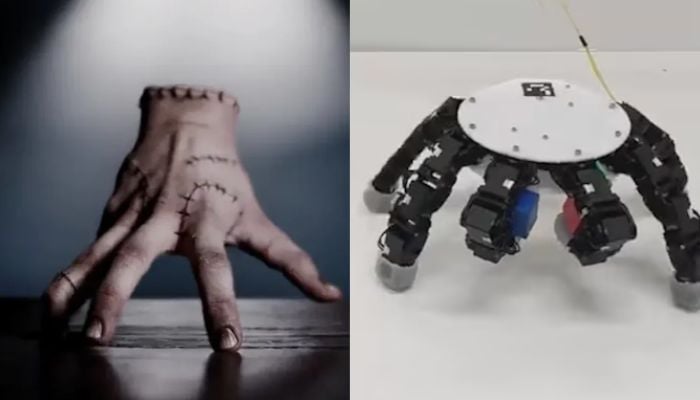
A team of roboticists has made a striking new invention that feels straight out of “The Addams Family.”
Scientists have developed a hand-shaped robot that can detach from its arm, crawl across surfaces, pick up objects, and then reattach itself.
The research, published in Nature Communications, introduces a radical rethink of what a robotic hand can do, and where it can go.
The robot has developed in collaboration with the Swiss Federal Institute of Technology in Lausanne (EPFL) and collaborators.
This silicon-and-motor-powered device resembles a mechanical version of “Thing” from the famous Netflix series “Wednesday.”
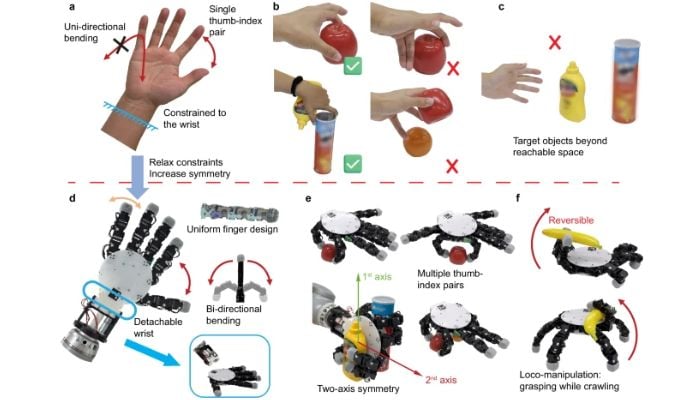
In contrast to conventional robotic hands modelled after the human form, this design rejects the constraints of the human design.
Its palm is circular and holds identical reversible fingers that can curve in both directions, enabling it to grasp objects from either side and even simultaneously.
Senior author of the study, Aude Billard, stated: “One of the problems with the human hand is its asymmetry.”
Human hands majorly rely on a single thumb and usually need awkward wrist movements to perform complex tasks.
On the contrary, this robotic hand enables any pair of fingers to act as opposing digits. This dramatically expands its range of grips.
One of the most unusual features of the robotic hand is its detachability. When released from the robotic arm, the hand transforms into a crawling robot, using its fingers as legs to scuttle into tight or hard-to-reach spaces.
Once it retrieves an object, it can return and reattach itself, seamlessly switching back into a conventional hand.
The design was further perfected using computer simulations before being tested in real life.
Applications of this technology include industrial inspection of pipes and engines, as well as service robots that can pick up dropped items.
The researchers also see the future of this technology in prosthetics and human-robot interfaces.
Although some experts have noted the limitations of grip strength and fine motor skills, many consider this achievement a breakthrough.
In fact, by thinking outside the box and not imitating nature but rather using it as an inspiration, the scientists may have paved the way for a new generation of more versatile and mobile robots.