NASA scientists baffled by mysterious deep-space signal detected 8 billion light-years away
The signal itself contains four distinct components
Published March 18, 2026
The National Aeronautics and Space Administration (NASA) scientists are baffled after receiving a mysterious signal from an unknown source in deep space.
A MeerKAT radio telescope in South Africa, featuring 64 antennas, detected the radio signal from a violently merging galaxy more than 8 billion light-years away.
According to the Daily Mail, the signal was detected to be a hydroxyl megastar, which is a giant last in space. A very strong signal of radio waves is generated after the collision of galaxies full of gas molecules.
The system dubbed HATLAS J142935.3-002836 is the most distant, nearly halfway across the universe, megastar ever detected by NASA.
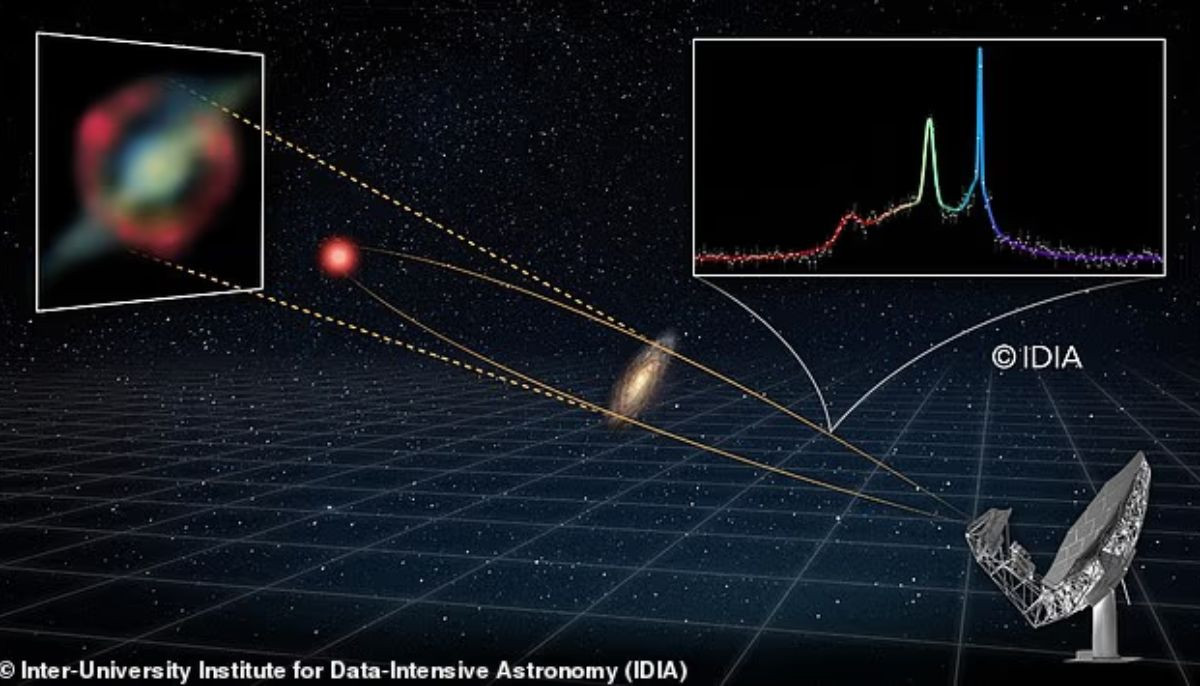
A postdoctoral researcher at the University of Pretoria Manamela explained that as the radio waves traveled toward Earth, they did not move through empty space alone. Instead, they were amplified by another galaxy positioned directly along their path.
“This galaxy acts like a lens, similar to a droplet of water on a window,” he said, adding, “Its mass bends the surrounding space-time and magnifies whatever passes through it.”
In simple terms, the radio signal was strengthened by what scientists describe as a cosmic telescope before it was detected by the powerful MeerKAT radio telescope, leading to what he called a remarkably fortunate discovery.
The signal itself contains four distinct components, suggesting it originates from multiple regions within the same galaxy system.
At least two of these regions appear to be strongly magnified by gravitational lensing, making the signal more than ten times brighter than it would normally appear.
This added amplification made it possible for the MeerKAT radio telescope to detect the signal, even though it comes from more than 8 billion light-years away.