India-US reset
India might no longer be insulated from the consequences of its geopolitical choices
Published February 01, 2026
The year 2025 marked a decisive reality check for Indian foreign policy. India's major partners recalibrated their engagement in ways that challenged New Delhi's narratives of strategic autonomy, diplomatic indispensability, and strategic exceptionalism.
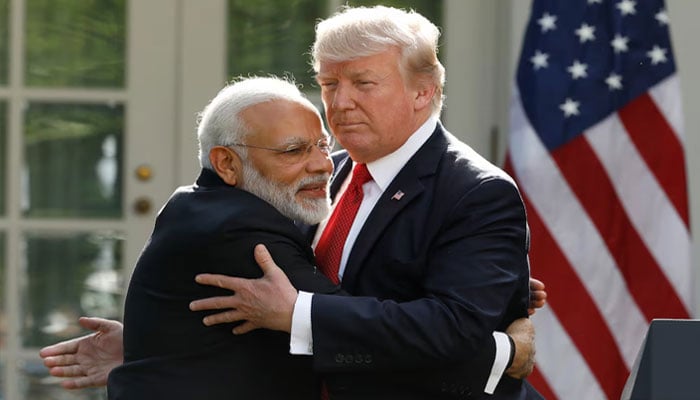
At the centre of this shift were frictions between India and the US in 2025. Some measures towards the end of the year, such as the October 2025 renewal of the ten-year Defence Framework Agreement and the Indian Prime Minister Narendra Modi's "warm and engaging" conversation with US President Donald Trump, fuelled speculations of a potential thaw in bilateral relations.
However, beneath the surface of cordiality, the relationship remains under strain. Since January 2025, New Delhi has discovered that proximity to Washington no longer comes with a free get-out-of-jail card. Unlike the prior Biden Administration, where Washington tolerated India's zero-sum agenda, the second Trump administration has adopted a more conditional and transactional approach.
This accountability has not taken the form of pressure on India to fulfil its geostrategic expectations as a "net security provider" in the region. Instead, it materialised as economic penalties and political holdback. In August 2025, the Trump administration imposed 50% tariffs, the highest applied on any US partners, along with tightened visa scrutiny affecting the Indian diaspora.
This directly struck two pillars of India's global self-projection: economic strength and diaspora influence. Together, these measures punctured New Delhi's narrative of being an inevitable alternative to China in global supply chains and investment flows. In fact, the Trump administration imposed more tariffs on India than on China.
It appeared that President Trump's tone on balancing trade with China further exposed the fragility of India's claims to be a viable alternative. Despite US-China geopolitical competition, Washington treated China as economically indispensable rather than replaceable. This indicated that Washington's trade pressure on India in 2025 was unusually severe compared to China.
While Washington called for India to "make trade fairer," these measures were perceived in New Delhi as "economic coercion," and many Indian analysts linked them to President Trump's dissatisfaction over the denial of credit for brokering the May 2025 India-Pakistan ceasefire. Regardless, these measures were a departure from past practices.
In the past, Washington and New Delhi have compartmentalised their economic, political, and geostrategic bilateral relations. A disruption in one did not meaningfully disrupt their strategic cooperation. Even with serious political controversies, such as the exposure of an Indian-linked assassination plot on US soil, the Indo-US relations continued as business. That firewall seemed eroded in 2025.
Washington's explicit linkage of punitive tariffs to India's continued purchase of discounted Russian oil has further narrowed India's room for manoeuvring in its pursuit of strategic autonomy. The issue of India's strategic autonomy has been a focus of attention in Washington since the Russia-Ukraine conflict began in 2022.
However, the post-May 2025 environment has exposed its limits. Reports that India reduced Russian oil imports after the tariffs highlighted that, when tested by economic costs, strategic autonomy could not sustain the burden. In 2025, India's assumption that a free oscillation between Washington and Moscow would persist proved increasingly flawed.
This is because neither Washington nor Moscow appeared willing to continue India's approach to balancing the multipolar world. New Delhi assumed that it had successfully diversified its relations with major global actors and it had a "menu of countries" to extract benefits from. When Washington sidelines New Delhi, it can turn to alternative partners such as Russia. However, major powers are more calculated now.
While the Trump administration has taken a firm approach towards India, Russia has confined its engagement to maintaining symbolic cordiality without offering concrete strategic or economic gains. President Vladimir Putin's December 2025 visit to India, though diplomatically warm, produced no major new agreements in defence, energy, nuclear cooperation, or space.
Even existing commitments, particularly the delayed delivery of the S-400 systems, remain unfulfilled, contributing to operational and financial setbacks for the Indian military. New Delhi fails to understand that the relationship with the US is not built on its interpretation of strategic exceptionalism, but rather on mutual accommodation. The US prioritises its own strategic and economic interests over a special and privileged partnership.
India's privileged relationship with the US provided it with substantial strategic traction, particularly through its entry into the Quad, which opened access to elite Western political and security platforms.
In 2025, India was scheduled to host the postponed 2024 Quad Summit following its much-touted G20 presidency. However, it appears that accumulating trust deficit and reputational damage from extrajudicial killings in Canada, and meddling in its domestic affairs, have led to further postponement of India being the host of the high-level summit. To date, the shattered confidence in India has not been restored to host the twice-postponed Quad Summit.
The Quad platform remains largely inactive as a result of India's miscalculation that it could act independently with major powers and their partners without consequences. This nullifies India's narrative of "multi-alignment."
Even as China's military build-up, both conventional and nuclear, continues, India has been unable to project itself as a credible counterweight. Instead, the setbacks suffered during the May 2025 conflict exposed significant weaknesses in India's military preparedness and strategic planning.
From Washington's perspective, India no longer appears to be a dependable balancer against China, but rather a constrained actor prioritising its own immediate interests over broader regional responsibilities.
What seemed more severe for New Delhi was the Trump administration's renewed engagement with Islamabad. While this did not reflect a tilt towards Pakistan, it did indicate that Washington is balancing relations with South Asian states, a process often framed through a zero-sum, India-centric lens that fails to recognise the region's geographic extent.
The post-May 2025 Indian aggression indicates that the region requires balancing rather than over-prioritisation. This balancing was also evident from the reported willingness of the US to potentially upgrade Pakistan's F-16 fleet.
For New Delhi, this measure indicated that 2025 altered regional strategic dynamics by eroding the presumed military primacy and the uncontested dominance of India in South Asia. For Islamabad, it is an indication of Pakistan's relevance as a prominent security actor in the region.
In 2025, Pakistan has reinforced its strategic anchor, international standing, practised restraint and maintained active diplomacy to create substantial advancements in Washington.
For India, this implied that 2025 was characterised by suspicion, reduced political trust, and a shift from unconditional partnerships to accountability-based engagement. Moving forward, it appears that India might no longer be insulated from the consequences of its geopolitical choices.
The writer is a research analyst in emerging technologies and international security based in the US. She tweets/posts @MaheenShafeeq
Disclaimer: The viewpoints expressed in this piece are the writer's own and don't necessarily reflect Geo.tv's editorial policy.
Originally published in The News