The mirage of growth
Current projections place Pakistan’s total exports of goods and services in FY2025-26 at roughly $40-41bn
Published February 04, 2026
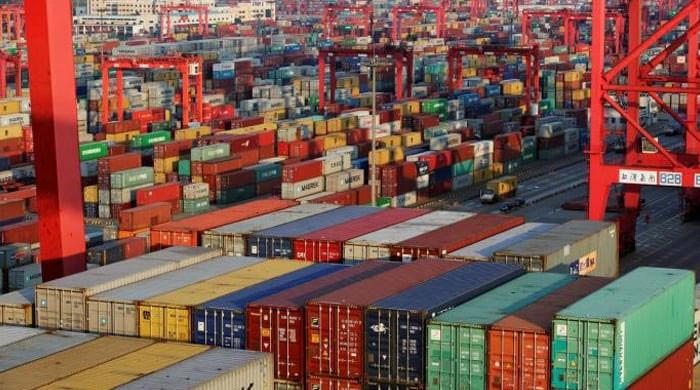
The rhetoric around reaching $100 billion in exports by 2030 is closer to wishful thinking than credible strategy. Current projections place Pakistan’s total exports of goods and services in FY2025-26 at roughly $40-41 billion, with merchandise exports around $32 billion and services close to $8-9 billion.
That baseline is being weakened further by recent performance: in the first seven months of FY2025-26, merchandise exports declined, with July 2025-January 2026 shipments falling to about $18.2 billion, nearly 7.0% lower than a year earlier, widening the trade deficit by 28.2%. Even textiles and food exports — long the backbone of the export economy — have underperformed amid rising costs and intensifying global competition.
Against this backdrop, Prime Minister Shehbaz Sharif has announced a package of incentives aimed at easing cost pressures on industry, including a roughly Rs4 per unit cut in industrial electricity tariffs, reductions in wheeling charges, and a sharp cut in export refinance rates to around 4.5%. These measures may provide temporary relief, but on their own they are unlikely to alter Pakistan’s export trajectory in any meaningful way without deeper structural reform.
Even taking the $40-41 billion export figure at face value, the arithmetic is unforgiving. Reaching $100 billion by 2030 would require sustained annual export growth of more than 25% in dollar terms, every year, for the rest of the decade. Pakistan has never achieved anything close to this pace, even during periods of favourable global conditions, macroeconomic stability, or ample external financing.
Absent a radical transformation in productivity, urban infrastructure, industrial clustering and export competitiveness, the $100 billion target remains aspirational rather than credible. It may sound persuasive in policy speeches, but economics is not moved by slogans. Without structural reform, this is less a strategy than a sandcastle.
At the heart of this disconnect lies a deeper problem. Pakistan’s ambition of export-led growth sits uneasily with a reality the state has long avoided confronting: the country is far more urban than its politics, planning frameworks and fiscal structures are willing to admit. This gap between how Pakistan actually lives and how it is officially governed is steadily eroding productivity, deepening inequality and weakening the foundations of growth.
Official census figures continue to classify only 38%-39% of Pakistan’s population as urban, based on administrative boundaries drawn decades ago. This framing obscures the scale of demographic change underway. A large and growing share of Pakistanis now live in dense, built-up settlements that function economically and socially like cities but remain officially labelled ‘rural’. These areas absorb migrants, host non-farm employment and shape labour markets, yet fall outside municipal governance, urban investment and political attention.
The much higher estimates of urbanisation, often cited as close to 88%, do not rely on census definitions. They reflect the application of the Degree of Urbanization methodology, an internationally endorsed framework that classifies settlements based on population density, clustering and built-up land rather than administrative labels. Under this lens, roughly half of Pakistan’s population lives in high-density cities, with much of the remainder in moderately dense towns and urban clusters that operate as extensions of metropolitan economies. These are not villages in any meaningful economic sense, even if they continue to be governed as such.
This distinction matters because export-led growth is fundamentally an urban process. Manufacturing clusters, logistics networks, skilled labour markets, services exports and female workforce participation all depend on functioning cities. Pakistan’s failure to recognise and govern its de facto urbanisation has turned what should have been an economic advantage into a structural constraint.
Across Punjab, Sindh and Khyber Pakhtunkhwa, agricultural land has steadily given way to unplanned sprawl. Real estate speculation has often proven more profitable than investment in export-oriented industry, distorting incentives and locking capital into unproductive assets. The result is an urbanisation model that rewards land accumulation rather than productivity.
Karachi illustrates the problem starkly. It remains the country’s principal export hub and revenue generator, yet suffers from chronic under-governance. Fragmented authority, weak metropolitan institutions and minimal reinvestment have produced vast informal settlements where labour is abundant but human capital formation is limited.
Lahore, Faisalabad and Gujranwala face similar pressures, albeit with better infrastructure and equally weak planning discipline.
Economically, the contradiction is clear. Urban areas generate the bulk of output, services exports and tax revenue, yet receive inadequate investment relative to their population and economic weight. Informality dominates employment, particularly for migrants, women and youth — the very groups an export-oriented economy must absorb productively. After years of decline, poverty has begun to edge back up following floods, inflation and fiscal tightening, exposing the fragility of urban livelihoods.
The persistence of a large agricultural workforce is often cited as evidence against widespread urbanisation, but this is a false dichotomy. Dense towns and peri-urban zones reflect mixed economies, where agriculture increasingly coexists with services, construction, manufacturing and trade. Mechanisation, remittances and rural infrastructure have steadily reduced dependence on subsistence farming, even as official classifications lag behind economic reality.
Environmental stress further compounds these challenges. Air pollution in major cities imposes heavy health and productivity costs, while groundwater depletion, heat stress and flood risk increasingly threaten industrial zones and transport corridors. Climate adaptation is now central to urban resilience and export competitiveness.
Politically, however, Pakistan remains anchored in a rural imagination. Electoral incentives reward patronage over planning and land distribution over labour productivity. Despite the promise of devolution, meaningful fiscal and administrative authority remains concentrated at federal and provincial levels, leaving local governments weak, underfunded or intermittently suspended. Urban voters are mobilised rhetorically but governed reluctantly.
This avoidance carries risks. Large, under-serviced urban populations are not only economically underutilised but also politically volatile. Recent protests have shown how quickly urban discontent can translate into national instability. Ignoring these constituencies while relying on remittances, consumption and repeated stabilisation cycles is a holding pattern not a growth pattern.
If Pakistan is serious about export-led growth, urban reform must move from the margins to the centre of economic policy. That begins with acknowledging the true scale and nature of urbanisation, using globally comparable standards rather than administratively convenient ones. Fiscal transfers must follow people and productivity, not outdated boundaries. Cities need empowered metropolitan governments with authority over land use, transport, housing and climate resilience.
A credible National Urban Policy would align housing, mobility, skills development and industrial zoning with export objectives. It would discourage speculative land hoarding, prioritise affordable housing near employment centres and integrate informal workers into the formal economy. Public-private partnerships can help, but only with transparency and regulatory discipline.
Pakistan’s urban transition is already underway. Whether it becomes a platform for sustained export growth or a drag on economic stability will depend less on demographics than on political courage. Avoiding the issue has costs the country can no longer afford.
The writer is former head of Citigroup’s emerging markets investments and author of ‘The Gathering Storm’.
Disclaimer: The viewpoints expressed in this piece are the writer's own and don't necessarily reflect Geo.tv's editorial policy.
Originally published in The News