Hope won't get us jobs
WB President Banga’s insistence that job creation be treated as central outcome of policy is correct and long overdue
Published February 19, 2026
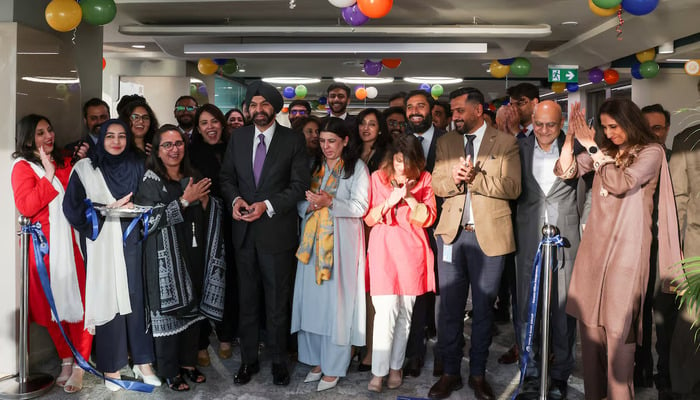
When the president of the World Bank, Ajay Banga, warned that Pakistan must create 25-30 million jobs over the next decade, he was doing more than offering a headline-grabbing number. He was identifying the country’s single most binding economic constraint.
Banga’s insistence that job creation be treated as the central outcome of policy — the ‘north star’ — is correct and long overdue. It is also welcome that the World Bank’s Country Partnership Framework envisions approximately $4 billion per year, with a stronger emphasis on outcomes and private-sector mobilisation.
But diagnosis and financing are only the starting point. The harder, and persistently avoided, question is this: how will these jobs be created when the World Bank itself says Pakistan’s growth model is broken, and when the macroeconomic framework in place is designed largely to balance books rather than build an economy?
Unless this contradiction is confronted directly, Pakistan risks repeating a familiar cycle: fresh inflows of external finance absorbed by an unchanged system, rising debt, headline ‘stability’ and a growing gap between economic numbers and lived reality.
The World Bank’s country diagnostics are unambiguous. Pakistan’s economy is structurally uncompetitive. Exports are far too small for a country of over 250 million people. Firms face high and volatile energy costs, excessive and poorly designed taxation, distorted tariffs, weak contract enforcement and unpredictable regulation. Productivity growth is anaemic. Private investment remains chronically low. Firm entry and scaling are limited.
This is not a cyclical slowdown awaiting a return of confidence. It is a structural failure. Yet policy responses continue to assume that growth will automatically reappear once short-term macroeconomic ‘stability’ is restored. Pakistan has tried this repeatedly. Stabilisation without transformation has produced neither durable stability nor sustained growth. Instead, it has delivered a recurring pattern: austerity, brief improvement in headline indicators, rising unemployment and poverty — and eventual relapse into crisis.
It is politically convenient to frame the problem as one of insufficient funding. Funding has indeed been a serious constraint. External inflows have been volatile, domestic savings have been weak and fiscal space has been narrow. But this is only half the truth. The more uncomfortable reality is that whatever funds Pakistan has mobilised have too often been wasted.
Fragmented programmes, politicised allocation, weak execution and near-total absence of accountability have turned scarce resources into activities rather than outcomes. Roads were built without fixing logistics. Power plants were added without reforming distribution and governance. Skills programmes were launched without jobs to absorb trainees. The result is a growing stock of assets that fail to generate productivity, exports or employment.
This collision of funding constraints with governance failure explains why Pakistan continues to oscillate between stabilisation and crisis, while failing to build an economy capable of creating mass, productive employment.
It is important to be precise. Pakistan has rarely produced coherent, implementable national economic strategies with political ownership, institutional alignment and accountability for results. What it has produced instead are plans and policy documents that struggle to survive political transitions and bureaucratic fragmentation.
The deeper problem is incentive design. The state is organised around inputs, approvals, and control, not outcomes. Budgets define spending, not impact. Ministries are judged by utilisation rates and project counts rather than by job creation, export expansion or productivity gains. Federal and provincial planning are poorly aligned and mostly contradictory. Development spending can appear large in aggregate yet deliver little because it is fragmented and misdirected.
As Planning Minister Ahsan Iqbal articulated, Pakistan suffers from a severe coordination deficit. Every rupee that flows through an uncoordinated system becomes a potential source of duplication, leakage or capture. Fixing this deficit requires more than procedural reforms. It demands a whole-of-government approach anchored in shared priorities, outcome-linked budgeting, empowered coordination, and credible monitoring.
A revealing comparison is this: countries that escaped middle-income traps invested as much effort in fixing how governments make decisions as they did in building roads, ports and power plants. Pakistan has largely done the opposite — investing in visible hardware while neglecting to fix the institutional framework that turns inputs into outcomes.
This governance failure is compounded by a deeper policy contradiction. While the World Bank diagnoses a broken growth model and calls for job-creating, private-sector-led expansion, Pakistan’s macroeconomic framework under programmes with the IMF has focused narrowly on fiscal balance.
Fiscal and current account deficits have been reduced primarily by shrinking the economy rather than by improving competitiveness. Revenue targets have been met through imposing high and regressive taxes, punitive petroleum levies, and ever-higher extraction from a shrinking formal sector. External adjustment has been achieved through import compression driven by high interest rates and suppressed demand, not through export expansion.
This is not an adjustment through productivity but through contraction. Even more troubling is that the ‘books’ being balanced are themselves distorted. Pakistan still relies on cash-based accounting, which obscures assets, liabilities, arrears, guarantees and future obligations. Timing manoeuvres allow artificial surpluses to be reported. So while scorecards track fiscal targets, Pakistan is neither fixing the books in a balance-sheet sense nor building an economy capable of creating jobs.
An economy cannot generate three million jobs a year while capital is crowded out by government borrowing, firms are taxed into retreat, energy costs destroy competitiveness, and policy uncertainty raises risk premiums beyond viability. A broken model cannot be repaired by applying greater force.
The persistence of this model is not accidental. Incentives explain it.
Pakistan’s policy environment systematically rewards incumbency. Powerful political actors, protected firms, and entrenched cartels survive behind tariffs, para-tariffs, discretionary subsidies, preferential credit and regulatory barriers. These privileges create vested interests that resist reform with remarkable effectiveness.
The result is a two-tier economy: inefficient incumbents serving sheltered domestic markets, and a narrow band of exporters — often in low value-added activities — that struggle to scale. Consumers pay higher prices. Workers face fewer opportunities. Productivity stagnates, but rents persist.
Any serious attempt to deliver jobs at scale must confront this political economy. Protecting inefficiency is economic sabotage. Jobs are not created by compliance with fiscal targets. They are created by firms that invest, expand, export and innovate. That requires access to finance, competitive energy, predictable regulation, skilled labour and growing markets.
A macroeconomic framework that treats growth as a risk and private enterprise as a tax base cannot coexist with a jobs agenda. The contradiction between a ‘broken growth model’ diagnosis and a contraction-led stabilisation programme explains why Pakistan keeps meeting targets and missing its future.
Banga is right that the World Bank is “in the business of hope”. But hope alone will not create 30 million jobs. Without confronting the disconnect between growth diagnostics and macroeconomic policy, Pakistan will continue to balance distorted books while shrinking its productive base.
Pakistan now faces a stark choice. It can continue to manage decline through accounting optics and the protection of the status quo. Or it can redesign its political-economic architecture to reward productivity, competitiveness and enterprise. The first path perpetuates crisis. The second is hard — but possible.
In a subsequent article, I will outline the governance, political economy and policy framework that Pakistan must build if it is serious about creating a competitive economy capable of delivering jobs at scale.
The writer is a former managing partner of a leading professional services firm and has done extensive work on governance in the public and private sectors. He can be reached out @Asad_Ashah on X.
Disclaimer: The viewpoints expressed in this piece are the writer's own and don't necessarily reflect Geo.tv's editorial policy.
Originally published in The News