What happened to Karachi?
Karachi once embodied economic dynamism, cultural openness, intellectual confidence and a degree of civic order; today, that promise lies fractured
Published February 20, 2026
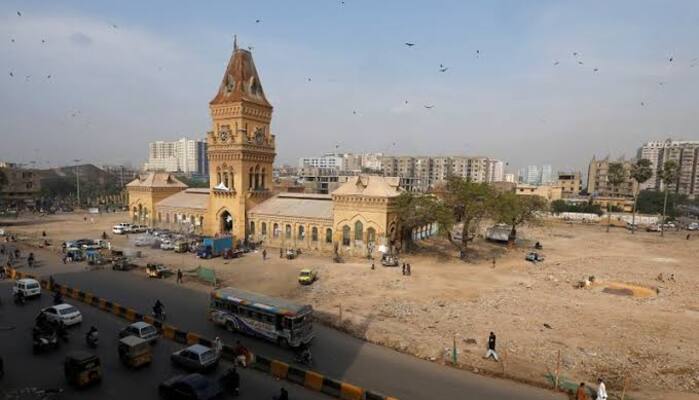
Once upon a time, Karachi was not just a city but a promise — a place where people could dream of opportunity, dignity, mobility and social ascent. The City of Lights was not a metaphor but a lived reality. Karachi once embodied economic dynamism, cultural openness, intellectual confidence and a degree of civic order. Today, that promise lies fractured. Broken roads, illegal billboards, trembling bridges, stagnant drains and a governance system stripped of competence define the city. At the root of Karachi’s decay is institutional failure.
I first visited Manora Beach in 1997. It was serene, clean and dignified. When I returned in 2026, it felt unrecognisable. The white sand was buried under encroachments, garbage floated between fishing boats, stray dogs roamed freely, and the sea itself seemed abandoned. The beach remains, but its spirit is gone. This is Karachi in miniature: assets, authority and budgets coexisting without purpose. The tragedy is magnified by scale. Karachi, a megacity of over 20 million, generates nearly 25% of Pakistan’s GDP, over half of federal tax revenue, most maritime trade, and 40% of formal employment. Yet its infrastructure is collapsing. Roads are fractured, sewage runs into streets and the sea, and bridges like the Mauripur flyover visibly tremble.
Karachi possesses a rich, humane, socially tolerant, and diverse culture, shaped by generations of migrants from across Pakistan who came to work and survive. Food and employment remain accessible across income groups. The city’s tragedy is not poverty. Labour is abundant, resilient and inexpensive. Unemployment rarely becomes existential because informal work almost always exists. Nearly 45% of Karachi’s economy operates informally, sustaining millions while remaining outside taxation, regulation and urban planning. Around 35% of the population lives in informal settlements, often without clean water, waste disposal or reliable electricity. The crisis, therefore, is not survival but aspiration. Law and order in Karachi is also widely misunderstood. Crime exists in all major cities. Karachi is not uniquely violent by global standards. Phone snatching and street crime plague London; New York struggles with organised retail crime and stabbings; Paris regularly witnesses urban unrest and antisocial behaviour.
Karachi’s deeper problem is systemic absence. Traffic management is missing, urban master planning is weak, enforcement is inconsistent and accountability is virtually nonexistent. The human cost is devastating. Independent road safety assessments record over 600 traffic fatalities annually, with motorcyclists accounting for 55%. Pedestrians and cyclists die crossing highways without footbridges, speed enforcement, protected lanes or freight restrictions. These are not accidents but administrative failures. In functioning cities, road safety is treated as a public health issue. Karachi’s tragedy is not incapacity, but the absence of institutions judged by outcomes.
Another painful symbol is Nahr-e-Khayyam. Envisioned as a green urban waterway, it could have become Karachi’s public corridor of ecology, mobility and leisure, like Cheonggyecheon or the Thames embankment. Instead, it became a stagnant sewer of embarrassment. Karachi currently treats less than 15% of its sewage, discharging the rest directly into the environment. Solid waste generation exceeds 12,000 tons per day, much of it dumped openly. Air pollution regularly exceeds WHO safety limits by three to four times. Yet, the solution is straightforward: professionally designed filtration and treatment plants, continuous water circulation, cycling tracks, regulated recreation zones, landscaping, pedestrian walkways, lighting and cafés.
Encroachment is another major hurdle in the governance and provision of services to the city, where enforcement remains selective. Courts intervene (Nasla Tower demolitions), bulldozers arrive to illegal markets occupying highways, chaos briefly retreats and then returns stronger. A dysfunctional governance system is not a new phenomenon. London is governed by the Greater London Authority (GLA), with an elected mayor who holds direct accountability for policing, transport, housing, and climate policy. In 2000, Mayor Livingston modernised London through initiatives such as congestion charges and underground infrastructure. While New York has integrated IoT traffic systems, data policing, and smart utilities, New Delhi and Mumbai were once similarly dysfunctional but addressed this issue through master planning by international urban firms that integrated transport, zoning, utilities and housing.
Another example is Singapore, which has empowered its citizens through the Urban Redevelopment Authority (URA), a single authorised body that governs land use, transport corridors, housing density, environmental resilience and infrastructure financing. Although the situation perhaps may still not be ideal in these cities, they have made their cities functional and operational, with their systems continually evolving towards sustainability.
Karachi, however, cannot be governed as it operates under fragmented authorities, overlapping mandates and without a metropolitan command structure — 60% falls under varying authorities, and only 40% comes under the elected mayor. The model is ungovernable due to the division of power, with very little scope for accountability and responsibility. There is a similar paradox in the education system: Karachi has Pakistan’s best private schools and universities, with elite students achieving a 90% literacy rate that competes globally, whereas in informal settlement areas, literacy rates struggle at 55% and remain locally trapped. Perhaps, the city is not divided by wealth, but by access. Funds are not the problem, as Pakistan earmarks billions annually in development budgets; the problem lies in misalignment: schemes sanctioned without targets; contracts awarded to those without competence; infrastructure built without maintenance planning; corruption that steals, but incompetence is more destructive.
Ultimately, a single empowered metropolitan authority, modelled on Singapore’s URA or London’s GLA, with a new discipline of devolution into small administrative zones with elected councils. This body could synchronise varying authorities and agencies under an integrated metropolitan framework, with legal authority over zoning, utilities, transport and enforcement.
The city can be transformed within a decade if traffic management is addressed through intelligent traffic systems that use real-time data, mandatory GPS, and speed limiters for heavy vehicles. A separate freight corridor outside urban arteries. Fire services are trained to international standards and enforce health and safety standards without exception. Public dashboards for water, waste, transport, and emergency response would also promote transparency and performance. These are not political ideas, but managerial principles, as cities and systems are not built by slogans, nostalgia or rhetoric. They are built on governance, devolution, accountability and planning.
Karachi possesses extraordinary strength, with communities and people who are resilient, adaptive and entrepreneurial. Its workforce is young and dynamic, and its food culture can compete with any global standard. It’s a tragedy that a city that should be exporting talent, innovation and industry instead exports frustration. Hope is compromised in Karachi, and so is its future. When citizens stop expecting improvement, then decay becomes permanent and dysfunction becomes normal. The choice is there: either become a governed metropolis or remain an unmanaged settlement of millions. The funds exist, so does the expertise, but what’s missing is the courage to prioritise competence, systems and governance. Karachi does not need speeches or rhetoric but institutions and governance worthy of its people.
The writer is a political economist, public policy commentator and advocate for principled leadership and regional cooperation across the Muslim world.
Disclaimer: The viewpoints expressed in this piece are the writer's own and don't necessarily reflect Geo.tv's editorial policy.
Originally published in The News