AI is coming for Pakistan's freelancers. We need to talk about it!
Over 2.3m Pakistanis earn their living online; $3.8bn in IT exports
Published February 23, 2026
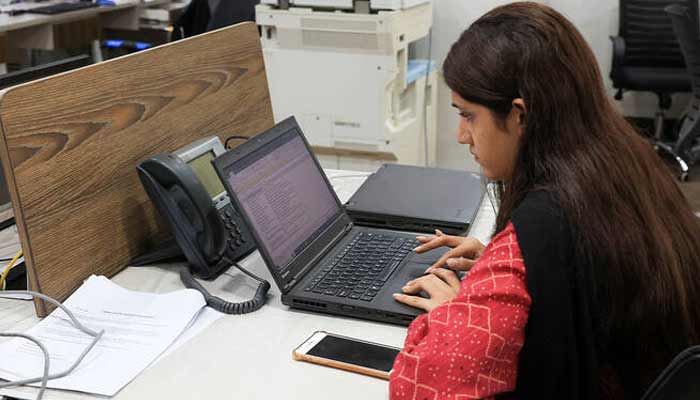
Count the families behind those numbers. The mother in Multan doing graphic design from home because she can’t leave the house. The 23-year-old in Faisalabad sending Upwork money to three siblings. The fresh grad in Lahore who skipped every other career path because freelancing paid better than anything else at entry level.
AI is coming for all of it
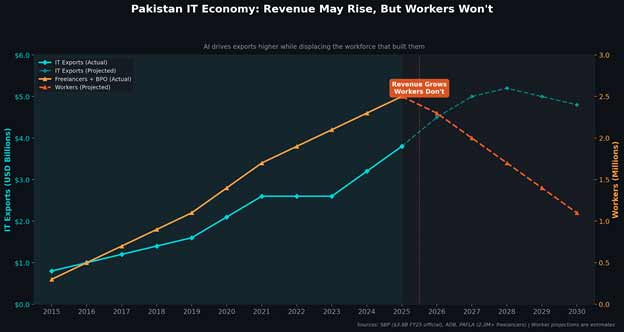
Let me show you what’s already happened
Klarna launched an AI assistant in February 2024. First month: 2.3 million conversations handled. The work of 700 full-time agents. Resolution time dropped from 11 minutes to under 2. A projected $40 million in profit improvement for the year.
That wasn’t a pilot. That was a replacement
By May 2025, Klarna’s CEO admitted they had gone too far. Quality had dropped. They began rehiring human agents. But here is the part that matters for Pakistan: they did not rehire 700. They brought back a fraction, mostly as gig workers. The jobs did not come back at the same scale. They never do.
Dukaan’s CEO announced in July 2023 that AI replaced 90% of their support staff. First response time went from 1 minute 44 seconds to instant. Costs down 85%.
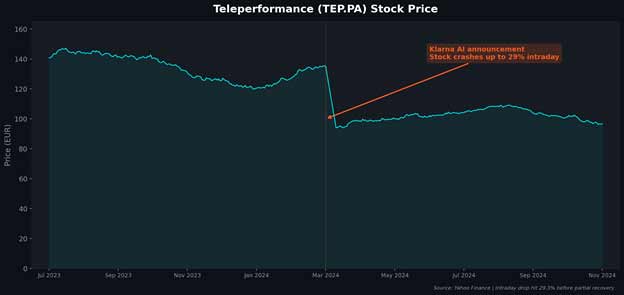
Teleperformance, one of the world’s largest BPO employers, lost up to 29% of its stock value in a single day after the Klarna news. It hit a seven-year low. The market had already priced in what was coming.
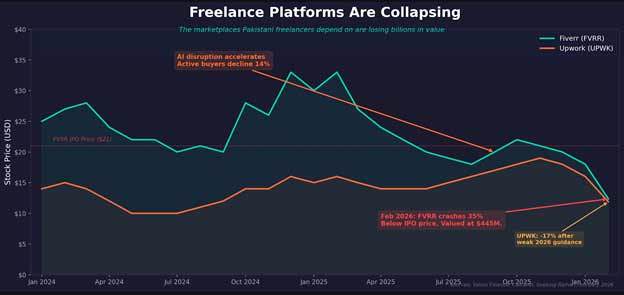
And it’s not just the companies that hired freelancers. The platforms they work on are collapsing too
Fiverr, the marketplace where millions of Pakistani freelancers sell their services, has lost over 60% of its stock value in the past twelve months. As of February 2026, it trades at $12.35 per share, below its 2019 IPO price, and is valued at just $445 million, barely above its own cash reserves. The company laid off 25% of its workforce and its CEO declared a return to “startup mode.” Active buyers on the platform dropped from 3.6 million to 3.1 million in a single year. The reason is simple: businesses that used to hire freelancers for design, writing, and coding are now using AI tools instead.
Upwork tells a similar story. The stock dropped 17% in a single day after its Q4 2025 earnings call, where the company projected a decline in Gross Services Volume for 2026. Active clients fell 6% year-over-year. Both companies are trying to pivot toward AI-enabled services, but the damage to the traditional freelance marketplace model is already done.
These are not abstract stock charts. These are the two platforms that built Pakistan’s freelance economy. When their business models break, our freelancers are the first to feel it.
Now look at who we are.
We built our digital economy on exactly the jobs AI disrupts first.
Content writing. Graphic design. Virtual assistance. Data entry. Video editing. Customer support.
These are not fringe activities. They are the bread and butter of over 2.3 million Pakistani freelancers, the backbone of our entire digital export story.
A Pakistani graphic designer with five years on Fiverr told me she had a good run until early 2024. Since then, almost nothing. Clients are generating logos with Midjourney. Writing copy with ChatGPT. Doing in seconds what took her hours. She didn’t lose her work to someone cheaper in another country. She lost it to a $20 monthly subscription.
Researchers at Brookings found that freelancers in AI-exposed occupations have already seen a 2% decline in contracts and a 5% drop in earnings since the release of ChatGPT and image-generation tools in 2022 (Hui, Reshef, and Zhou, 2024). Not projected. Documented. Already happening.
The math that should keep you up at night
An AI tool costs $20 to $100 a month. Works 24/7. Never needs a PayPal workaround. Never goes offline during load shedding.
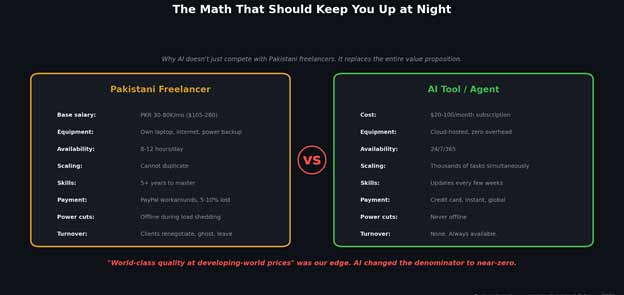
The value proposition of Pakistani freelancing was always world-class quality at developing-world prices. AI has changed the denominator to near-zero. The math no longer works.
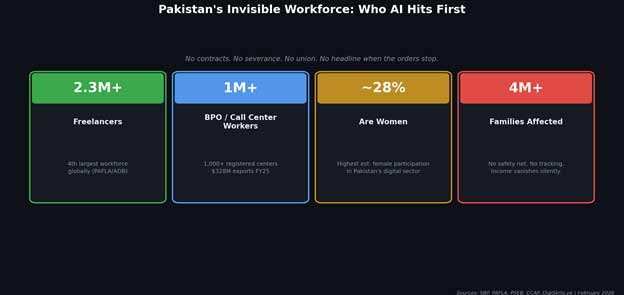
And unlike the Philippines, which has 1.8 million workers in formal BPO jobs with contracts and at least some institutional visibility, our 2.3 million freelancers are invisible. They work from bedrooms in Sahiwal and apartments in Karachi. No contracts. No severance. No union. When their orders stop coming, there is no event. No headline. No political crisis. Just quiet income loss, household by household, with no one tracking it.
Who gets hit hardest? It is Pakistani women
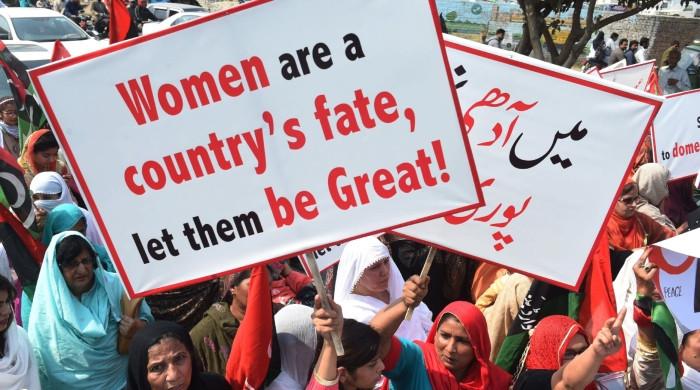
Freelancing was a revolution for women in this country. It allowed participation in the economy without leaving home, without navigating unsafe commutes, without fighting cultural barriers. Women make up roughly 28% of Pakistan’s digital skills trainees according to DigiSkills.pk, and some industry surveys estimate female representation in freelancing at even higher levels. In a country where overall female labor force participation sits at just 22%, freelancing became the single most powerful vehicle for women’s economic inclusion. AI doesn’t just threaten their earnings. It threatens the most promising path to female economic participation we have built in a generation.
The average affected freelancer is 22 to 30 years old. Supporting a family. No pension. No savings buffer. When this income stops, there is nothing beneath them.
This is not anti-AI.
I have spent the past few years arguing that Pakistan must embrace blockchain, crypto, and AI as instruments of national economic transformation. I still believe that. Deeply.
But there is a difference between embracing AI and sleepwalking into its consequences.
Over 2.3 million Pakistanis and their families are going to feel this. Many are already feeling it. We need to convert our BPO centers into AI operations hubs rather than let them empty out. We need reskilling specifically for AI-adjacent roles: prompt engineering, workflow design, agent management. Not generic coding bootcamps. We need a transition fund with real money behind it.
The tipping point isn’t 2030. It isn’t even 2027.
It has already started.
We need to start talking about this. Now.
Sources & Citations:
IT Exports: State Bank of Pakistan (SBP), FY25 annual data: $3.8 billion. H1 FY26: $2.24 billion (+20% YoY).
Freelancer count: Pakistan Freelancers Association (PAFLA), 2.3 million+ active freelancers. ADB estimate: 2.37 million.
BPO/Call Centers: SBP/CCAP, $328 million FY25 exports (+24.6% YoY). 1,000+ PSEB-registered centers, 1M+ workers.
Klarna: Official press release, Feb 27, 2024. Reversal: Bloomberg, Fortune, May 2025. CEO admitted quality decline.
Dukaan: CNN, Fortune, July 2023. CEO Suumit Shah tweet and interviews.
Teleperformance: Bloomberg, Reuters, Feb 28, 2024. Intraday drop of 29.3% to 7-year low of EUR 94.28.
Fiverr: Calcalist, Yahoo Finance, Fast Company, Feb 2026. Stock down 35% YTD, 60% over 12 months. Active buyers declined from 3.6M to 3.1M. 25% workforce laid off Sep 2025. Valued at $445M, below 2019 IPO price.
Upwork: Yahoo Finance, Seeking Alpha, Feb 2026. Stock dropped 17% post-Q4 2025 earnings. GSV decline projected for 2026. Active clients down 6% YoY.
Brookings: Hui, Reshef, Zhou (2024). “Short-Term Effects of Generative AI on Employment.” 2% contract decline, 5% earnings drop.
Women in freelancing: DigiSkills.pk 2.0 data (28% female trainees). Overall female LFPR: 22% (World Bank/ILO).
Philippines BPO: IBPAP, 1.82 million workers in 2024. $38 billion revenue.
Pakistan IT targets: Uraan Pakistan vision, $5B by FY26, $10B by FY29.
Oxford Internet Institute Online Labour Index: Pakistan ranked 4th.
The writer is the chairman of the Pakistan Virtual Assets Regulatory Authority (PVARA).