Pakistan plans plastic reform: Its informal recyclers hold the key
Close to half of the country’s waste is handled by vulnerable informal recyclers, so how much can a national framework really do?
Published March 03, 2026
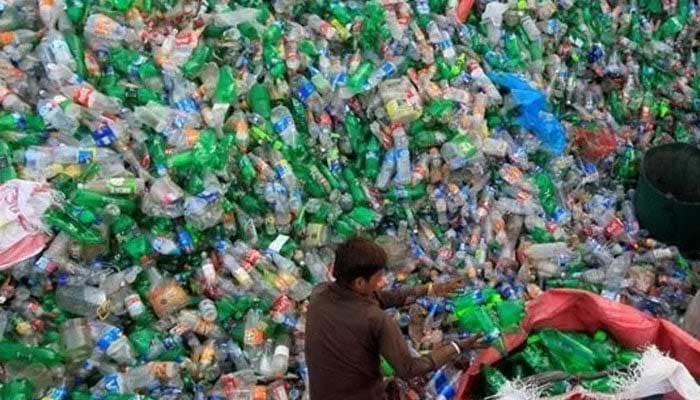
On a balmy winter day, Irfanullah Wahid and his cousin Faisal Asadullah amble through a maze of carts in Karachi’s Shireen Jinnah neighbourhood. They are young – only 11 and 10 years old respectively – and the white bags they carry are almost as tall as they are. They laugh and joke, but their eyes are peeled. Every few steps, they pause, bend, pick something up off the street and slip it into the bags.
Wahid collects only metal cans. Asadullah sticks to thick plastics.
Asadullah stops to pull out a flimsy plastic bag, commonly known as ‘shopper’ across Pakistan, stuck in the wheel of a cart. His practised hands rip it off with ease. “I don’t collect these”, he says, holding it up to show the difference with the sturdier material he rummages for.
Around him, there is scattered litter. Chips packets, sachets of shampoo and of saunf-supari (mouth freshener). Most are made of non-recyclable laminates which has no use for. “The kabadiwallah (recycler) won’t pay for this,” he says.
In Pakistan, about two million tonnes of plastic waste are generated every year and only 15-18% is recycled. Without urgent intervention, the country’s plastic waste is projected to reach 12 million tonnes by 2040.
This plastic waste will not lie inert in landfills. In cities like Karachi and Lahore, clogged drains will worsen urban flooding before plastics reach the Arabian Sea. They might fragment into microplastics, seep into soil, crops, water and human bodies. The routine burning of mixed waste will poison the air.
And as the scale of the problem grows, pressure is mounting to shift responsibility for plastic waste onto those who produce it.
Food and beverage companies, alongside NGOs, recyclers and leading packaging firms have formed what they call the CoRE Alliance. In 2025, it joined government representatives in calling for a national framework that shifts the cost of packaging waste from consumers to companies.
Known as Extended Producer Responsibility (EPR), the framework is designed to reduce waste through a product’s entire lifecycle. Businesses must pay producer responsibility organisations – which are yet to be set up – to collect, recycle and safely dispose of waste, all while meeting government transparency and safety requirements.
“The goal is simple: better plastic management today, lasting circularity for the future,” says Hussain Ali Talib, head of communications at a private firm.
And yet, while a unified national EPR is certainly a step forward, experts say any such framework must include the 200,000 to over 333,000 people working in Pakistan’s unorganised waste sector.
Dr Ayesha Khan, CEO of the Akhtar Hameed Khan Foundation, says that both producers and the government must recognise waste pickers and recyclers as “frontline partners” because they handle about 40% of Pakistan’s waste. “Without acknowledging this invisible force, EPR cannot succeed,” she says.
An invisible force made up of workers like Wahid and Asadullah.
A system built on informal labour
In Pakistan, the Indus is called many things: the Father of the Rivers, the Lion River. Its waters have fed civilisations both past and present. And yet today, one identity threatens to eclipse the rest. It is among the most plastic-polluted rivers in the world. In cities like Karachi, the river morphs into ‘islands of floating trash’: the flotsam including plastic, bottles and Styrofoam.
Plastic waste in the river is “overwhelmingly greater” in weight and proportion than any other type of waste, found a 2022 World Bank study, with single-use items making up one in every four plastic pieces. Nationally, Pakistan throws out 55 billion plastic bags every year, and rising.
Khan explained that in urban centres, a significant portion of waste is handled by informal waste pickers, many of them women and children, who operate in unsafe and unregulated conditions.
In Karachi, an estimated 40,000 pickers recover 500-1,000 tonnes of waste every day from the streets and informal dumping spots that municipal crews don’t reach. “Waste pickers are the invisible hands keeping our cities from becoming piles of waste,” says Khan. They work without protective gear; no gloves, masks or boots, and without any identification, contracts or health cover.
For some, solutions lie in localised models of intervention.
The Akhtar Hameed Khan Foundation, for instance, is testing what Khan describes as a “scalable pilot” in the city of Sahiwal, Punjab province, 1,000km from Karachi. Based in the low-income settlement of Bhutto Nagar, the initiative involves creating cooperatives of individual waste pickers, and linking them to the town’s municipal system and recycling markets.
Pakistan’s climate minister Dr Musadik Masood Malik tells Dialogue Earth: “I feel a rule-regime that supports the small and medium-sized recycling enterprises will not only rejuvenate the circular economy in the plastic centre, but it also makes good economic sense. If the rules are clear and consistent, enforcement will be easier.”
Why integration is harder than it sounds
Pakistan’s whole informal economy is vast, accounting for an estimated 59% of the country’s GDP, employing millions in work that exists largely beyond state oversight.
When it comes to waste, there are pickers, itinerant buyers and small-scale recyclers. Together they form a decentralised network collecting, sorting and reselling plastic and other materials. Yet this system operates in legal and economic precarity. Many workers lack formal identification, social protection or stable incomes. In fact their livelihoods depend on remaining outside regulatory systems that could expose them to taxation or eviction.
Many, like Wahid and Asadullah, are children. As policymakers and companies push for EPR, there is then a central question: how do you formalise a system whose survival has long depended on staying informal?
Parent companies of multinationals which already work with EPR models say buy in from “local counterparts” will be their biggest challenge. “Bringing them to the table will be the biggest challenge,” says Zia Naqi, CEO at SPEL, a manufacturer of plastic packaging and auto parts. “The cost of cleaning up waste will fall on the formal sector,” he adds, “squeezing ethical companies with higher costs and a tougher ease-of-doing business environment closely watched by investors.” SPEL is one of the 29 members of CoRE Alliance.
Khan says it is true that in the initial stages the burden will fall on the formal sector, but that as trust builds, the informal sector will see a shift towards sharing costs. “It’s a messy area. What needs to happen is alignment of incentives with climate-smart policies. Informal waste pickers are on the fringes and invisible. That is why we all must advocate and organise them,” Khan says.
Many experts say an inclusive approach would result in a stronger EPR framework. “We are striving for a Pakistan-specific EPR policy framework, based on best global practices, after which it can be legislated,” Waqar Ahmad, CEO of the CoRE Alliance, tells Dialogue Earth.
He emphasised that implementation must be practical, phased and coherent. “No company can recycle all its waste from the outset – it simply won’t work.” He suggests starting at “10% and gradually scaling up to 80-100% over the next 8-10 years,” allowing companies to build capacity and adjust under a harmonised framework across federal and provincial governments.
Policy on paper, reality on the ground
In neighbouring India, EPR frameworks were formally adopted in 2020, offering an early test of whether policy can shift responsibility for plastic waste onto producers.
Though India’s 2022 plastic packaging EPR guidelines were a positive step, weak enforcement meant polluters often continued to shun their responsibilities, according to an assessment by think-tank the Centre for Science and Environment. Nearly 59% of producers, importers, brand owners and manufacturers fell short on their targets on flexible plastic packaging – which includes shopping bags and sachets – the assessment found. In 2024, over 1,000 of them were issued a show-cause notice for not meeting their EPR targets.
Dharmesh Shah, who works in Kerala as a senior campaigner for the Centre for International Environmental Law, says there “remains a significant gap between policy intent and on-ground implementation”. Shah characterised India’s EPR policies as largely “myopic”, as they focus almost entirely on downstream interventions, managing waste after products have already been manufactured and placed on the market.
He emphasised that a core principle of EPR is product redesign and the elimination of poorly designed products. At present, he says, most EPR policies including the Indian framework do not “impose obligations on manufacturers to address these upstream issues.”
Shah however notes that India has been at the forefront of recognising the waste challenge and instituting EPR-based frameworks. “India is also engaged in ongoing discussions with the European Union on the circular economy, where EPR is a central pillar,” Shah says.
Back on the streets of Karachi, Wahid and Asadullah still have their eyes peeled. They still carry bags larger than themselves. From 8am until early afternoon, they walk through the city’s bylanes, collecting plastic and tin cans, earning just Rs70 (USD 0.25) for each kilogram. There is madrassa later, and sometimes more waste picking after that.
Neither is formally employed. Neither appears in official plans for managing the country’s plastic. Yet it is their labour that cleans up much of Pakistan’s waste, on which any effort to manage it will depend.
Zofeen Ebrahim is an independent journalist. She posts on X @zofeen28
This article was originally published by Dialogue Earth. It has been published on Geo.tv with permission