Centre seeks provincial share in targeted fuel subsidy amid price surge
Country's top leadership, including four chief ministers, scheduled to meet next week to take final decision on fuel prices
Published March 28, 2026
- Govt needs Rs300bn to provide targeted subsidy.
- Sufficient petroleum stocks available till May 10: ministry.
- Fuel prices to hover around $200 per barrel if crisis persists.
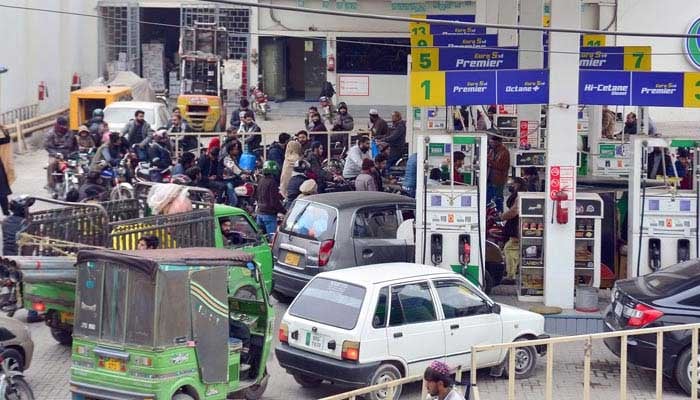
The federal government has asked provinces to set aside Rs154 billion from their NFC share for a potential fuel subsidy on two- and three-wheelers, as authorities weigh relief measures against rising global oil prices, The News reported on Saturday.
There are two options: one is to pass the impact of international oil prices on to the consumers, and the second is to provide a targeted subsidy for two-wheelers (motorbikes) up to 20 litres and three-wheelers 30 litres. For this, the government needs an amount of Rs300 billion for a four- to six-week period.
In this regard, President Asif Ali Zardari, Prime Minister Shehbaz Sharif and the four chief ministers are scheduled to meet next week to take a final decision on the escalated fuel prices.
The Ministry of Petroleum has informed the Centre and provinces that the country had sufficient fuel to meet the domestic requirements till May 10.
However, the fuel prices are projected to hover around $100, $150, and $200 per barrel if the Gulf crisis region persists over the coming weeks.
In a formal meeting, Adviser to the Khyber Pakhtunkhwa Chief Minister on Finance Muzammil Aslam said a smooth fuel supply was ensured, but the prices were showing a complex situation.
He said KP may ask the Centre to calculate the consumption of fuel by each province and then seek contribution from the provinces on the basis of actual data. The Centre asks the provinces to share the data of motorbikes registered with the excise authorities.
According to an official announcement made by the finance ministry, Federal Minister for Finance and Revenue Senator Muhammad Aurangzeb on Friday chaired a high-level consultative meeting on the petroleum products situation in line with the directions of the president and prime minister.
The meeting commenced with a detailed presentation by the Petroleum Division on the current status of petroleum products’ availability and noted with satisfaction that the fuel supply situation remained stable and adequate across the country.
The Ministry of Information Technology and Telecommunication also gave a comprehensive presentation on proposed technological solutions to facilitate a targeted subsidy mechanism for petroleum products, with a focus on transparency and efficient delivery.
The provincial leadership shared their views on the prevailing situation and policy options.
Sindh Chief Minister Murad Ali Shah appreciated the efforts of the federal government for maintaining uninterrupted fuel availability and emphasised the importance of behavioural measures to promote fuel conservation.
Punjab Senior Minister Marriyam Aurangzeb emphasised the need for developing multiple policy scenarios in response to the evolving petroleum price situation.
She stressed that any reduction in international petroleum prices should be effectively passed on to consumers and highlighted the importance of incorporating behavioural aspects into crisis management to ensure more sustainable consumption patterns.
Muzammil Aslam lauded the efforts of Federal Minister for Finance and Revenue Muhammad Aurangzeb and Federal Minister for Petroleum Ali Pervaiz Malik for effectively managing the oil supply situation.
He noted that Pakistan’s management of petroleum supplies had remained comparatively better than that of several countries in the region.
Balochistan Minister for Finance and Mines & Mineral Development Mir Shoaib Nosherwani also shared his views during the meeting.
The Finance Division briefed the participants on the fiscal situation and noted that limited fiscal space was available, primarily confined to revenues from the petroleum levy. It was emphasised that any relief measures needed careful calibration to maintain macroeconomic stability.
Aurangzeb underscored that the current situation should be treated as an opportunity to undertake structural reforms rather than a constraint.
He emphasised the importance of adopting data-driven decision-making, particularly in areas of taxation and subsidy design, to ensure transparency, efficiency, and better targeting of relief.
He also highlighted the need to promote responsible consumption behaviour and ensure that policy responses remain fiscally prudent while maximising relief for the public.
The participants agreed to expedite efforts to finalise a targeted subsidy framework using technological solutions, while ensuring continued coordination between the federal and provincial governments.
The IT minister informed the meeting that a QR code would be developed for providing subsidised fuel to two-wheelers. The government intends to procure 24,000 smart Android mobile phones, which will be used to provide a fuel subsidy App.