Fuel prices could keep rising for months even if Hormuz reopens, says US EIA
US Energy Information Administration hikes 2026 Brent price forecast by 22% to $96/bbl
Published April 07, 2026
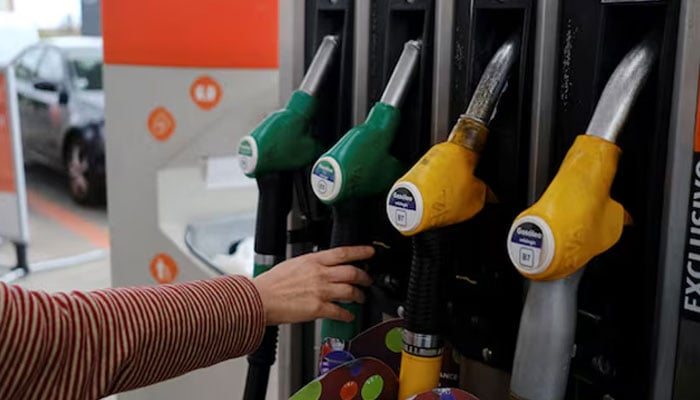
NEW YORK: Fuel prices could keep rising for months even after the Strait of Hormuz reopens, the US Energy Information Administration said on Tuesday, deviating from President Donald Trump's assurances that consumers will see immediate relief when the war with Iran ends.
The US-Israeli war with Iran, now in its second month, has sent oil and fuel prices skyrocketing around the world as Iran has blocked the Strait of Hormuz, a key trade chokepoint responsible for the transiting of one-fifth of the world's oil and gas.
Trump, whose approval rating dipped to new lows as pump prices surged to multi-year highs, has repeatedly told Americans that the sticker shocks will be temporary.
However, the US Department of Energy's statistical arm was less certain in its short-term energy outlook report. The agency now sees global benchmark Brent crude oil spot prices averaging $96 a barrel this year, up from the EIA's prior forecast of $78.84, and for both retail gasoline and diesel prices to keep rising.
The agency said full restoration of oil flows through the Strait of Hormuz will take months even after the war ends, keeping prices elevated until flows resume fully and Middle Eastern producers return to normal output.
"Just as we had never before seen the strait close, we've never seen it reopen. What exactly that looks like remains to be seen," the EIA said.
Trump has used incendiary language in his ultimatum to Iran to open the Strait of Hormuz by the end of Tuesday, suggesting "a whole civilization will die" if his demands are not met. Indirect talks between the US and Iran brokered by Pakistan have not produced a compromise.
"We maintain a risk premium on crude oil prices throughout the forecast period as we expect uncertainty around future supply disruptions to keep prices above pre-conflict levels," the EIA said.
US fuel prices to peak in April
US retail gasoline prices are likely to peak at a monthly average of $4.30 a gallon in April, and average more than $3.70 a gallon for the year, the EIA said in its short-term energy outlook series.
The US national average price of gasoline stood at $4.14 a gallon as of Tuesday, highest since August 2022, AAA data showed. Motor fuel prices could surge past $5 a gallon, threatening to take out the June 2022 record of $5.017 a gallon within weeks if there is no clear plan to reopen the Strait of Hormuz, GasBuddy analyst Patrick De Haan told Reuters last week.
Diesel prices, meanwhile, have been surging even more rapidly than gasoline as the Middle East is a key supplier of both the fuel and the crude oil grades that yield the greatest diesel volume upon refining.
The EIA said it expects diesel prices to peak at a monthly average of $5.80 a gallon in April, and average $4.80 a gallon for the year. Diesel peaked at $5.82 a gallon in June 2022 in the wake of Russia's invasion of Ukraine, according to AAA data. As of Tuesday, the average was $5.65 a gallon, according to AAA.
Global oil demand hit by Middle East conflict
The EIA on Tuesday also slashed its forecast for global oil demand growth to half its previous estimate due to reports of fuel shortages in parts of the world, and government initiatives aimed at curbing fuel usage and exports.
Global oil demand is now expected to grow by about 600,000 barrels per day to 104.6 million bpd, down from its prior forecast for growth of 1.2 million bpd this year.
"We assume reductions in demand occur primarily in Asia, which is more reliant on crude oil supplies from the Middle East," the EIA said.
Oil demand will rebound next year once supply flows return to normal later this year, the agency said. It expects demand growth to average 1.6 million bpd next year.