Vance says talks failed to reach deal with Iran on ending war
US vice president says any shortcomings in talks not due to Pakistan, which had “done an amazing job” in facilitating dialogue


- Vance says no deal reached; blames Iran for rejecting terms.
- US sets red lines; Iran unwilling to accept key conditions.
- Iran says progress made but key differences still remain.
ISLAMABAD: US Vice President JD Vance departed Pakistan on Sunday after announcing that intensive negotiations with Iran had failed to produce an agreement, despite more than 21 hours of discussions.
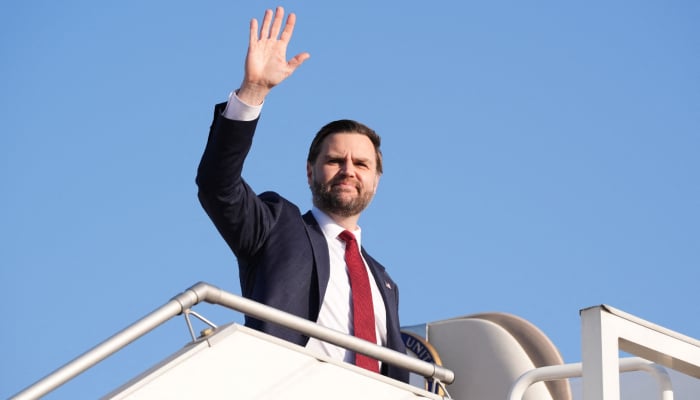
Vance boarded Air Force Two at 7:08am and waved to Pakistani officials from the top of the stairs. Deputy Prime Minister and Foreign Minister Ishaq Dar, Chief of Army Staff and Chief of Defence Forces (CDF) Field Marshal Asim Munir, Interior Minister Mohsin Naqvi among others were present on the occasion.
His departure came almost an hour after he addressed a press conference after the trilateral ‘Islamabad talks’, mediated by Pakistan, which continued for almost 21 hours after they began on Saturday afternoon.
During the press conference, Vance said talks with Iran lasted around 21 hours and covered a range of critical issues. “The bad news is that we have not reached an agreement, and I think that's bad news for Iran much more than it's bad news for the United States of America,” he added.
“We have made very clear what our red lines are, what things we are willing to accommodate them on and what things we are not willing to accommodate them on,” said Vance, adding that the Iranian delegation had “chosen not to accept our terms”.
At the outset of the presser, Vance thanked Prime Minister Shehbaz Sharif and Field Marshal Munir for their hospitality, acknowledging Pakistan’s efforts to bridge differences between Washington and Tehran.
He said any shortcomings in the negotiations were not due to Pakistan, which had “done an amazing job” in facilitating dialogue.
Responding to questions, Vance said Washington’s core demand remained an "affirmative commitment" from Iran that it would neither pursue nuclear weapons nor develop capabilities enabling rapid weaponisation.
“That is the core goal of the President of United States, and that's what we've tried to achieve through these negotiations,” he added.
He said the key issue remained a long-term commitment from Iran, stating: “Do we see a fundamental commitment of will for the Iranians not to develop a nuclear weapon, not just now, not just two years from now, but for the long term? We haven't seen that yet. We hope that we will.”
On the scope of discussions, Vance said: “We talked about all those issues... and we talked about a number of issues beyond that,” adding, “we just could not get to a situation where the Iranians were willing to accept our terms.”
He maintained that the US delegation had shown flexibility: “I think that we were quite flexible. We were quite accommodating.”
Vance said the team remained in close contact with Washington throughout the negotiations. “We were talking to the president consistently... a half dozen times, a dozen times over the past 21 hours,” he said, adding that they were also in touch with the wider national security team.
He said Washington was leaving Islamabad with what he described as its “final and best offer,” adding that it remained to be seen whether Iran would accept it.
Vance, special envoy Steve Witkoff and Jared Kushner met Iranian Parliament Speaker Mohammad Bagher Ghalibaf and Foreign Minister Abbas Araghchi for about two hours before a break, according to a source familiar with Pakistan’s mediation efforts.
The US departure came as a setback, after earlier indications that talks between the United States and Iran would continue despite remaining differences, with negotiations in Islamabad entering a second day and moving into a technical phase involving the exchange of written proposals.
In a post on X, the Government of Iran said another round of talks concluded after about 14 hours and that technical teams from both sides were now sharing detailed “expert texts” following high-level discussions in Islamabad.
"The talks will resume on Sunday after a break," it added.
It added that negotiations would continue despite outstanding gaps, signalling a shift into a more detailed drafting stage aimed at narrowing differences on key issues.
'US failed to gain Tehran's trust'
Iran's Parliamentary Speaker Mohammad Baqer Qalibaf, who led his country's delegation along with Foreign Minister Abbas Araqchi, blamed the US for not winning Iran's trust despite his team offering "forward-looking initiatives".
"The US has understood Iran's logic and principles and it's time for them to decide whether they can earn our trust or not," Qalibaf said on X.
“We certainly consider diplomacy of authority to be another method, alongside military struggle, for achieving the rights of the Iranian people, and we will not stop for a moment from trying to consolidate the achievements of the 40 days of Iranian national defence.”
He also thanked the efforts of “our friendly and brotherly country” Pakistan, for facilitating the process of the negotiations.
'No deal expected in one meeting'
Meanwhile, Esmail Baghaei, spokesperson for Iran’s foreign ministry, said that the Iran and the US have "reached an understanding on a number of issues" and that there were "differences of opinion on two to three important" matters.
“These negotiations were held after 40 days of imposed war and were held in an atmosphere of mistrust and suspicion. It is natural that we should not have expected from the beginning to reach an agreement within one meeting,” he said.
Earlier, Iranian state broadcaster IRIB reported that "unreasonable demands" by the United States scuppered talks in Islamabad to end the war in the Middle East.
"The Iranian delegation negotiated continuously and intensively for 21 hours in order to protect the national interests of the Iranian people; despite various initiatives from the Iranian delegation, the unreasonable demands of the American side prevented the progress of the negotiations. Thus the negotiations ended," IRIB said on Telegram.
On the other hand, Iran's Tasnim news agency citing an informed source said, "As long as the US does not agree to a reasonable deal, there will be no change in situation in Strait of Hormuz."
Various issues including Strait of Hormuz, nuclear rights have been among the points of contention in the talks, Iran's Press TV reported.
The conflict, which began on February 28 following coordinated US-Israeli strikes targeting Iran’s leadership and infrastructure, has resulted in more than 2,000 deaths and widespread regional instability. Tehran responded with retaliatory operations, including the disruption of shipping through the Strait of Hormuz and attacks on Israeli and US targets in the region.
A ceasefire was eventually announced on April 8, with Pakistan playing a central role in mediation. However, key disagreements persist. Washington has proposed a 15-point framework focusing on nuclear and missile issues, sanctions relief and reopening of the Strait of Hormuz, while Tehran has presented a 10-point plan seeking greater control over the waterway, transit fees, and comprehensive sanctions removal.
The international community has broadly welcomed Pakistan’s diplomatic role, backing its efforts to de-escalate tensions and facilitate negotiations aimed at achieving lasting peace.
Delegations from the two countries had arrived in Islamabad for the negotiations.
The high-powered American team, headed by Vice President JD Vance and comprising Special Envoy Steve Witkoff and President Donald Trump's son-in-law Jared Kushner, arrived in Islamabad on Saturday to participate in the negotiations.
Separately, a senior Iranian delegation led by Parliament Speaker Mohammad Baqer Ghalibaf also arrived in Islamabad ahead of the talks. The delegation includes Foreign Minister Abbas Araghchi, who is expected to play a key role in the negotiations.
PM vows mediation efforts
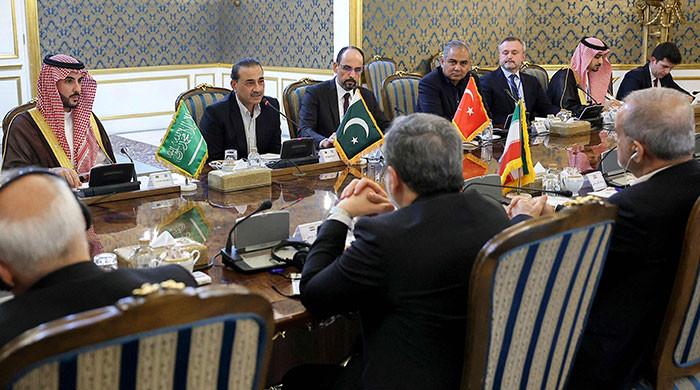
Late in the day, PM Shehbaz held a meeting with the Iranian delegation. The Iranian side was led by the Speaker of the Iranian Consultative Assembly, Mohammad Bagher Ghalibaf, assisted by Foreign Minister Abbas Araghchi.
Appreciating Iran’s engagement in the Islamabad Talks, PM Shehbaz affirmed Pakistan’s sincere resolve to continue playing its role as a mediator to help build momentum towards achieving meaningful results in the interest of regional and global peace and stability.
DPM Dar, Chief of Army Staff and Chief of Defence Forces Field Marshal Asim Munir and Interior Minister Naqvi attended the meeting from Pakistani side.
Ahead of the talks, Ghalibaf stressed that Washington must fulfil prior commitments, including easing restrictions on Iranian assets and ensuring a ceasefire in Lebanon, warning that progress would otherwise be difficult.
Vice President Vance expressed cautious optimism about the outcome but warned that any attempt by Iran to undermine the process would draw a firm response.
Shortly after the two delegations held separate meetings with PM Shehbaz, Iranian media said that negotiations with the US had begun, though the format of the talks remained unclear.
The Fars and Tasnim news agencies said "it was decided to begin negotiations" following "progress made during preliminary talks and the reduction of attacks” by to Israel.
Iranian agencies Mehr and Isna also announced the start of negotiations, after PM's Office said the peace talks had "commenced".
What's on the table?
As delegations from the US and Iran sit down for critical negotiations in Islamabad, a wide-ranging but complex issues are expected to dominate the discussion, The News reported.
Negotiations are structured around two competing proposals: a 10-point framework presented by Iran and a 15-point plan advanced by the United States. While both sides have expressed willingness to engage, significant differences remain.
At the heart of the negotiations is Iran’s nuclear programme. Washington is pressing for firm guarantees that Tehran will not develop nuclear weapons, alongside strict limits on uranium enrichment and intrusive monitoring by the IAEA.
Iran, however, is seeking recognition of its right to pursue peaceful nuclear activities, including enrichment, which it considers a matter of national sovereignty.
Economic sanctions are another central issue. Iran is demanding the immediate and complete lifting of all US and international sanctions, along with the release of its frozen financial assets abroad.
The US position differs sharply, favouring a phased easing of sanctions tied directly to verifiable Iranian compliance on nuclear and security commitments.
Control and access to the strategically vital Strait of Hormuz is also a major point of contention. Iran is seeking formal recognition of its regulatory role over the passage, citing its geographic and economic significance.
The US, on the other hand, insists on fully open and secure international shipping lanes without restrictions, given the strait’s importance to global energy supplies.
Regional influence remains a sensitive topic. Washington is pushing for an end to Iran’s support for allied armed groups across the Middle East, while Iran is demanding a halt to military actions against those groups and broader de-escalation in regional conflicts.
Iran has called for the withdrawal of US forces from the region and a formal guarantee of non-aggression. The US has not indicated a willingness to scale back its military footprint, citing security commitments to allies.
Another contentious issue is Iran’s ballistic missile programme. The US is seeking limits on missile development and broader defence capabilities, while Iran views such demands as an infringement on its sovereign right to self-defence.
Tehran has also raised the issue of compensation for damages resulting from recent conflicts, while the US is expected to push for accountability mechanisms addressing attacks on its interests and allies.