Napoleon's secret letter remained unsolved for 217 years, AI cracked it in six hours: Here's how
Six hours of AI processing helped in solving the 217 year old mystery
Published October 03, 2026
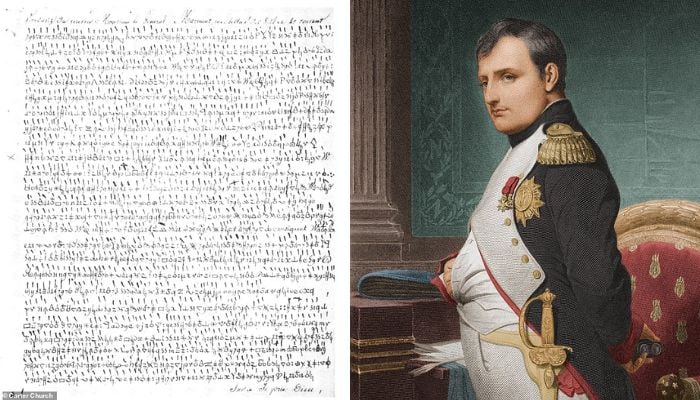
A man with no previous codebreaking experience has managed to solve a 217-year-old military cipher linked to Napoleon Bonaparte, with a little help from artificial intelligence.
Carter Church, an AI engineer at cybersecurity company SentinelOne, had never tried to crack a historical cipher before but after coming across the mysterious document, he decided to see what GPT-6 Astra could make of it.
What followed took about six hours of AI processing.
The document dates back to 1809, when Napoleon's France was preparing for another war with Austria. It was sent from the headquarters of Napoleon's stepson, Eugène de Beauharnais, to French General Auguste de Marmont. Napoleon had ordered Eugène to send Marmont the information in a cipher.
For more than two centuries, however, the message had no published complete reading.
Church started with a low-resolution scan of the coded document. It contained around 1,300 units made up of numbers, letters and unusual hand-drawn symbols.
The AI first had to work out what those symbols actually were before it could even begin figuring out what they meant.
It transcribed the document, tracked down a partial key previously compiled by cryptology historian Daniel Tant and then helped build a computer solver to work through the remaining symbols. Some of the symbols, it turned out, represented entire French words rather than individual letters.
There is one catch to the eye-catching six-hour figure.
That refers to roughly six hours of AI model execution, rather than the entire project being completed from start to finish in six hours. Church said his own involvement stretched across a few evenings.
And the secret itself was less dramatic than its 217-year wait might suggest.
The decoded message was essentially a military briefing, laying out the positions and strength of French and allied forces as tensions with Austria moved towards war. It also reassured Marmont that he should not be intimidated by enemy forces around him.
The solution was later reviewed by Satoshi Tomokiyo, who runs the historical cipher website Cryptiana, where the puzzle had been listed as unsolved. The cipher has since been marked as solved.