Who is Karl Deisseroth, Hegemann, and Nagel? Get to know 2026 Nobel Prize in Medicine Laureates
American and German scientists win 2026 Nobel Prize in medicine for optogenetics
Published October 05, 2026
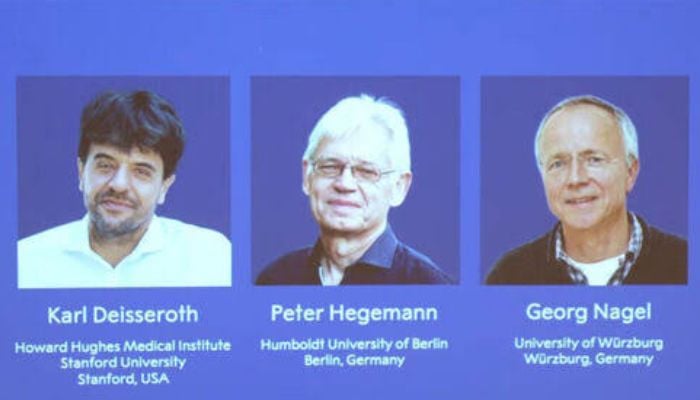
The 2026 Nobel Prize in Physiology or Medicine was awarded on Monday, October 5, to three scientists named American Karl Deisseroth and German Peter Hegemann, and Georg Nagel.
They made discoveries concerning light-gated ion channels and optogenetics, a technique that uses light to control individual nerve cells in the brain.
Karl Deisseroth
The 54-year-old is the D.H. Chen Foundation Professor of Bioengineering and professor of psychiatry and behavioural sciences at Stanford University. He earned his bachelor’s degree in biochemical sciences from Harvard University in 1992 and an MD-PhD in neuroscience from Stanford in 1998.
A psychiatrist by training, he was drawn to the field after encountering patients suffering from depression and autism, seeking more precise explanations for their conditions. He has led his laboratory at Stanford since 2009, named the field “optogenetics” in 2006, and later developed hydrogel tissue chemistry, including CLARITY and STARmap.
He is married to neuroscientist Michelle Monje, with whom he has four children, and authored the 2021 book Projections: A Story of Human Emotions.
Peter Hegemann
Born on December 11, 1954, in Münster and raised in Aachen, Hegemann is a professor of experimental biophysics at Humboldt University of Berlin and holds a Hertie Senior Research Chair for Neurosciences.
He studied chemistry at the University of Münster before switching to biochemistry at LMU Munich, completing his PhD at the Max Planck Institute of Biochemistry in 1984. He discovered channelrhodopsin, the light-sensitive protein at the heart of optogenetics. He has three children and has said scientific research is akin to charting unknown territory.
Georg Nagel
The 73-year-old is a biophysicist and professor at the Department of Neurophysiology at the University of Würzburg. He studied biology and biophysics at the University of Konstanz and received his PhD from the University of Frankfurt in 1988.
He became seriously ill at age five and spent many summer holidays undergoing surgery. As a child, he loved mathematics, physics, and biology, and in his spare time he worked as a teacher, opened a café, and took up hand gliding. He is credited with discovering channelrhodopsins.
The trio is awarded for their collaborative work on developing optogenetics. Hegemann and Nagel discovered channelrhodopsin, a light-sensitive protein in algae. Deisseroth then transformed it into a light-controlled switch for neurons in living animals, enabling researchers worldwide to study brain function and disorders.
Their research is already providing insights about brain disorders. Animal models are being used to understand schizophrenia, Alzheimer’s disease, Parkinson’s disease, epilepsy, and addiction. Researchers are also applying the technique to try to restore vision to people blinded by retinitis pigmentosa and to improve cochlear implants.
The three laureates will share a prize sum of 12 million Swedish crowns ($1.2 million).